| Exam Component | Date | Time | Duration |
| Paper 4 – Oral | 13 July 2026 | 14:15 | 00:20 |
| 14 July 2026 | 08:15 | 00:20 | |
| 15 July 2026 | 08:15 | 00:20 | |
| 16 July 2026 | 08:15 | 00:20 | |
| 17 July 2026 | 14:30 | 00:20 | |
| Paper 3 – Listening Comprehension | 15 October 2026 | 14:00 – 14:45 | 00:45 |
| Paper 1 – Writing | 19 October 2026 | 13:30 – 15:20 | 01:50 |
| Paper 2 – Comprehension | 19 October 2026 | 16:05 – 17:55 | 01:50 |
For the full official timetable, students and parents can also refer to the SEAB 2026 GCE O-Level Examination Timetable for the latest exam schedule details.
The O-Level English Language syllabus consists of four papers, and candidates are required to sit all four. Together, they make up a total of 180 marks.
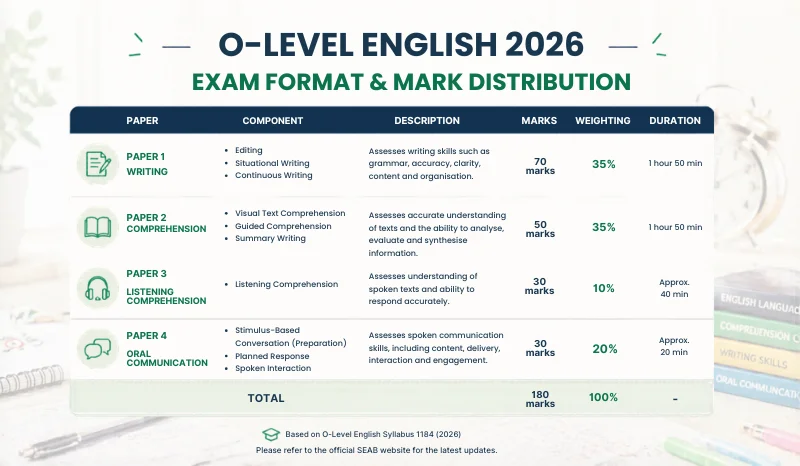
– 70 marks
– 35% weighting
– 1 hour 50 minutes
Paper 1 includes:
– 70 marks
– 35% weighting
– 1 hour 50 minutes
– 30 marks
– 10% weighting
– About 45 minutes
– 30 marks
– 20% weighting
– About 20 minutes, including 10 minutes of preparation time
For Planned Response, students prepare and deliver a response of up to two minutes based on a video clip and prompt. For Spoken Interaction, they discuss a topic broadly related to the same video clip with the examiners.
For the full official breakdown of the 2026 O-Level English syllabus, you can refer to the SEAB English Language (Syllabus 1184)
Students identify and correct grammatical errors in a short passage.
Important detail:
This section tests whether students can:
This section tests:
Paper 2 includes:
Paper 3 has 2 sections:
This paper mainly tests:
Students:
Students:
Students and parents who would like to read the full assessment requirements in detail can also visit the official SEAB English Language (Syllabus 1184)
Here is why the timeline matters:
For many families, simply understanding this timeline already helps reduce panic. Students can plan more sensibly when they know what is coming first.
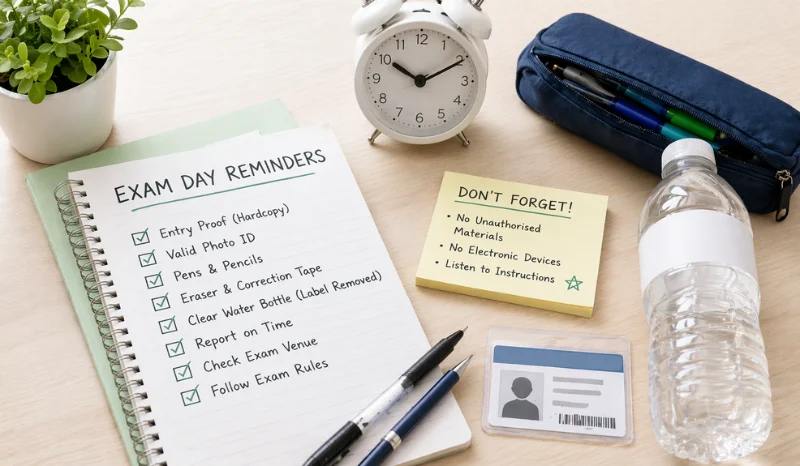
Before the exam, students should make sure they are clear about the practical details too.
Issue of Entry Proof:
Note: All amendments of subjects (including deleting of subjects) must be made through the Candidates Portal by 26 May 2026, 11.00pm.
Students must bring:
Students should:
Students must not bring in:
It is also a good idea for students to read SEAB’s examination rules in advance, so they are clear about what is allowed and can avoid unnecessary mistakes on exam day.
Please note that exam procedures, reporting details and timelines may be updated by SEAB, so for the most accurate and latest information, always refer to the official SEAB Important Dates for Candidates and SEAB GCE O-Level page.
Private candidates should also note these 2026 details:
Private candidates should also check their Entry Proof carefully, as they may be assigned to different examination centres for different modes of assessment.
There have been official announcements about the implementation of the Singapore-Cambridge Secondary Education Certificate (SEC) from 2027. For students taking O-Level English in 2026, the main priority should still be understanding this year’s exam dates, paper format and requirements. As policies and implementation details may be updated over time, students and parents should continue to check the official SEAB website for the most accurate and latest information.
O-Level English in 2026 is not something students should think about only in October.
At WRITERS AT WORK, we provide structured support for O-Level English, helping students strengthen their writing, comprehension and oral skills with greater clarity and confidence.


Agnes Ng, Co-Founder and Teaching & Curriculum Director of WRITERS AT WORK. An NUS Honours graduate and published author with over 30 years of experience, Agnes has been the architect of the organization’s student-centric curricula since 2012.
Dedicated to teacher mentorship and academic excellence, she has guided hundreds of students to achieve outstanding results. Her expertise and commitment to high-quality education remain the cornerstone of WRITERS AT WORK’s success in empowering every learner.



Start practising and learning

