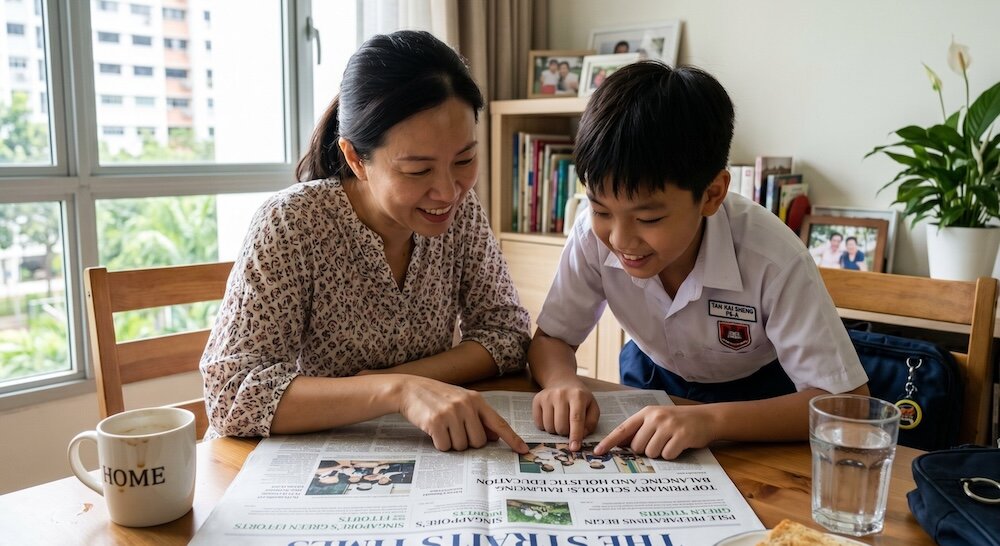
Most Singapore parents are happy to chat with their child over dinner. The bit that stops the conversation is not the time, the inclination, or the language. It is the topic. Once you have asked about the day at school and the homework that is left, the room can go quiet. This is the gap that current affairs fill better than almost anything else. A real-world story gives your child something concrete to think about and a vocabulary to think about it with. Done two or three times a week, it lifts oral exam preparation in a way no worksheet can match.
The ten topics below have been chosen for three reasons. They map directly onto the themes Singapore’s PSLE and O-Level oral examiners have used in the last two years. They reflect the conversations Singapore is genuinely having in 2025 and 2026. And they sit at the right level for upper primary and secondary students to engage with seriously. For broader context, our PSLE Oral Topics 2025 Guide and our archive of past years PSLE oral questions give you a sense of how these themes have shown up in the exam room.
The 2025 update to the PSLE Stimulus-Based Conversation replaced illustrated posters with real-life photographs. The shift matters. Examiners no longer expect students to lean on visual cues. They expect them to bring their own knowledge of the world to the conversation. The O-Level oral examination has moved in the same direction. The Planned Response component, introduced in 2023, gives candidates ten minutes to plan a structured response to a short video clip on a real societal issue, before moving into a Spoken Interaction segment with the examiners.
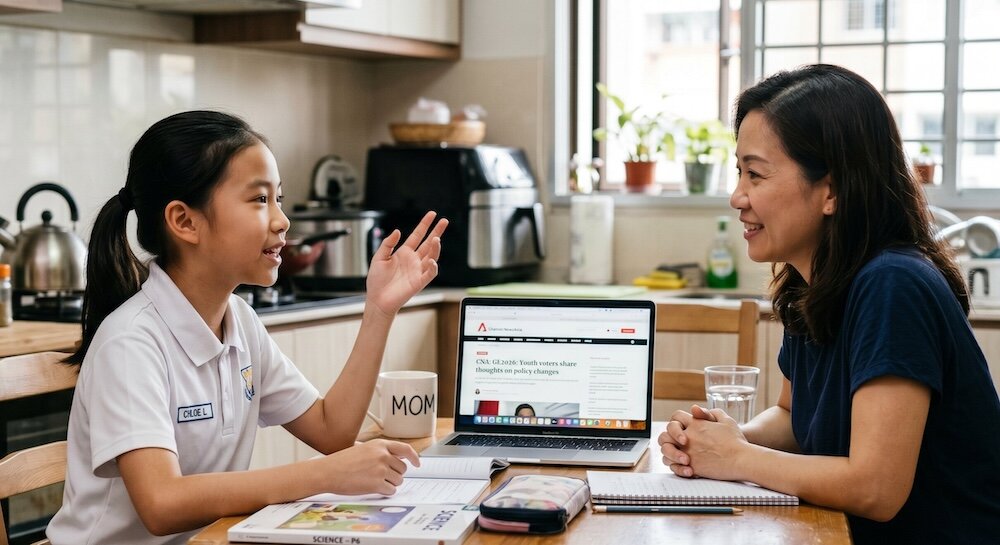
What both exams are testing is whether your child has thought about the world before being asked to talk about it. The students who do well are the ones whose home conversations have been touching these topics for months. Not in a forced exam-prep way. Just in the natural rhythm of parent and child reading a Straits Times piece together or trading thoughts over breakfast about something on the news. Ten minutes a few times a week, across a school year, adds up to a confident speaker.
Each topic below has been tested at least once in a recent PSLE or O-Level oral exam, or is publicly identified by Singapore’s Ministry of Education as a core current-affairs concern. Each has a current Singapore hook to make the discussion feel real rather than abstract. And each has discussion questions calibrated for upper primary or secondary, so you can pick the right level for your child without having to rewrite anything.
Technology and AI featured directly in the 2025 O-Level oral examination, and they sit at the heart of Singapore’s national policy conversations right now. The Ministry of Manpower has reported that resident employment growth in 2025 stayed resilient despite AI fears, with unemployment at 2.8 per cent. The government has set aside more than 400 million dollars through the Enterprise Workforce Transformation Package to help workers adapt. Cleaning robots are visibly being trialled at Changi Airport. The conversation is happening at every level of society, and it is one a Primary 6 or secondary student can have at home.
Discussion questions:
The 2024 National Youth Mental Health Study by the Institute of Mental Health found that almost one in three young Singaporeans aged 15 to 35 reported severe or extremely severe symptoms of depression, anxiety or stress. The Workplace Fairness Act passed in November 2025 now protects workers with mental health conditions. Young workers raised mental health as a top concern at NTUC’s pre-Budget 2026 discussions. This is no longer a quiet topic. It is a national one, and your child has almost certainly already encountered it in school or among friends.
Discussion questions:
Singapore has been actively studying laws from Australia and elsewhere on tightening social media access for children. The Ministry of Health’s January 2025 guidelines recommend that children aged 12 and below limit recreational screen time to less than two hours a day. An international NTU study published in July 2025 linked heavy social media use to declining attention spans and emotional volatility in young people. “Brain rot” was the Oxford Word of the Year 2024, which tells you how widely the concern has spread. Every Primary 6 or secondary student has a view on this, whether they admit it or not.
Discussion questions:
Discussion questions:
The 2025 PSLE Oral Day 2 Stimulus-Based Conversation used a bustling hawker centre as the visual prompt and asked students why people enjoy going to hawker centres. Singapore’s hawker culture was inscribed on the UNESCO Intangible Cultural Heritage list in 2020. Hawker food prices rose by close to 30 cents on some items between 2022 and 2023, and fewer young Singaporeans are choosing to enter the trade. The story of hawker culture is the story of Singapore. It also happens to be a topic on which every child has a real opinion, because every child has a favourite stall.
Discussion questions:
Education has been one of the most consistently tested themes across both PSLE Oral and O-Level oral examinations. The 2025 O-Level papers featured questions on problem-solving activities and on whether school skills apply at work. The Ministry of Education has been refreshing curricula at Singapore’s Institutes of Higher Learning to equip graduates with practical AI skills. Full Subject-Based Banding has given secondary students greater flexibility in subject combinations. Students have plenty of material here, and they tend to have surprisingly strong views.
Discussion questions:
The Ministry of Health issued new dietary and screen time guidelines in 2025 specifically aimed at children and teens. The PSLE Stimulus-Based Conversation has previously asked students how they keep fit and maintain a healthy lifestyle. Singapore’s ageing population means that habits formed early carry national consequences over decades, which gives this topic a real policy dimension on top of the personal angle. Your child has things to say here, especially if exam-year pressure has crowded out the habits they want to keep.
Discussion questions:
At Prime Minister Lawrence Wong’s 2025 Varsity Voices Dialogue, students raised concerns about housing affordability. Two in three Singapore workers said in a 2026 NTUC survey that their pay has not kept up with the cost of living. Young workers raised housing affordability and job security as their top concerns at NTUC’s Budget 2026 consultations. The “Singapore Dream” of owning a home and raising a family is now something families openly negotiate with their children. Upper primary students will have less to say here than secondary students, but even a Primary 6 child has noticed the conversation in the kitchen.
Discussion questions:
Day 5 of the 2025 O-Level oral examination featured pottery and asked whether young people are creative but lack the opportunity to express it. PSLE Oral conversations regularly touch on hobbies and free-time activities. Singapore’s National Arts Council actively promotes student participation in the arts as part of the holistic education agenda. This is an unusually accessible topic because every child can speak from personal experience, whether they paint, code, dance, write or build.
Discussion questions:
Community values run through PSLE Oral conversations every year. Past PSLE oral questions have directly asked students whether they have ever helped someone in need. Singapore’s ageing population means caring for the elderly is now a permanent national conversation. Gracious behaviour and civic consciousness are explicitly part of Singapore’s National Education goals. This is the topic where examiners are listening hardest for honesty, since the slogans are easy and the real moments are not.
Discussion questions:
The mechanics of a good home conversation are not complicated. The trick is to ask one warm-up question, listen properly, then probe gently with a follow-up. Useful follow-ups include “Why do you think that happens?” and “Can you give me an example?” and “What do you think someone who disagreed would say?” These are exactly the prompts the Spoken Interaction component of the O-Level oral exam will use, so the home version is direct training for the exam.
Two more things are worth saying clearly. Let your child disagree with you, and praise the way they explain their thinking rather than rushing them to a conclusion. The Singapore parent who can sit with a half-formed opinion from their teenager and ask “what makes you think that” without flinching is doing the most valuable thing they can do for their child’s English at home.
At WRITERS AT WORK, our Primary 5 and Primary 6 English programmes give students weekly speaking practice with feedback on exactly the kinds of real-world topics in this list. The disciplined approach that powers our composition work through STORYBANKING® shapes how we coach oral too. We help students observe carefully, build their own bank of personal examples for each major theme, and express opinions in a way that sounds natural rather than rehearsed. The home discussion habit you build with this list and the structured practice in class work best together.
If you would like your child to practise oral with structure every week alongside the conversations you are already having at home, get in touch through our website. Our piece on the benefits of English writing classes gives a fuller view of how the centre’s programmes are designed. Follow us on Instagram, Facebook and YouTube for weekly tips.
Ten minutes, three times a week, is plenty. The frequency matters more than the length. A short, regular habit across a school term builds more content than a long Sunday lecture. Most families weave the discussion into breakfast, the car ride to school or the time after dinner.
Pick from the lighter end of the list and use the questions tagged for primary readers. Hawker culture, hobbies, health and helping others all work well at Primary 5 and 6. Mental health and social media also work at upper primary as long as you stay personal, and the environment is reliably accessible too. Cost of living and AI ethics may stretch a Primary 6 child further than they are ready for, but they are useful by Secondary 1 or 2.
Stay curious. Ask them why and ask for an example. The Spoken Interaction segment of the O-Level oral exam will test whether they can hold and explain a view under gentle pressure, so the practice of being challenged at home is genuinely useful preparation. If their view shifts after the discussion, that is part of the learning. If it does not, you have still given them practice in defending it.
Yes. The thinking habit and the formation of opinions transfer across languages. Even if some of the discussion happens in another language, pull out two or three English phrases from a news article each week and slot them into the conversation. Your child will arrive at the oral exam with the content already in place, and the English vocabulary will follow.

Agnes Ng, Co-Founder and Teaching & Curriculum Director of WRITERS AT WORK. An NUS Honours graduate and published author with over 30 years of experience, Agnes has been the architect of the organization’s student-centric curricula since 2012.
Dedicated to teacher mentorship and academic excellence, she has guided hundreds of students to achieve outstanding results. Her expertise and commitment to high-quality education remain the cornerstone of WRITERS AT WORK’s success in empowering every learner.



Start practising and learning

