Have you ever read a piece of writing that felt short and choppy, like every sentence was stopping and starting? Or maybe you have written something that felt flat, even though your ideas were good? Chances are, conjunctions could have helped. Conjunctions are small words that do a big job. They connect ideas, show relationships between thoughts, and help writing flow naturally. Once you know how to use them well, your sentences will feel more confident and your writing will be much easier to read.
A conjunction is a word that joins two words, phrases, or clauses together. Without conjunctions, every idea has to stand alone in its own sentence. With them, you can combine ideas in a way that shows how they relate to each other.
For example, instead of writing “She was tired. She kept studying.” you can write “She was tired, but she kept studying.” The word “but” tells the reader that something unexpected happened.
There are three main types of conjunctions, and each one works slightly differently.
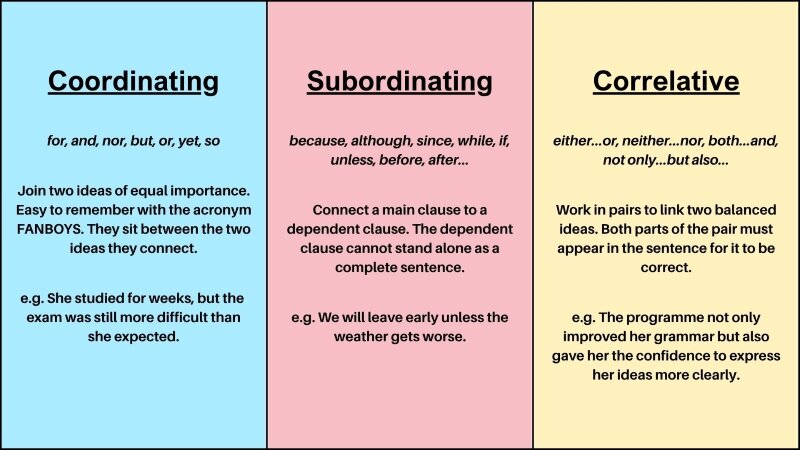
Different conjunctions serve different purposes. Here is a quick look at what each type can do for your writing.
Before: I woke up early. I went for a run.
After: I woke up early and went for a run.
“And” is the simplest way to link ideas, but it works best when the two things being joined are closely related.
Before: The weather was cold. We went for a walk.
After: The weather was cold, but we went for a walk.
Adding “but” shows contrast and makes the sentence more interesting. It tells the reader something slightly surprising happened.
Before: She did not attend the event. She was feeling ill.
After: She did not attend the event because she was feeling ill.
“Because” connects the reason directly to the result, making the writing flow smoothly instead of stopping and starting.
Before: You can have tea. You can have coffee.
After: You can have tea or coffee.
Instead of stating each option as a separate sentence, “or” brings them together neatly in one. This is especially useful when listing alternatives, as it keeps the writing tight and easy to follow.
Before: He finished his homework. He went out to play.
After: After he finished his homework, he went out to play.
“After” makes the sequence of events clear and adds a natural rhythm to the sentence.
Before: You have to study. Otherwise you will not pass.
After: Unless you study, you will not pass.
“Unless” makes the condition clear in one smooth sentence, removing the need for two separate ideas.
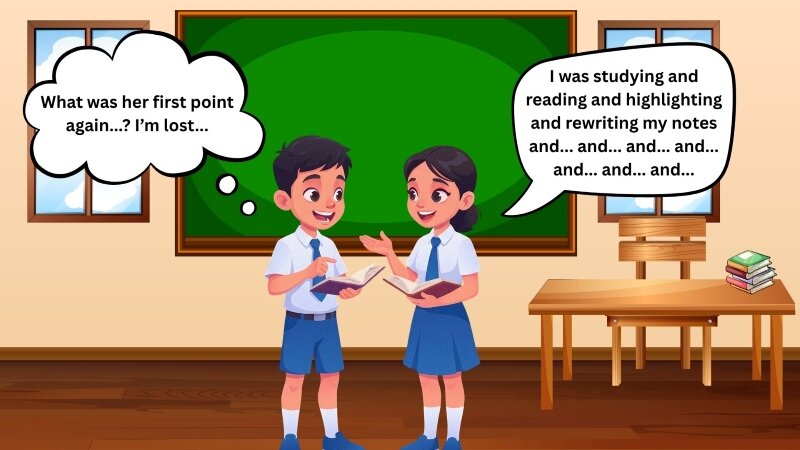
“And” is the most straightforward conjunction, which is exactly why students reach for it too often. When every idea is joined with “and”, the writing loses variety and starts to feel flat and repetitive.
The corrected version uses “after” to show time, and “where” to add detail, creating a sentence that flows naturally. When you find yourself using “and” more than once in a sentence, pause and ask whether a different conjunction might express the idea more clearly.
This happens when two conjunctions that do the same job are used together in the same sentence. Because both words carry the same meaning, one of them is always redundant.
“Although” and “but” both show contrast, so using them together is one conjunction too many. The fix is simple: pick one and drop the other.
Correlative conjunctions always work in fixed pairs. “Either” must be paired with “or”. “Neither” must be paired with “nor”. “Not only” must be paired with “but also”. Mixing them up, or replacing one half of the pair with a different conjunction, breaks the structure and changes the meaning of the sentence entirely.
“Either…and” is not a recognised pair in English. “Either…or” correctly presents two one option or the other. A helpful way to remember this is to learn the pairs together as a fixed unit, the same way you would learn a two-word phrase.
Time to put your conjunction knowledge to the test. Give these a go!
1. She was exhausted, ___ she refused to give up.
2. ___ it was raining heavily, the match continued as planned.
3. You must finish your vegetables ___ you can have dessert.
4. She practises every day ___ she wants to improve her writing.
5. ___ you submit the form by Friday, your application will not be processed.
6. He did not study, ___ he failed the test.
7. She likes both singing ___ dancing.
8. I wanted to help, ___ I did not know what to do.
9. ____ you apologise ___ you leave the room.
10. ___ you apologise, she will forgive you.
1: She was exhausted, yet she refused to give up.
“Yet” is a coordinating conjunction that shows contrast, similar to “but”. It highlights that something unexpected happened despite the situation. “So” would suggest a result, not a contrast. “For” introduces a reason, which does not fit here.
2. Although it was raining heavily, the match continued as planned.
“Although” introduces a contrast between two ideas. Despite the rain, the match went ahead. “Because” would introduce a reason, which does not make sense here. “So” shows a result and does not fit here either.
3. You must finish your vegetables before you can have dessert.
“Before” correctly shows that one action must happen prior to another. Finishing the vegetables comes first then dessert comes after. “After” would reverse the intended order. “While” suggests two things happening at the same time, which does not fit.
4. She practises every day because she wants to improve her writing.
“Because” introduces the reason for her daily practice. “Although” would show contrast, which does not make sense here. “Unless” introduces a condition that must be met to avoid a specific outcome, which also does not fit here.
5. Unless you submit the form by Friday, your application will not be processed.
“Unless” means “except if”. The sentence is saying that the only way the application will not be processed is if the form is not submitted on time. “If” introduces a condition but does not carry the same negative implication. “Although” shows contrast and does not fit.
6. He did not study, so he failed the test.
“So” shows that the second idea is the result of the first. Because he did not study, he failed. “And” simply adds one idea to another without showing cause and effect. “Because” introduces a reason, but it would need to be placed before the cause, not after it.
7. She likes both singing and dancing.
“Both…and” is a correlative conjunction pair. Once “both” appears, “and” must follow to complete it. “Or” is used with “either”, not “both”. “But” shows contrast, which contradicts the positive and inclusive meaning of “both”.
8. I wanted to help, but I did not know what to do.
“But” is a coordinating conjunction that shows contrast. The speaker wanted to help, yet something prevented them from doing so. “Because” would introduce a reason, which does not fit the meaning. “And” simply adds one idea to another without showing the tension between wanting to help and not knowing how.
9. Either you apologise or you leave the room.
“Either…or” presents two alternatives. The person must choose one of two options: apologise or leave. “Neither…nor” negates both options, meaning neither would happen, which does not fit the meaning. “Not only…but also” adds one idea to another rather than presenting a choice, so it does not work here either.
10. If you apologise, she will forgive you.
“If” introduces a condition that makes something possible. Apologising is the condition and being forgiven is the result. “Unless” would require the sentence to be negative: “Unless you apologise, she will not forgive you.” “So” shows a result rather than a condition and does not work here either.
Conjunctions are only the beginning. There is a whole toolkit of grammar skills, vocabulary strategies, and writing techniques waiting to be explored. The right guidance makes all the difference. At WRITERS AT WORK, we work with students from Primary 1 to Secondary 4 to build exactly that toolkit, piece by piece, in a way that sticks.
Join our Comprehensive English Programme today and start building the skills that will show up in every essay, every exam, and every piece of writing you do.

Absolutely! Short, choppy sentences can make writing feel abrupt and underdeveloped. Conjunctions allow students to combine related ideas smoothly and vary their sentence length. A mix of longer, joined sentences and shorter punchy ones creates rhythm and keeps the reader engaged.
“If” introduces a condition that makes something possible. “You will pass if you study.” “Unless” means “except if” and introduces a condition that prevents something. “You will not pass unless you study.” You can also replace “unless” with “if not” and see if the meaning stays the same. “You will not pass if you do not study” means the same thing, so “unless” works.
Not always. “While” can show that two things happen at the same time, which is its most common use. But it can also show contrast in more formal writing, similar to “although”. For example, “While I understand your concern, I disagree with your conclusion.”

Agnes Ng, Co-Founder and Teaching & Curriculum Director of WRITERS AT WORK. An NUS Honours graduate and published author with over 30 years of experience, Agnes has been the architect of the organization’s student-centric curricula since 2012.
Dedicated to teacher mentorship and academic excellence, she has guided hundreds of students to achieve outstanding results. Her expertise and commitment to high-quality education remain the cornerstone of WRITERS AT WORK’s success in empowering every learner.



Start practising and learning

