This is why choosing the right English Enrichment for Primary School matters. Parents are not just looking for another class. They are looking for a programme that solves real learning problems and leads to real PSLE impact. The good news is that these struggles usually come from clear skill gaps. When English enrichment is designed well, it does more than give children extra work. It builds stronger foundations, better habits, and greater confidence over time.
One of the biggest frustrations for parents is seeing their child work hard without making enough progress. Tuition may be happening, but the results still seem limited. The issue is often not effort. It is foundation. English is cumulative, so weak sentence control, poor idea organisation, and passive reading can affect every part of the paper.
More practice alone will not solve this. Children need to be taught how to improve. They need to learn how to write more clearly, read more actively, and answer more precisely.
Once these fundamentals become stronger, progress becomes more visible. Parents often notice better sentence fluency, clearer answers, and stronger confidence before grades shift in a major way. This is also why the right programme can help both weaker and stronger students. A weaker child may need to rebuild core skills. A stronger child may need greater precision and consistency to aim higher.
Another common problem is inconsistent results and performances. A child may do reasonably well in one area of English but still underperform overall:
This happens because PSLE English is not a one-skill subject. Strong results depend on writing, comprehension, grammar, vocabulary, listening, and oral communication working together. That is why good English Enrichment for Primary School should prepare children broadly, not partially. A child needs support across all major components, not just one area of weakness.
Starting early also helps. PSLE readiness is rarely built in the final months alone. It grows over time through age-appropriate support and steady skill development.
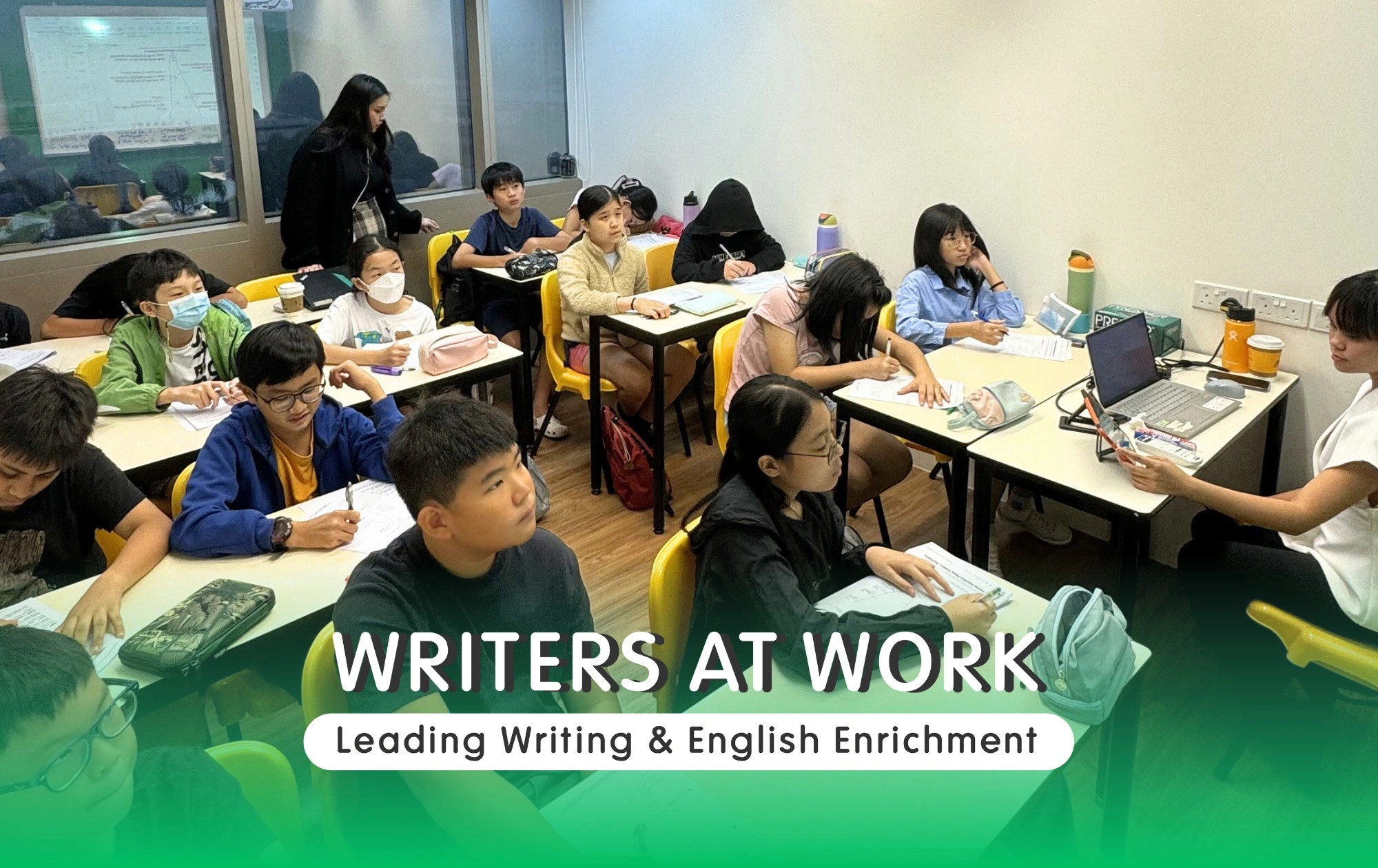
At WRITERS AT WORK, our Comprehensive English programmes target all major components of the paper. Our Pure Writing programmes give focused support to students who need deeper help in composition, generating ideas, organisation, and expression.
Many parents have seen tuition that produces a lot of worksheets but not enough real growth. There may be plenty of completed work, yet the same mistakes keep appearing. The issue is often the teaching approach. If tuition is based mainly on drilling, children may become familiar with tasks without truly understanding how to improve.
When children learn why an answer works, how a sentence can be strengthened, and how ideas can be developed more clearly, that is what turns practice into learning. This matters even more for children who dislike English. They do not need lower standards. They need teaching that is clearer, more engaging, and more purposeful.
When students begin to understand what they are doing, confidence grows. As confidence grows, participation improves. As participation improves, performance often follows. To be impactful, tuition should include feedback that shows where a child is improving, what still needs attention, and how the programme is helping.
At WRITERS AT WORK, we focus on explicit teaching, purposeful practice, and meaningful feedback. Our goal is not to keep children busy, but to help them become stronger and more capable users of English.
The real problem is not that children cannot improve in English. It is that too many programmes focus on extra practice without addressing the reasons progress has stalled.
At WRITERS AT WORK, we believe meaningful improvement comes from targeted teaching, complete preparation, and steady skill-building over time. That is why our programmes are designed to support students in the areas that matter most.
By offering both Comprehensive English and Pure Composition Writing pathways, we are able to support children more precisely according to their needs. This gives them a stronger foundation not only to improve, but to work towards stronger outcomes such as AL1 in PSLE English.
English Enrichment for Primary School helps children strengthen key PSLE skills such as writing, comprehension, grammar, vocabulary, listening, and oral communication. A strong programme builds the foundations needed for more confident and consistent improvement.
Parents should look for English Enrichment for Primary School that targets real skill gaps, provides clear teaching, and gives meaningful feedback. The right programme should improve writing, comprehension, and oral skills while building confidence over time.
The right English Enrichment for Primary School improves PSLE results by strengthening the core skills tested across the paper. With clear teaching, targeted practice, and feedback, children can close learning gaps and perform more confidently.