Recycling and the environment are important topics for composition writing because they help students write about responsibility, community effort and care for the planet. These topics can appear in stories about school clean-up activities, Earth Day events, family recycling habits, neighbourhood litter problems or a character learning to make better choices.
Many students know simple phrases such as “save the Earth” or “throw rubbish properly”. While these are useful starting points, stronger writing requires more precise vocabulary. Students should learn how to describe eco-friendly habits, recycling actions and the reasons behind protecting the environment.
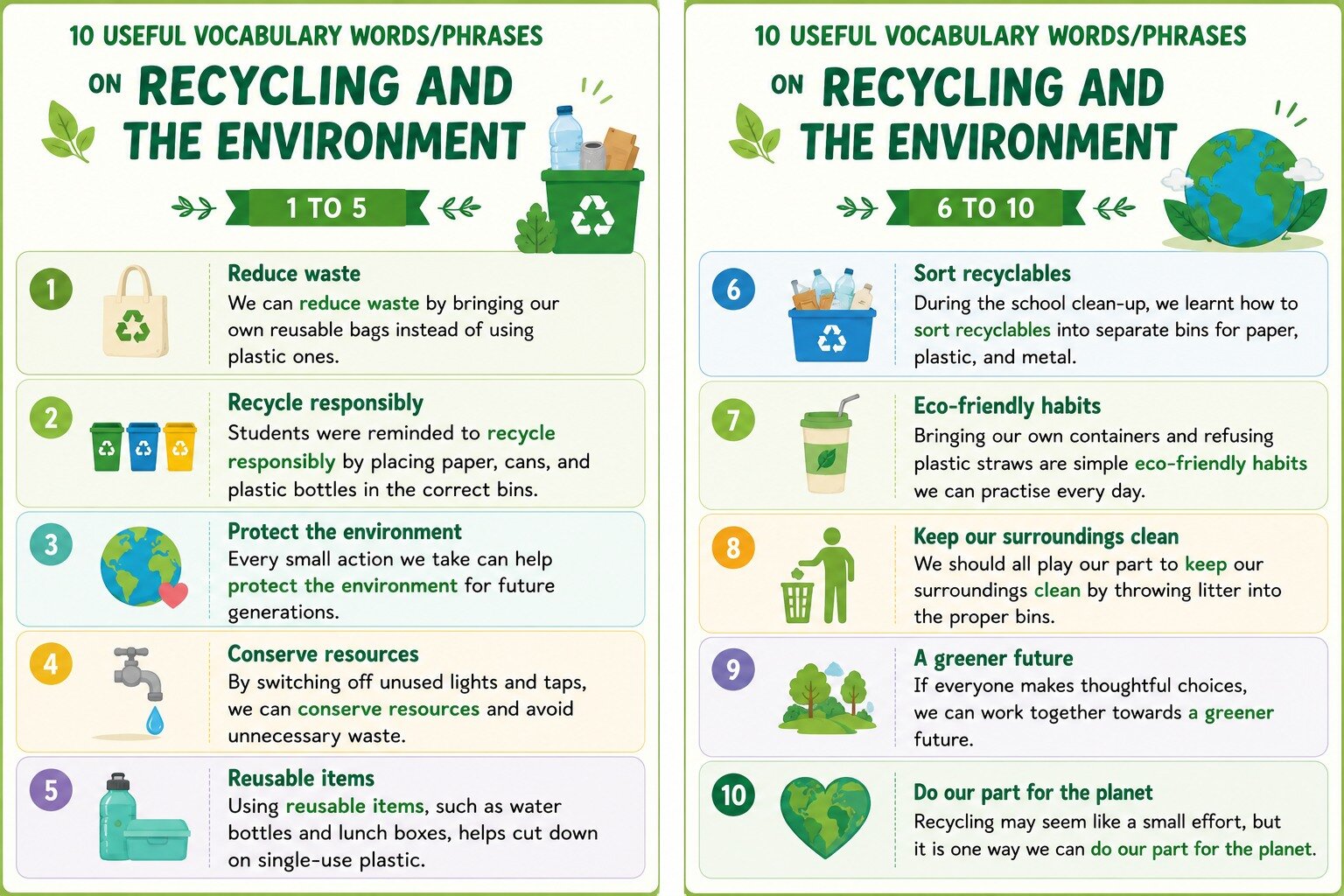
Use this vocabulary bank to describe actions, habits and goals related to recycling and protecting the environment.
|
Word or Phrase |
Meaning |
Example Sentence |
|
Reduce waste |
To produce less rubbish |
We can reduce waste by bringing reusable bags instead of using plastic ones. |
|
Recycle responsibly |
To recycle in the correct way |
Students were reminded to recycle responsibly by placing bottles and paper in the right bins. |
|
Protect the environment |
To keep nature clean and safe |
Every small action we take can help protect the environment. |
|
Conserve resources |
To avoid wasting water, electricity or materials |
By switching off unused lights, we can conserve resources. |
|
Reusable items |
Items that can be used many times |
Reusable items, such as lunch boxes and water bottles, help reduce single-use plastic. |
|
Sort recyclables |
To separate items for recycling |
During the clean-up, we learnt how to sort recyclables into different bins. |
|
Eco-friendly habits |
Habits that are good for the environment |
Bringing our own containers is one of the eco-friendly habits we can practise. |
|
Keep our surroundings clean |
To maintain a clean shared space |
We should keep our surroundings clean by throwing litter into proper bins. |
|
A greener future |
A cleaner, healthier future for the planet |
If everyone makes thoughtful choices, we can work towards a greener future. |
|
Do our part for the planet |
To contribute to protecting the Earth |
Recycling may seem like a small effort, but it helps us do our part for the planet. |
|
Single-use plastic |
Plastic used once and then thrown away |
Avoiding single-use plastic can greatly reduce waste. |
|
Labelled recycling bins |
Bins marked clearly for different materials |
The school placed labelled recycling bins around the canteen. |
|
Household items |
Things used at home |
Old household items can sometimes be reused creatively. |
|
Thoughtful choices |
Careful decisions that consider their impact |
Thoughtful choices can help families reduce waste every day. |
|
Community effort |
A shared action by a group of people |
Keeping the neighbourhood clean requires community effort. |
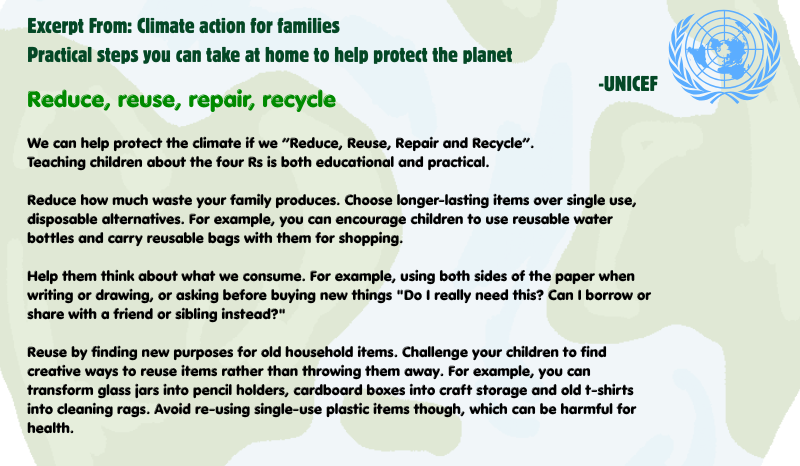
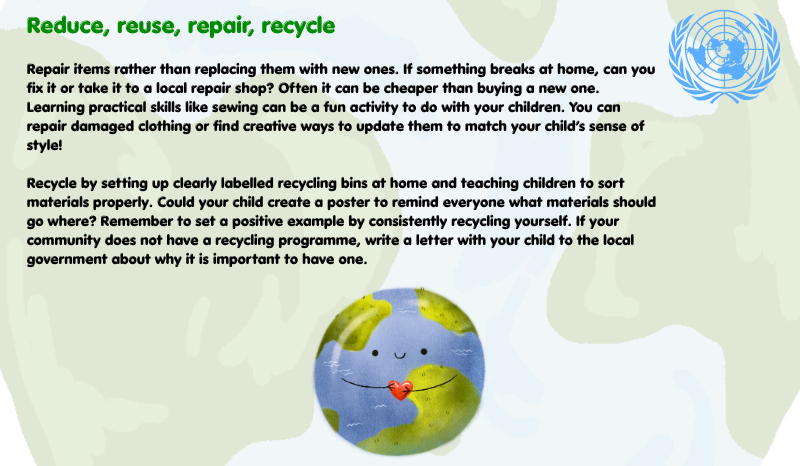
This excerpt from an article from UNICEF teaches practical ways families can help protect the planet. Students can “lift off” useful phrases from such texts and adapt them into their own writing. This does not mean copying entire paragraphs. Instead, it means learning strong expressions and using them naturally in new sentences.
|
Phrases from the Excerpt |
How You Can Use It |
|
Practical steps you can take at home |
Useful for introducing simple family actions |
|
Help protect the planet |
Useful for explaining the purpose of recycling |
|
Reduce, reuse, repair and recycle |
Useful as a memorable environmental slogan |
|
Choose longer-lasting items |
Useful when writing about avoiding waste |
|
Single-use, disposable alternatives |
Useful for describing items that create waste |
|
Help them think about what we consume |
Useful for reflection or advice |
|
Do I really need this? |
Useful as a thought or question in a story |
|
Find new purposes for old household items |
Useful for describing creative reuse |
|
Rather than throwing them away |
Useful when explaining why reuse matters |
|
Repair items rather than replacing them |
Useful for writing about avoiding unnecessary buying |
|
Set up clearly labelled recycling bins |
Useful for school or home recycling scenes |
|
Sort materials properly |
Useful for describing correct recycling habits |
|
Be consistent by recycling yourself |
Useful for showing leadership by example |
|
A recycling programme |
Useful for describing a school or community project |
|
Why it is important to have one |
Useful for persuasive or reflective writing |
Recycling compositions work best when students connect action to purpose. Instead of simply writing, “Maya recycled the bottle,” students can write:
“Maya rinsed the plastic bottle and placed it in the correct recycling bin, reminding Alex that sorting materials properly was one small way to help protect the planet.”
This sentence is stronger because it shows the action, the method and the reason behind it.
Students can also use recycling vocabulary to build a clear story structure:
|
Story Part |
What to Include |
|
Beginning |
A problem, such as litter after recess or confusion about recycling |
|
Middle |
A character teaches, helps or organises an eco-friendly action |
|
Climax |
The group faces a challenge, such as mixed-up recyclables or unwilling classmates |
|
Ending |
The character reflects on how small actions can lead to a greener future |
Passage
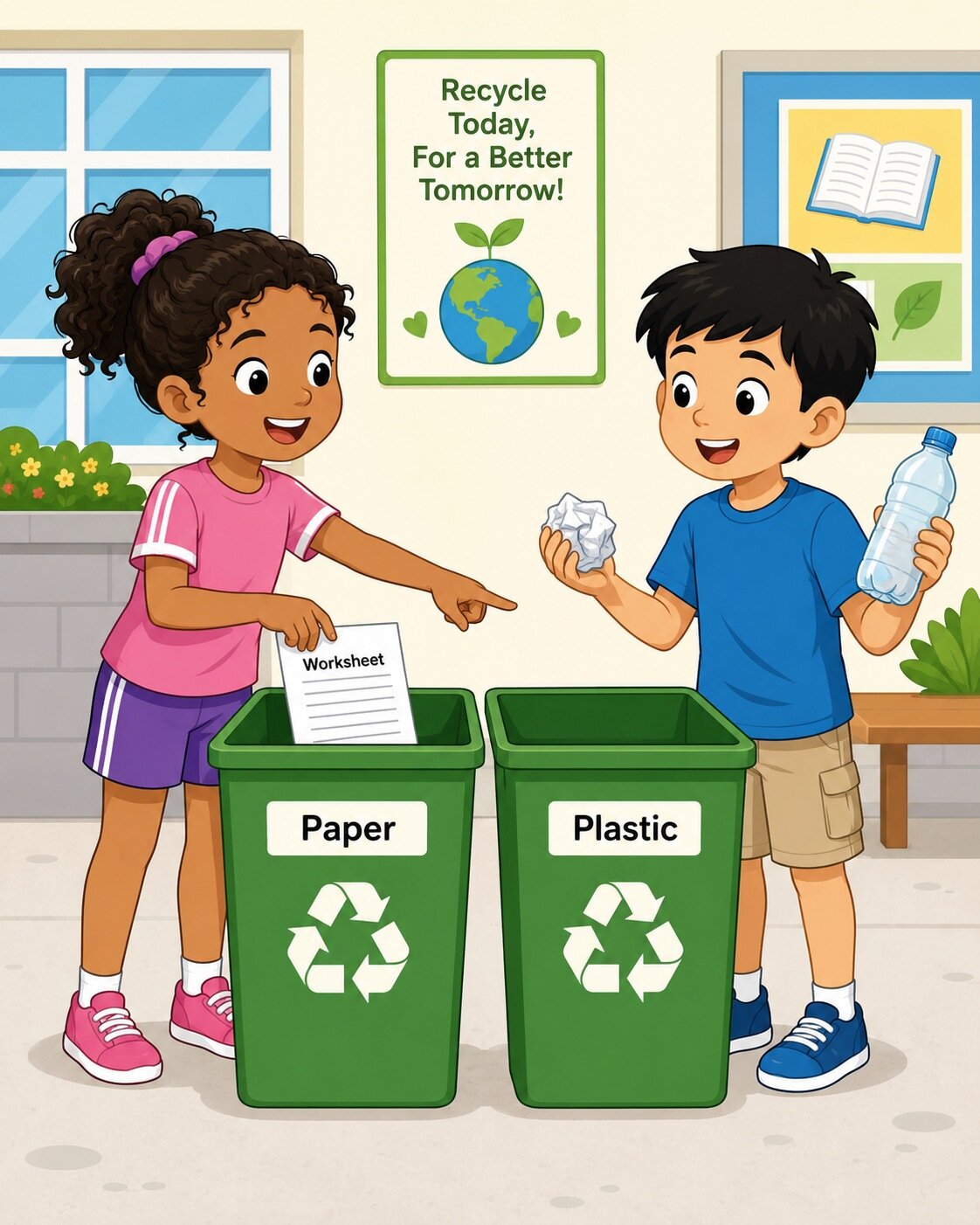
During recess, Maya noticed Alex standing uncertainly in front of the recycling bins. He was holding an empty plastic bottle in one hand and a crumpled worksheet in the other.
“Do these go into the same bin?” Alex asked.
Maya smiled and shook her head. “Not quite. We need to __________ first. Paper, plastic and metal should go into different bins.”
Alex looked surprised. “I thought recycling just meant throwing everything into one recycling bin.”
“That’s a common mistake,” Maya explained. “If we want to __________, we must recycle properly. We can also __________ by using both sides of a worksheet before throwing it away.”
Alex nodded thoughtfully. “So recycling is not just about bins. It is also about making better choices.”
“Exactly,” Maya replied. “For example, we can bring __________ like water bottles and lunch boxes instead of using disposable plastic. Every small action helps us __________.”
By the end of recess, Alex had placed the bottle and paper into the correct bins. He smiled, realising that recycling was simple once someone showed him how.
Word Bank
| Word Bank |
| sort recyclables |
| protect the environment |
| conserve resources |
| reusable items |
| do our part for the planet |
Fill in the Blanks
Answer Key
Recycling and the environment are meaningful topics because they encourage students to think beyond themselves. These compositions are not only about bins, bottles and paper. They are about responsibility, thoughtful choices and care for the world we share.
At WRITERS AT WORK, students learn how to use topic-specific vocabulary meaningfully in composition writing. Instead of memorising phrases blindly, they learn how to choose the right words for the right situation and build stronger, clearer stories.
Parents who want structured writing support can explore our English tuition for primary students, browse our free model compositions, or learn more at WRITERS AT WORK.
Beyond the classroom, students and parents can also tap into our wider learning resources through W@W eSeries, and stay updated with tips, insights, and student support on TikTok and Facebook.
Recycling is useful because it helps students write about responsibility, community action and making thoughtful choices. It also gives students clear actions to describe, such as sorting recyclables, reducing waste and using reusable items.
Useful phrases include “protect the environment”, “conserve resources”, “eco-friendly habits”, “a greener future” and “do our part for the planet”.
Students can build a topic-specific word bank, practise using phrases in short sentences, and then apply them in a story about a school, home or community recycling effort.

Jemmies Siew, Managing Director and Co-Founder of WRITERS AT WORK Enrichment Centre. With over 15 years of experience in education, entrepreneurship, and marketing, Jemmies has helped shape Singapore’s English enrichment landscape through her vision for transformative learning.
She is passionate about connecting real-world issues with language learning, helping students think critically and express themselves clearly. Connect with her on LinkedIn to follow her insights on education, content marketing, and thought leadership.



Start practising and learning

