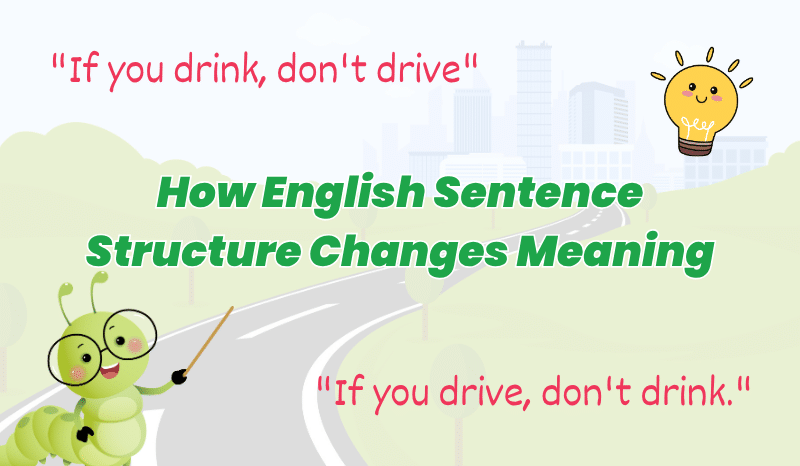
A clip from Singapore’s Parliament recently went semi-viral. A minister, discussing road safety messaging, made a small but pointed suggestion: swap the country’s long-standing anti-drink-driving slogan from: “If you drink, don’t drive” to “If you drive, don’t drink.”
The discussion took place as Parliament considered measures that included lowering Singapore’s prescribed alcohol limits for drink driving. The Ministry of Home Affairs has also advised drivers not to drink at all when they plan to drive, as alcohol affects individuals differently and there is no universally “safe” number of drinks before driving.
This short exchange offers an interesting example of the nuances of English. By reversing the familiar message, Lee did not correct a grammatical mistake. Instead, he changed the order in which the listener processes the two actions.
At first, the revised statement may sound like a simple grammatical correction or a clever rearrangement of words. However, there is no grammatical error in the original sentence.
Both versions are grammatically correct. Both also communicate the same broad safety message: drinking and driving should not happen together.
What changes is the way each sentence guides the listener through that message.
The difference is therefore not about correct or incorrect English. It demonstrates how English sentence structure can determine what we consider first, which situation we treat as established and which action receives the strongest emphasis.
Both statements follow the same basic conditional structure:
🟢 If + condition, instruction
The first part, known as the if-clause, introduces the situation that the listener should consider. The second part is the main clause, which gives the instruction.
In “If you drink, don’t drive”, drinking is the condition and not driving is the instruction.
In “If you drive, don’t drink”, driving is the condition and not drinking is the instruction.
It is important to clarify that “If you drink, don’t drive” does not literally mean that the listener has already started drinking. In English, an if-clause can introduce either a present or future possibility.
However, drinking remains the sentence’s mental starting point. The listener is first asked to imagine a situation in which drinking may take place. Only then does the sentence introduce the instruction not to drive.
Reversing the two verbs changes that starting point.
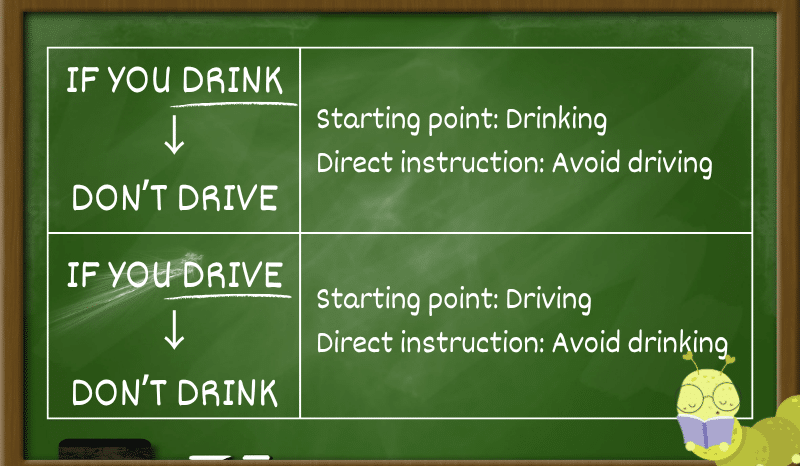
In “If you drink, don’t drive”, the listener begins with the possibility of drinking. The sentence then addresses what should happen as a result: the person should not drive. The practical question may become:
🤔 “How will I get home if I drink?”
The listener might consider taking a taxi, asking someone else to drive or leaving the car behind. The message remains responsible, but it frames the issue from a situation in which drinking is already being considered.
“If you drive, don’t drink” begins from a different position. The listener first identifies as the driver. Once that responsibility has been established, drinking becomes the action that must be removed. The question becomes:
🤔 “Since I am driving, should I drink at all?”
The broad safety message has not changed, but the order of thinking has.
The first sentence begins with drinking and then manages the consequences. The second begins with the decision to drive and prevents drinking from becoming part of the situation.
The reversed sentence may feel more preventive because it moves the decision about alcohol to an earlier stage.
With “If you drink, don’t drive”, a person may first consider drinking and then decide whether driving is still possible. At this point, the person may begin negotiating with themselves:
“I am only having one glass.”
“I still feel fine.”
“I am probably under the limit.”
The sentence does not cause these thoughts. However, its structure places drinking before the decision about driving.
“If you drive, don’t drink” establishes the driving commitment first. Instead of asking the listener to judge whether they can drive after consuming alcohol, it removes the need to make that judgement.
The decision is no longer:
🤔 “Can I still drive after drinking?”
It becomes:
🤔 “Since I am driving, I will not drink.”
In this sense, the second version works like a pre-commitment. The person decides earlier that being the driver means avoiding alcohol altogether.
This is where language and behavioural psychology meet. Sentence structure does not simply organise information. It can also frame when a decision appears to take place.
The strongest command in each sentence appears in the main clause.
In the original statement, the command is: “Don’t drive.”
In the reversed statement, it is: “Don’t drink.”
The if-clause establishes the situation, but the main clause tells the listener which action must not happen.
The final word also matters. Short slogans often depend on a strong and memorable ending. The first version ends with “drive”, leaving the restriction on driving in the listener’s mind. The second ends with “drink”, making alcohol the final and directly rejected action.
A small change in word order therefore affects both the logical structure and the rhetorical emphasis of the message.
We can observe a similar difference in these two sentences:
1️⃣ “If you use your phone, don’t drive.”
2️⃣ “If you drive, don’t use your phone.”
Both sentences warn against combining phone use with driving. Both are grammatically correct and communicate the same broad safety principle.
The first begins with phone use. It tells the listener that if they are occupied with their phone, they should not drive. The second begins with driving. Once the listener recognises that they are driving, phone use becomes the behaviour that must stop.
Once again, the difference lies in which activity is presented as the condition and which becomes the target of the instruction.
The first structure starts with an activity and controls what should happen afterwards. The second establishes the listener’s responsibility first and removes a competing behaviour.
Neither sentence is automatically better in every context. The more effective version depends on the audience, the situation and the behaviour that the speaker wants to emphasise.
Once we recognise this pattern, we begin to notice it throughout the English language. Reversing the order of the same words can change the relationship between two ideas, even when the vocabulary and grammar remain almost identical.
Consider these two statements:
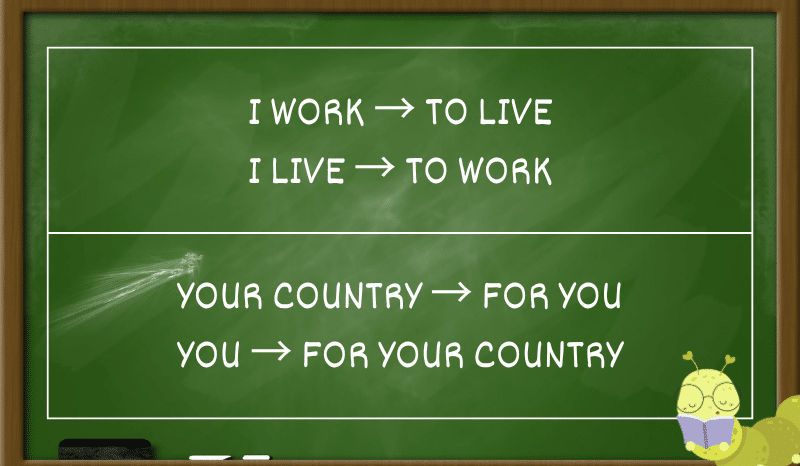
1️⃣ “I work to live.”
2️⃣ “I live to work.”
Both sentences use the same key verbs, but they express very different attitudes towards work and life.
In “I work to live”, living is the goal. Work is presented as a means of supporting one’s life.
In “I live to work”, work becomes the purpose. The sentence suggests that a person’s life is centred around working.
Neither sentence contains a grammatical error. However, reversing the verbs changes the value system communicated by the sentence. What first appeared as the means becomes the goal, while the original goal takes on a supporting role.
A well-known example of this type of reversal appears in John F. Kennedy’s 1961 inaugural address:
“Ask not what your country can do for you—ask what you can do for your country.”
The quote begins with what an individual may receive from the country. It then redirects attention towards what the individual can contribute. As “your country” and “you” exchange positions, the focus moves from receiving to giving.
This mirrored reversal is commonly known as antimetabole, a rhetorical technique in which the same words are repeated in the opposite grammatical order. It is closely related to the broader technique of chiasmus.
The reversal does more than make Kennedy’s statement memorable. The sentence itself performs the shift in perspective that it asks listeners to make.
In both “I work to live” and Kennedy’s statement, the grammar remains correct before and after the reversal. What changes is the role assigned to each idea, the order in which the listener processes them and the point that receives the greatest emphasis.
This does not mean that reversing a sentence will always produce a clearer or stronger message. The technique works only when the relationship between the ideas remains meaningful.
However, these examples show that word order is not simply about arranging a grammatically correct sentence. It can shape the values, perspective and contrast expressed through that sentence.
The same principle applies beyond slogans and mirrored expressions.
Consider these two sentences:
1️⃣ “When the lights went out, the children screamed.”
2️⃣ “The children screamed when the lights went out.”
Both describe the same event, but they do not create exactly the same reading experience.
The first sentence establishes the darkness before revealing the children’s reaction. It guides the reader through the event in sequence and may help to build suspense.
The second presents the scream immediately. The children’s reaction becomes the first thing the reader notices, while the power failure is introduced afterwards as its cause.
This distinction is especially useful in composition writing. A student may place the setting first to build anticipation or place the character’s reaction first to create immediate impact.
Neither sentence is necessarily incorrect. Each serves a different purpose.
Even the position of a single word can change meaning:
1️⃣ “Only Sarah answered the question.”
2️⃣ “Sarah only answered the question.”
In the first sentence, “only” limits the person. Sarah was the only person who answered. In the second, “only” appears to limit what Sarah did. Depending on the context, it may suggest that Sarah answered the question but did not explain her answer, offer further help or take any additional action.
The sentences use almost exactly the same words, but the placement of “only” changes what the reader understands it to describe.
A writer must therefore consider not only which words to use, but also where those words should appear.
Students sometimes assume that improving their English means using more difficult vocabulary or writing longer sentences. However, strong English also depends on arranging familiar words purposefully.
A sentence can be grammatically correct but still place emphasis on the wrong idea. It may reveal information too early, weaken an important reaction or direct the reader’s attention away from the main point.
This is especially important in composition writing. English sentence structure can determine how suspense develops, how clearly a character’s emotions are presented and how strongly an important moment affects the reader.
For example, a student writing about an accident could begin with the sound:
🟢 “A deafening crash shattered the silence.”
Alternatively, the student could begin with the character’s response:
🟢 “Mei Lin froze as a deafening crash shattered the silence.”
The first version places the event at the centre of the moment. The second directs the reader’s attention towards the character and her reaction.
Both can be effective. The better choice depends on what the writer wants the reader to notice first.
Instead of asking only whether a sentence is correct, students should also consider what the reader encounters first, which idea receives the strongest emphasis and whether the information appears in the most effective order.
The difference between “If you drink, don’t drive” and “If you drive, don’t drink” is therefore more than a swap between two verbs. It shows how English sentence structure can frame a situation, guide a decision and change the emphasis of a message.
Strong English is not only about knowing what to say. It is also about understanding how the order of our words changes the way an idea is received.


Jemmies Siew, Managing Director and Co-Founder of WRITERS AT WORK Enrichment Centre. With over 15 years of experience in education, entrepreneurship, and marketing, Jemmies has helped shape Singapore’s English enrichment landscape through her vision for transformative learning.
She is passionate about connecting real-world issues with language learning, helping students think critically and express themselves clearly. Connect with her on LinkedIn to follow her insights on education, content marketing, and thought leadership.



Start practising and learning

