
Singapore parents spent more than 1.8 billion dollars on private tuition in 2023, and English remains one of the most heavily-subscribed subjects. The question is no longer whether to put a child in English tuition. The question is how to tell a good programme from an expensive worksheet factory. After fifteen years of running an English centre in Singapore, we have a strong view on what the answer looks like, and it has very little to do with the fanciest signage on the shopfront.
This post is for parents trying to make that judgement before they commit, whether your child is in Primary 3 or Secondary 3. It walks through the things a serious English programme should be doing, the choices you have between formats, the red flags that should make you walk away, and the eight questions to ask any centre before you sign a term’s worth of cheques. For the W@W view on the same subject, our 2026 guide to choosing the best English tuition in Singapore is a useful starting point.
Singapore students are among the strongest English readers in the world. The 2021 Progress in International Reading Literacy Study ranked Singapore first globally, with 35 per cent of students reaching the highest “Advanced” benchmark, compared with just 7 per cent internationally. English is the daily language of instruction across almost every subject in Singapore schools, which means it is functional, not just academic.
So why does demand for English tuition stay so high? Three reasons cut through.
The first is that the MOE syllabus keeps moving, and exam formats keep changing. The PSLE English exam was substantially revised in 2025. The O-Level English exam was revised in 2023. A programme that has not updated its curriculum to match is preparing students for an exam that no longer exists.
The second is that even confident English students struggle to push from the middle band into the top one without targeted coaching on the components that reward technique most clearly, such as composition, comprehension, oral and visual text analysis. These reward structure as much as fluency, and structure is hard to learn on your own.
The third is harder to admit but worth being honest about. Singapore schools run classes of 30 to 40 students. A school teacher cannot give meaningful individual feedback on every child’s writing every week. Tuition centres fill the gap by being smaller and more targeted, when they are run well.
This is the easiest filter to apply when you are evaluating a centre. Ask them, directly, what the PSLE or O-Level English exam changes have meant for their curriculum. If the answer is vague, walk on.
For PSLE English, the 2025 changes were significant. Oral Communication now carries 20 per cent of the overall grade, up from 15 per cent, with total oral marks rising from 30 to 40. The Stimulus-Based Conversation now uses a real-life photograph rather than an illustration. Reading Aloud now opens with a short preamble that tells the student the Purpose and Audience of the passage along with the Context, all of which the student has to respond to with the right tone. Situational Writing now requires the student to generate their own idea for one content point. Visual Text Comprehension now features two related texts and asks inference-based questions. This blog goes deeper on the oral side of these changes.
For O-Level English, the 2023 revisions reshaped the oral exam around a video clip and a Planned Response, then a Spoken Interaction segment. Visual Text Comprehension now uses two shorter everyday texts and asks comparative questions. Essay Writing now has separate scoring for Content and Language, which gives students much clearer feedback on what to improve.
Any reputable programme should be able to explain, in concrete terms, how its curriculum has adapted to these formats. Vague reassurance is a red flag.
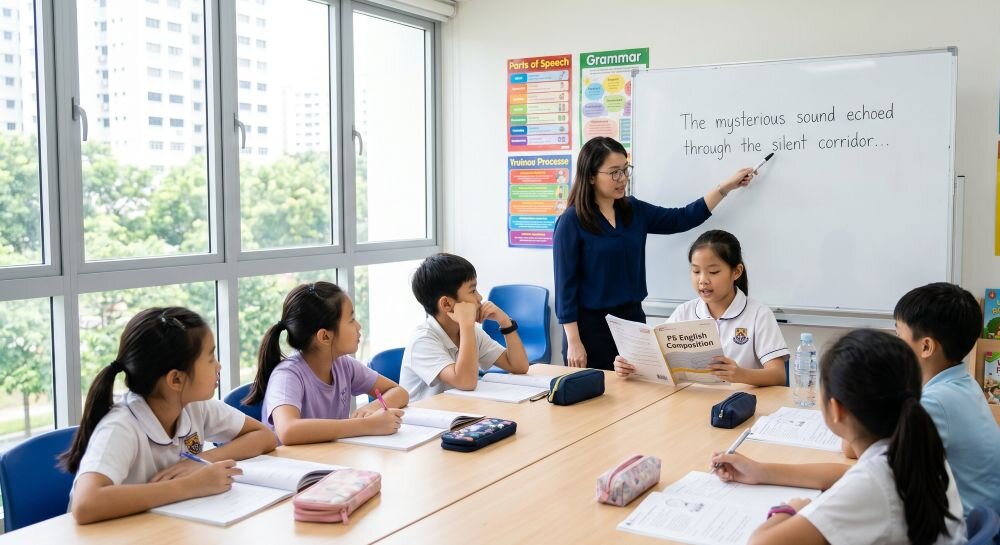
These are the six things that, in our view, separate a real English programme from a worksheet factory.
The first is that it teaches all four language strands and not only writing. The MOE framework treats English as a combination of reading, writing, speaking and listening, with grammar and vocabulary running through all of them. A programme that drills composition every week but treats oral as an afterthought is leaving 20 per cent of the PSLE English grade unaddressed.
The second is that it teaches strategy, not just practice. Repetition without explanation builds familiarity but rarely changes how a student thinks about a question. A child needs to understand why a comprehension answer earns its marks, how to plan a composition for coherence and impact, and what an oral examiner is actually listening for. Strategy-based teaching gives them the framework. Drilling alone does not.
The third is that the curriculum is scaffolded and progressive. Each lesson should connect to the previous one. Skills introduced in Primary 3 should be revisited and deepened by Primary 5. A programme that jumps between topics without a visible plan is hoping the right thing will stick. A programme with a real curriculum design knows what skill is being taught this term and why, in what sequence.
The fourth is that the tutors are qualified and stay informed. A degree in English, Linguistics, Literature or Education is the baseline. Specific experience teaching at your child’s level is the next layer. Active engagement with current syllabus changes is the third. Centres that will not tell you who your child’s teacher is, or that quietly rotate teachers every few weeks, are signalling something you do not want.
The fifth is that classes are small enough for individual feedback. Language is personal. Writing improvement needs specific, actionable feedback on each student’s actual work, not generic comments. A primary English class above ten students stretches the teacher beyond the point where they can give every child meaningful written and oral attention every week.
The sixth is that progress is tracked and communicated. A good centre does not wait for the parent to ask. It provides structured progress reports that name specific skills and areas still under construction. Reports that consist of a single grade or a percentile tell you almost nothing about what the next term should focus on. Our piece on the benefits of a structured curriculum explains how this kind of structured tracking actually works inside a programme.
This is the question we get most often. The honest answer is that it depends on what your child needs.
Group tuition, when the class size is small enough, is the right fit for most students. It is cheaper per hour, which matters across a school year. It builds the peer interaction that oral examination depends on, since your child practises speaking in front of an audience that is not their parent. It also exposes them to the way other students answer, which is a powerful learning channel that one-to-one cannot reproduce. Most established Singapore tuition centres pitch group sizes between four and eight students for English, and these are the centres worth looking at.
One-to-one tuition is the right fit when the child has very specific gaps that need closing fast, when exam anxiety is acute and a familiar adult listener helps, or when the child is significantly ahead or behind the group. It costs more per hour and provides no peer audience, but the personalisation is total. Some families combine both, with a small-group programme for regular skill development and short bursts of one-to-one closer to a major examination. This works well when the budget allows it.
A surprising number of parents conflate the two, and end up paying for the wrong service.
Tuition is academic and exam-aligned. It follows the MOE syllabus, targets the specific components that the exam tests, and aims at grade improvement. It is structured around assessment and includes practice with past examination material.
Enrichment is about language exposure and appreciation. It builds a love of language through storytelling, creative writing workshops, drama, debates and wide reading. It is excellent for younger children, for students who are already strong and want to deepen their relationship with English, and for families who want their child’s English to develop beyond the exam.
The best outcomes often come from pairing both. Tuition handles examination readiness. Enrichment, including the reading habit at home, builds the underlying fluency that good tuition cannot manufacture in a 90-minute session.
Some signals are clear once you know what to look for. These are the ones we would weight most heavily.
There is no transparency about who is teaching your child. The centre offers a one-size-fits-all curriculum with no acknowledgement of where your child actually sits. Materials look like they were last updated five years ago. Written work comes back with a tick and a number and nothing else. You have to chase the centre for an update on your child’s progress. Your child dreads going. The centre’s marketing leans heavily on a board of top scorers, with no explanation of what the curriculum did to get them there. There is no trial class on offer, or the centre is reluctant to let you observe. Tutor changes and last-minute cancellations are frequent.
Any one of these on its own is not necessarily disqualifying. Two or three together is your answer.
This is worth saying clearly. No tuition programme, however good, fully substitutes for the habit of wide voluntary reading. Vocabulary, sentence rhythm, comprehension depth and writing voice all come from authentic reading over time.
Singapore students top global reading literacy rankings but only 51 per cent of them reported enjoying reading in 2021, the lowest figure in a decade. The gap between strong examination scores and weak reading culture is not a paradox. It is exactly what produces students who can answer the comprehension paper but write flat compositions. Tuition can teach technique, but reading is what produces the underlying material a child draws on when the technique runs out.
Any English tuition programme worth its fees should be encouraging the reading habit at home, not replacing it. The simplest practical move is a weekly library visit and a small handful of age-appropriate books your child gets to choose. The investment is free and often the highest-return habit a Singapore family can build.
Take these to a trial class or a sales meeting.
A serious centre answers these questions with confidence. A weak centre struggles with all of them.
The reason this list reads the way it does is that we built WRITERS AT WORK around it. Since 2012 we have taught more than 9,850 students through structured English programmes that run from Pre-Primary 1 through to Secondary 4. The curriculum is updated to reflect each MOE syllabus revision, including the 2025 PSLE English changes and the 2023 O-Level English changes. Classes are small by design, so every child speaks every week and every piece of writing is read carefully by the teacher who knows them.
At the centre of every lesson is STORYBANKING®, the proprietary methodology we developed from hands-on classroom experience dating back to 2007. It gives students a personalised library of story material and a clear pathway from idea to plot to polished language, so that strong writing becomes a transferable skill they can reproduce under any exam condition. The same disciplined approach that powers our composition work shapes how we coach oral too, which is one reason 90 per cent of our PSLE students achieve AL1 to AL4 in PSLE English, and 90 per cent of our secondary students see a three-grade improvement after joining the programme.
The programmes run in both Pure Onsite and Pure Online formats, fully optimised for each environment rather than treated as a compromise. If you are evaluating English tuition options for your child and the questions in this post matter to you, visit our website or send us a direct message. We are happy to walk you through what a structured small-group English programme actually looks like, and how it might fit your child’s stage. Follow us on Instagram, Facebook and YouTube for weekly tips and updates.
Established small-group English tuition centres in Singapore typically charge between 150 and 350 Singapore dollars per month, depending on level and class size. One-to-one tuition runs from 25 dollars an hour at the lower end of the experience scale to well over 130 dollars an hour for senior teachers. A higher fee does not automatically buy a better programme. What it buys is overheads. The question is whether what you are getting under the hood is worth what you are paying for the centre’s signage.
Two possibilities. The first is that the programme is built around drilling rather than strategy, so your child has become familiar with the question types but is not getting better at the underlying skills. The second is that the curriculum is not properly scaffolded for your child’s level, so the same content is repeated without genuine progression. Either way, two years is enough time to evaluate the programme honestly. Visible improvement across a school term in your child’s writing and in their oral confidence is the bar.
No. One-to-one is excellent for closing specific gaps and for students with acute exam anxiety. For general English development, especially oral, small-group tuition is often the stronger choice because it builds the peer audience and the routine practice in front of others that the oral exam relies on. The right answer depends on the child.
The best test is what your child can do on their own. A good English programme should make itself progressively less necessary by equipping a child to plan and self-edit a composition without help, and to handle both the comprehension answer and the oral examiner with the same confidence. If your child cannot do these things after two or three years of weekly classes, that is the sign that something in the programme is missing, not that more tuition will fix it.

Jemmies Siew, Managing Director and Co-Founder of WRITERS AT WORK Enrichment Centre. With over 15 years of experience in education, entrepreneurship, and marketing, Jemmies has helped shape Singapore’s English enrichment landscape through her vision for transformative learning.
She is passionate about connecting real-world issues with language learning, helping students think critically and express themselves clearly. Connect with her on LinkedIn to follow her insights on education, content marketing, and thought leadership.



Start practising and learning

