Leadership and teamwork are at the heart of every classroom, CCA, and group project. In school, students are constantly placed in situations where they must collaborate — whether during a Science group experiment, a CCE discussion, or a class presentation. In fact, research shows that collaborative learning can significantly improve both academic performance and communication skills, as students learn not just from teachers, but from one another.
Nonetheless, teamwork is not always smooth. Conflicts arise, voices clash, and leaders struggle to balance direction with inclusion. For Primary 5 and Primary 6 students, this theme is especially important because exam compositions often explore group dynamics, responsibility, and peer relationships.
This guide gives parents and students a practical understanding of the vocabulary, phrases, and writing techniques needed to write confidently on leadership and teamwork themes.

PSLE composition markers are looking for stories that feel real and specific — not general ideas about teamwork, but actual moments that upper-primary students would recognise from their own lives. Here are some examples of the kinds of scenes that work well:
This theme covers a wide range of emotions. There’s the discomfort of being responsible for others. There’s the friction of people who disagree. There’s the satisfaction when a group finally finds its rhythm. And there’s the quiet moment when a character realises that good leadership sometimes means listening more than talking.
💡 Students who can write about leadership and teamwork well tend to also handle prompts about resilience, friendship, and school life — since all of these themes often come together in the same story.
Weak: “She helped the group.”
Stronger: “She coordinated the group, delegating tasks and motivating quieter members to contribute.”
Useful verbs to practise:
These help a reader picture the scene more clearly:
Collocations are phrases that native speakers use naturally. Using them makes a composition sound more fluent.
Examples:
💡 Don’t try to memorise everything at once. Use three to five new items in each practice composition. Over time, these phrases will start to feel natural.
Under exam pressure, it helps to have a few phrase patterns ready to go. These starters are useful for setting up leadership or teamwork scenes clearly:
💡 These are starting points, not fixed templates. Students should adapt them to fit their own stories.
A main character who never doubts themselves, never makes a mistake, and never needs anyone else feels unrealistic. Markers want to see growth, and growth requires a character who gets something wrong first. Maybe they misread the group, shut someone down too quickly, or hold on to control for too long. Imperfection isn’t a weakness in a composition. It’s what drives the story forward.
If four out of five group members do nothing throughout the story, the marker can’t tell whether the student really understands teamwork. Give at least two other characters distinct personalities — one who creates a problem, one who helps solve it. Even a small moment of interaction makes the group feel real.
Compare these two versions:
“She felt nervous but pushed through.” → Tells the reader what to feel.
“Her hand was on the classroom door for three full seconds before she pushed it open.” → Shows the reader the nervousness.
The second version is more powerful because the reader can picture it. When writing about emotions in a group or leadership scene, find a small physical action or detail that shows the feeling rather than naming it.
Instead of “they argued but then agreed”, show exactly what changed. What specific thing did someone say that shifted the mood? What compromise cost something? Was there a long silence before someone finally spoke? The more specific the moment, the more convincing the teamwork feels.
“After they talked, everything was fine.” This kind of ending flattens the story. A stronger ending shows one character doing something small and specific that signals a real, lasting change — not just in what they did, but in how they see their role. For example, a character who always needed to be in charge quietly lets someone else take the lead without making a fuss about it.
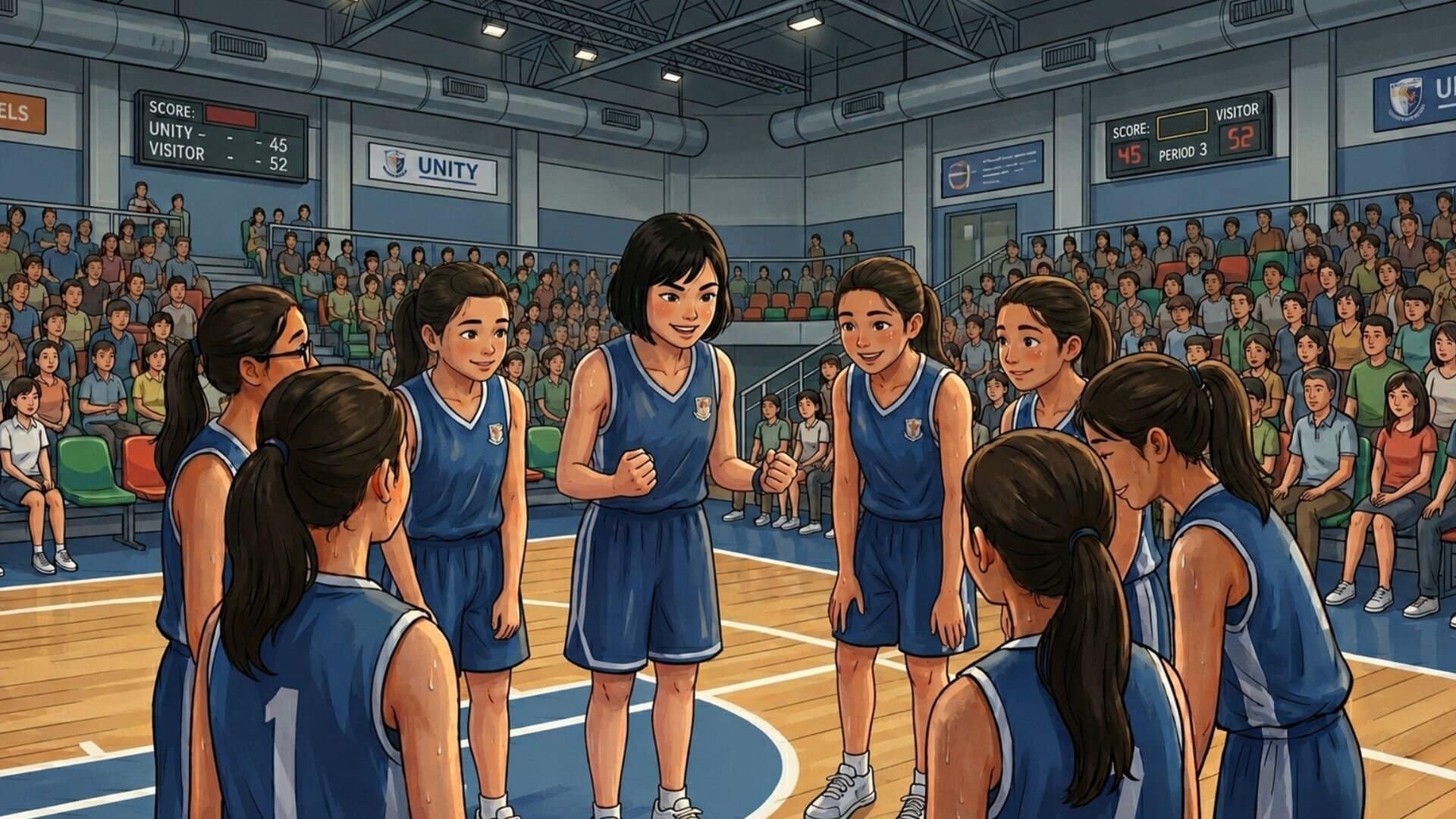
Set a 10-minute timed writing session using this prompt:
“The basketball team fell silent after losing the first round badly. Clenching her fists, Sarah gathered her teammates into a circle and began to speak. Write what happened next.”
While writing, aim to include:
After finishing, go back and highlight every strong verb in the draft. If there are fewer than five, that’s the rewrite focus — swap out weaker verbs for more precise ones.
💡 Band 4 Challenge: End the composition with a sentence that shows what Sarah learnt — not by saying “She learnt that leadership is important”, but through one quiet action or observation that the reader can picture.
At WRITERS AT WORK, our Pure Composition Programmes for Primary 5 and Primary 6 students are built around our signature STORYBANKING® approach — helping children develop a small, well-understood bank of phrases and flexible story skeletons they can actually use under pressure, not just memorise and forget.
We also offer comprehensive English programmes covering everything your child needs — from grammar and comprehension to oral communication.
Find out how STORYBANKING® can make a real difference for your child this year.

Understanding something and writing about it are two different skills. Most children have experienced group work, but they haven’t been taught how to translate those experiences into structured, vivid writing. That’s exactly what this guide helps with — giving them the specific vocabulary, phrases, and story patterns to express what they already know.
A: Not at all. What markers reward is a believable character journey. A team that struggles, reflects, and tries again is far more compelling than one that succeeds without any friction.
They overlap, but leadership and teamwork compositions specifically reward moments of responsibility, decision-making under pressure, and group dynamics. Friendship stories tend to focus on personal bonds, loyalty, falling out, and making up.
Encourage them to change the setting first — a CCA relay, a class performance, a campfire group activity — rather than always defaulting to a classroom project. Once the setting shifts, the characters and conflict usually follow naturally. The vocabulary bank and sentence starters in this guide are designed to work across different settings, not just one.

Jemmies Siew, Managing Director and Co-Founder of WRITERS AT WORK Enrichment Centre. With over 15 years of experience in education, entrepreneurship, and marketing, Jemmies has helped shape Singapore’s English enrichment landscape through her vision for transformative learning.
She is passionate about connecting real-world issues with language learning, helping students think critically and express themselves clearly. Connect with her on LinkedIn to follow her insights on education, content marketing, and thought leadership.



Start practising and learning

