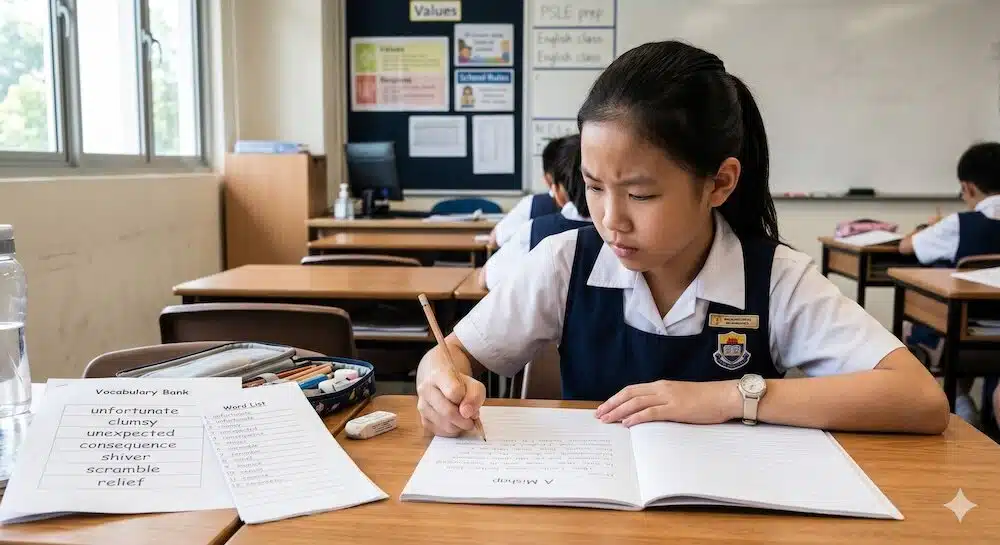
“Accidents” — sometimes set as A Mishap, An Unexpected Incident, or A Dangerous Situation — is one of the most frequently tested narrative themes in PSLE English composition. The theme rewards strong action verbs, controlled pacing, sensory description, and a confident grasp of recognisably Singaporean settings. It is also where many otherwise capable upper-primary students lose marks: Singlish creeps in under exam pressure, injuries get described in vague terms, and rushed endings flatten the drama.
This guide gives parents a clear picture of the vocabulary, phrases, and craft moves a P5 or P6 child needs to write a confident accidents composition.
Markers reward specific, grounded settings over vague or imaginary ones. The strongest accidents compositions are anchored in places a Singaporean child genuinely knows: a slippery HDB stairwell after a sudden rainstorm, a Punggol Park Connector cyclist who fails to brake in time, a school canteen at a busy lunch break, a void deck washing bay, a monkey-bar fall at a Bukit Batok playground, a PMD knocked off a Hougang junction, a kitchen burn at home. Singapore’s roads also recorded a ten-year high of 149 traffic fatalities in 2025, and 197 children were injured in road accidents between January and September alone — concrete material your child can reflect in their writing without inventing implausible scenes. “Accidents” sits inside the wider top 10 PSLE composition themes, and a child who can write it well usually handles other tension-driven themes as a result.
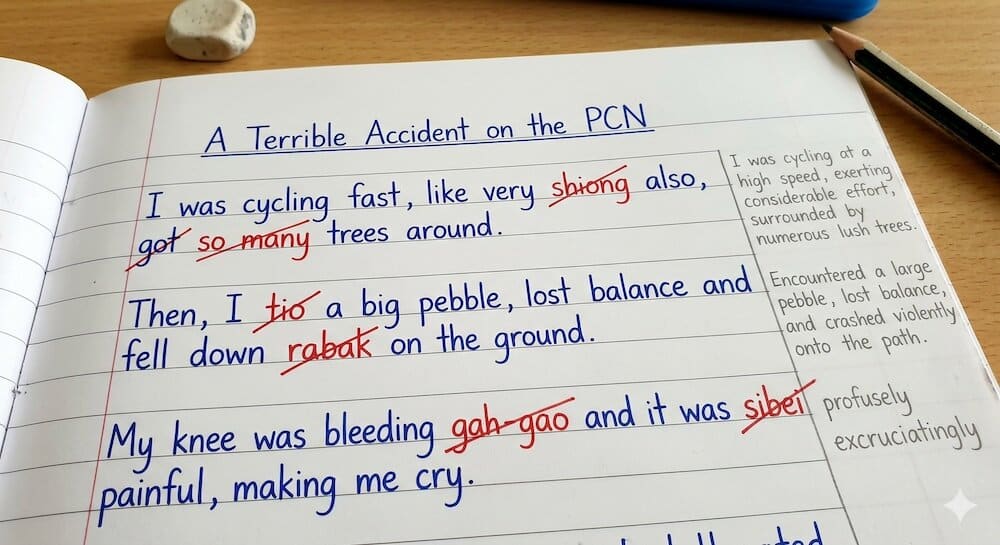
Strong verbs do most of the work. Instead of “fell down”, a P6 child should be able to choose between scrambled, hurtled, lurched, staggered, recoiled, or wrenched depending on what actually happened.
Vivid adjectives — excruciating, clammy, jagged, frantic, harrowing, gaping — name the sensation rather than label it as “very painful”.
Collocations such as sustain injuries, render assistance, severe laceration, lose consciousness, mount a rescue, seek medical attention and swift response give compositions a polished, idiomatic feel that examiners reward in the higher Content and Language bands.
We have laid out the full bank — strong verbs, vivid adjectives, thematic nouns, idioms, collocations, and Singapore-context example sentences for each — in a downloadable companion Word document, Writing About Accidents: Full Vocabulary and Phrase Bank. Pull three to five new items into each practice composition rather than trying to memorise everything; this is also the approach we recommend in our broader guide to expanding your child’s vocabulary bank.
A handful of well-rehearsed phrase patterns help a child structure the chaos of an accident scene under exam pressure.
These belong to the same family of usable phrases we recommend in our general guide on good phrases for P5 and P6 composition writing.
For a deeper look at endings, see our composition conclusion tips, and for the wider list of mistakes, our PSLE composition mistakes to avoid.
Set this single 10-minute prompt: “Ahmad, 11, was cycling home from school along the Tampines Park Connector when he suddenly heard a screech of tyres. Write what happened next.” Ask your child to use at least three vocabulary items from the Word doc bank, one collocation, and one of the sentence starters above. After writing, ask them to highlight every strong verb in their own draft. If they have fewer than five, that is the rewrite focus. This drill mirrors the planning rhythm we cover in our PSLE composition planning tips and pairs well with our step-by-step guide on how to start a composition.
Memorising and reproducing whole phrases is risky and often penalised when the topic does not match. The safer approach is to build a small personal bank — ten to fifteen vocabulary items, three or four sentence starters, two or three collocations — that your child genuinely understands and can adapt. Practise deploying them in different scenarios: a fall, a fire, a near-miss, a road accident. By the time the exam comes, the phrases feel like tools they own rather than borrowed material.
Yes. PSLE composition does not bar serious outcomes. What matters is that the emotional truth is handled with maturity — not melodrama. A composition where a character sustains a permanent injury or where someone dies can score in the higher bands if the writing shows controlled pacing, sensory grounding, and a thoughtful response from the narrator. Avoid trivialising the event with overly neat or instant recoveries.
Length is rarely the problem. Mid-band accident compositions usually share three patterns: a vague injury (“she was very hurt”), Singlish creeping into dialogue and narration, and a rushed ending. Pull a recent script and ask: can your child name the injury, point to one sensory detail, and identify how the narrator changes by the end? If any answer is no, that is the rewrite focus before adding more vocabulary.
At the PSLE level there is no meaningful distinction. “A Mishap”, “An Unexpected Incident”, “A Dangerous Situation” and similar prompts all sit inside the same theme. The marker expects the same building blocks: a clear conflict (the moment something goes wrong), a controlled escalation, a sensory peak at impact, the arrival of help, and an ending that shows what changed for the narrator. The vocabulary and phrase bank in this guide carries across all of them.

Agnes Ng, Co-Founder and Teaching & Curriculum Director of WRITERS AT WORK. An NUS Honours graduate and published author with over 30 years of experience, Agnes has been the architect of the organization’s student-centric curricula since 2012.
Dedicated to teacher mentorship and academic excellence, she has guided hundreds of students to achieve outstanding results. Her expertise and commitment to high-quality education remain the cornerstone of WRITERS AT WORK’s success in empowering every learner.



Start practising and learning

