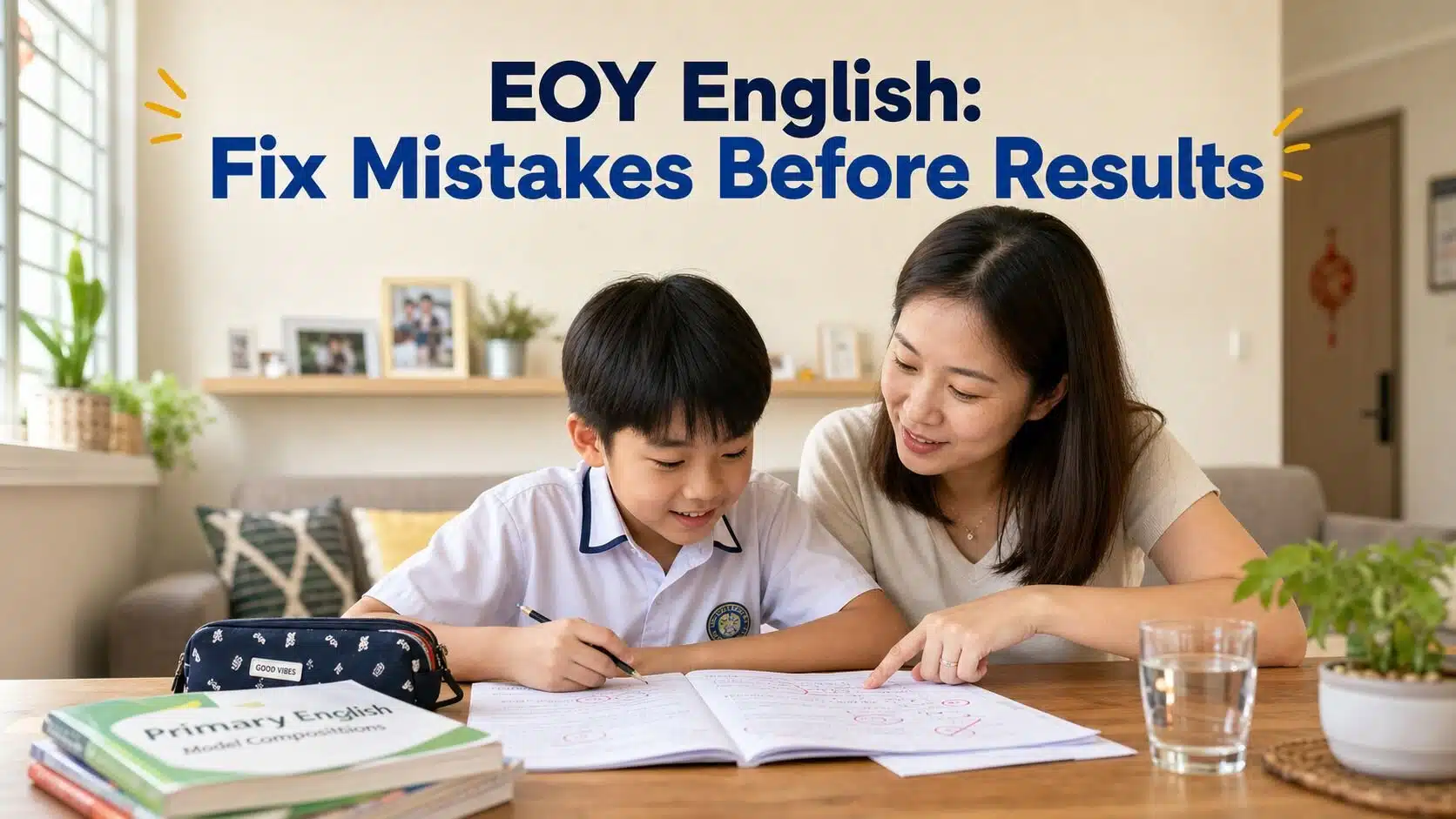
The weeks between your child sitting the end-of-year English papers and the results coming back are some of the most useful in the whole school year. Most families treat this stretch as dead time, a nervous wait for a number. It can be far more than that. While the paper is still fresh in your child’s mind, and while the year’s worksheets and class tests are still in the file, you already have everything you need to find the mistakes that keep costing marks.
The point of this window is diagnosis. You want to find the errors that keep repeating and understand why they happen, so you can fix them before the new school year adds fresh demands on top of old gaps. This guide walks you through how the primary English paper is built, the mistakes that surface again and again, and a calm, realistic way to work through them at home.
From P3 upwards, the primary English examination is assessed across four papers: Writing, Language Use and Comprehension, Listening Comprehension, and Oral Communication. Paper 2, Language Use and Comprehension, carries the most weight at 45 per cent, so it is usually where the most marks are won or lost. Composition sits inside Paper 1, while Oral now carries 40 marks. At P1 and P2, writing is assessed more gently, with short paragraphs rather than full compositions.
Knowing where the marks sit tells you where to look first. A child who drops six marks on open-ended comprehension and one mark on a spelling slip does not have a spelling problem. This window is your chance to see those proportions clearly, before the next year begins. For a fuller picture of how the primary papers fit together, our overview of what the PSLE involves is a useful starting point for parents.
Not every wrong answer is worth worrying about. A one-off slip is something your child can fix the moment you point at it: a misread question, or a word left out under time pressure. A pattern is different. It turns up across different papers and different weeks, regardless of the teacher or the topic. That is the signal of a real gap rather than carelessness.
The simplest test is to look at three separate pieces of work from across the year. If the same error appears in each one, you are looking at a pattern, and patterns are exactly what this window is for.
You do not need a teaching qualification to do this well. You need your child’s returned work and about twenty quiet minutes.
Start by gathering everything from the year: class assignments, weighted assessments, mock papers and marked worksheets. Pull from across all the Paper 2 components, not only composition, because that is where the marks quietly hide.
Next, log the errors rather than only counting them. A two-column list does the job: the error you noticed on the left, the component it came from on the right. After a dozen entries, the repeat offenders become obvious.
A quick colour code helps you sort what you find. Mark a question red when your child does not know the rule, and green when they clearly do. Use orange for the in-between answers they got right but were unsure about. Then ask your child to explain a red answer. If they cannot say why it is wrong, the gap is in understanding. If they groan “oh, I misread it”, it was a slip.
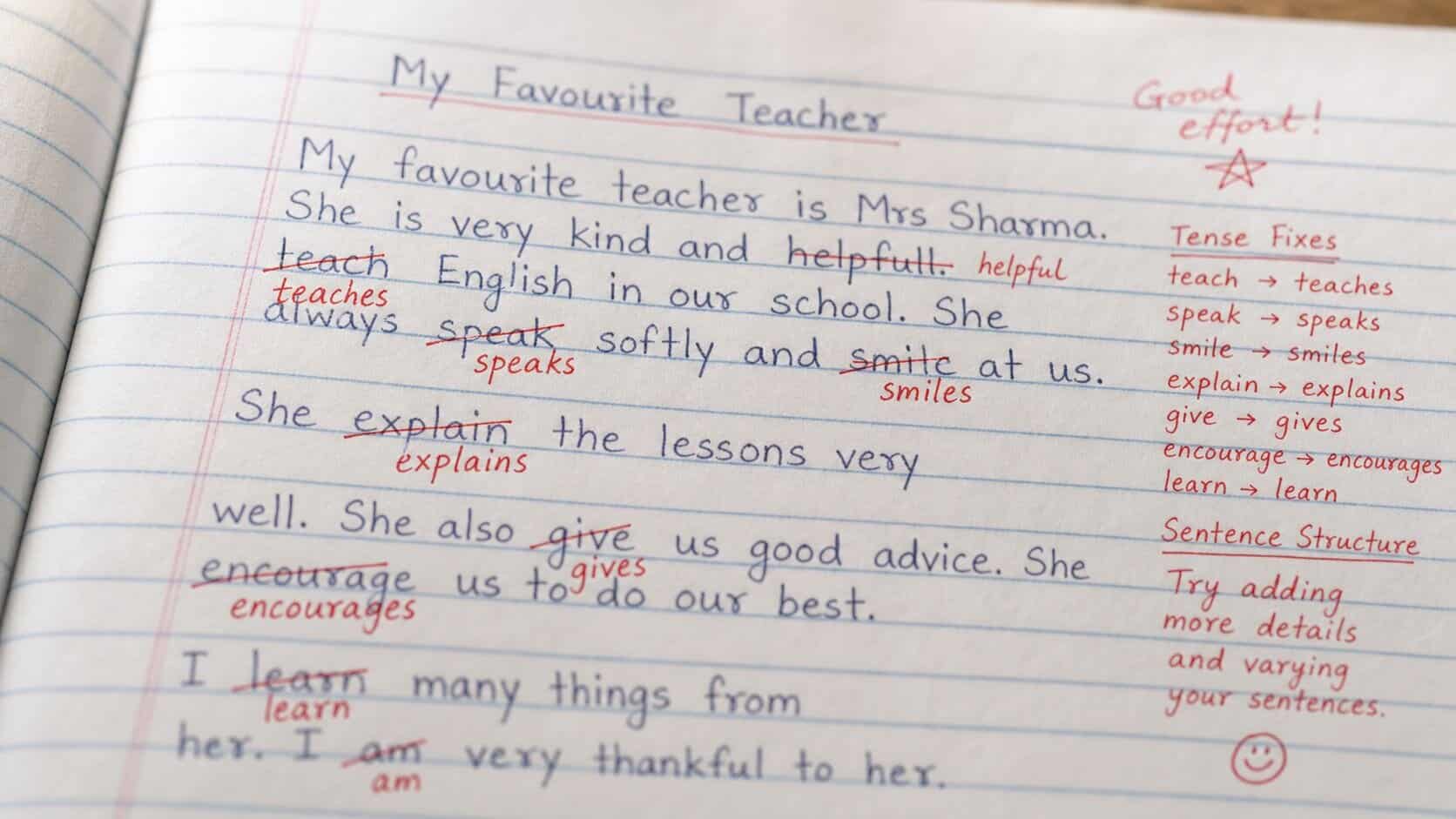
Finally, keep a small mistake journal. For each repeated error, your child writes the wrong version next to the corrected one, with a short note on why it failed. A two-minute reflection on why an answer went wrong does far more for memory than copying the right answer once.
Certain errors are so common that it is worth knowing them by name.
In composition, tense is the great repeat offender. Children slip from past to present inside the same paragraph: “She ran to the door and opens it.” Run-on sentences sit close behind, where two complete thoughts are joined with only a comma. Both are habits rather than one-time mistakes, which is exactly why a focused review helps. If tense is your child’s weak spot, our guide on mastering tenses is a good place to begin.
In comprehension, the open-ended questions leak the most marks. The usual causes are giving one point when the question is worth two, and copying chunks of the passage without explaining them. Beginning an answer with “Because” also costs the mark at this level. For inference questions, the full-mark answer is evidence from the text plus a clear conclusion, and our three tips for open-ended comprehension break this down for parents.
In grammar and editing, subject-verb agreement and word form lead the way: “She run fast” or “She sings beautiful.” These same errors often surface in composition too, so fixing the rule once pays off in two places. When this is the pattern, our guide to subject-verb agreement gives clear, worked examples.
From P4, synthesis and transformation brings its own traps. The most serious is quietly changing the meaning of the original sentence while rearranging the words. The fix is a single habit: after every answer, ask “does this still mean the same thing?”
In oral, marks slip away through flat, expressionless reading and through dead-end answers that give the examiner nothing to follow up on.
How you talk about mistakes matters as much as which mistakes you pick. Singapore’s exam culture can make this stretch tense for children, and a review that feels like an interrogation rarely sticks.
A few small shifts help. Choose a calm moment rather than the hour the marks come home. Sit beside your child rather than across the table, so the work feels like a shared problem instead of a verdict. Lead with a question: “Walk me through what you were thinking here” reveals the reasoning, where “Why did you do this again?” only makes a child shut down. Keep at least two encouraging comments for every correction, and stop before fatigue sets in. Thirty minutes is plenty for lower primary, and forty-five for upper primary.
When your child says something like “I go to the library yesterday”, you do not always need to correct it head-on. Modelling the right form lightly, “Oh, you went to the library? What did you borrow?”, lets the pattern sink in without a lecture.
EOY papers at P3 to P5 usually fall in October, with results released from November. That gives you a genuine two to six weeks. The trick is to keep it focused.
Work on one error type at a time. Five focused minutes a day on a single grammar pattern beats a two-hour scramble across everything. In the first week or two, diagnose and pick the single biggest repeat error. In the middle weeks, move to the next one only once the first is improving. In the final stretch, do a short, low-pressure exercise to keep skills warm and start building good habits for the year ahead, such as planning before writing and reading every comprehension question twice.
Practical activities can be small. Write opening paragraphs rather than whole compositions. Read aloud together for ten minutes a day. Record your child reading a passage and play it back, since children hear their own rushing straight away. Use a photo from the newspaper to practise the kind of conversation the oral asks for.
At WRITERS AT WORK, this thinking sits behind everything we teach. Our teachers help students see why a mistake happens and how to correct it for good, and our STORYBANKING® approach gives children a clear, repeatable way to plan and build their compositions instead of guessing each time. If you would like your child to start the new school year with last year’s gaps already closed, we would love to help.
Follow us on Instagram and Facebook for weekly tips you can use at home.
This is the ideal time. The paper is still fresh, and the year’s worksheets and mock papers give you plenty to work from. You are looking for patterns, not re-marking the exam, so you do not need the EOY script in hand.
Ask your child to redo a few of the “careless” questions a week later, without the original paper. If they get them right easily, it was a slip. If the same error returns, it is a pattern worth fixing properly.
Follow the marks. Paper 2 carries 45 per cent, and within it the comprehension sections lose the most marks to incomplete or vague answers. If composition is the weak spot, focused work on planning and story structure lifts it quickly.
Around fifteen to thirty minutes, built around one skill at a time. Short and consistent beats long and occasional, and full practice papers are best saved for later. One real correction a day adds up fast.

Jemmies Siew, Managing Director and Co-Founder of WRITERS AT WORK Enrichment Centre. With over 15 years of experience in education, entrepreneurship, and marketing, Jemmies has helped shape Singapore’s English enrichment landscape through her vision for transformative learning.
She is passionate about connecting real-world issues with language learning, helping students think critically and express themselves clearly. Connect with her on LinkedIn to follow her insights on education, content marketing, and thought leadership.




Start practising and learning

