Helping others is a meaningful theme in composition writing because it allows students to show kindness, empathy, courage and personal growth. A story about helping someone does not always need to be dramatic. It could be as simple as comforting a friend, returning a lost wallet, helping an elderly person, lending a listening ear or offering help to a classmate who is struggling.
However, many students tend to write sentences such as “I helped him” or “She was happy”. These are clear, but they do not create a strong emotional effect. To make a composition more vivid, students need precise vocabulary and good phrases for composition writing that show how the character feels, acts and changes.
Stories about helping others often work well because they naturally include a problem and a resolution. Someone faces difficulty, another person notices, and a kind action changes the situation.
For example, a student may help a classmate who has dropped his books. Another may comfort a friend who is close to tears. Someone may return a lost wallet or share an umbrella with a lonely student on a rainy day.
These small moments can become powerful composition scenes when students describe them clearly. The key is to show three things:
This helps students move beyond listing actions and begin showing emotion, reflection and character growth.
Vocabulary Bank: Helping Others
Use this vocabulary bank to describe helpful characters, difficult situations and positive outcomes.
| Word or Phrase | Meaning | Example in a School or Everyday Context |
|---|---|---|
| Kind-hearted | Caring and generous | The kind-hearted boy helped the elderly woman cross the road. |
| Compassionate | Showing concern for someone’s suffering | Jia En felt compassionate when she saw her classmate crying alone. |
| Considerate | Thoughtful towards others | It was considerate of him to share his umbrella with the new student. |
| Helpful | Willing to give assistance | The helpful monitor stayed back to arrange the classroom chairs. |
| Selfless | Putting others before oneself | Her selfless act of kindness made everyone admire her. |
| Responsible | Doing what is right | He made the responsible choice to return the wallet to the general office. |
| Empathetic | Able to understand how others feel | An empathetic friend knows when someone needs comfort. |
| Grateful | Feeling thankful | The elderly lady’s eyes shone with gratitude. |
| Relieved | Feeling less worried | His face lit up with relief when he found his missing wallet. |
| Reassuring | Making someone feel less worried | She gave her friend a reassuring smile before the performance. |
| Encouraging | Giving someone confidence | His encouraging words helped me try again. |
| Thoughtful | Showing care through small actions | The thoughtful girl lent her notes to her absent classmate. |
| Overwhelmed | Feeling unable to cope | I felt overwhelmed by my worries before my friend comforted me. |
| Lonely | Sad because one feels alone | A small act of kindness made the lonely student feel included. |
| Appreciative | Feeling thankful for help | My neighbour was appreciative when I helped carry her groceries. |
Collocations and Useful Phrases for Helping Others
Collocations are words that naturally go together. Learning them helps students write more fluent and natural sentences.
| Collocation or Phrase | How to Use It | Example Sentence |
|---|---|---|
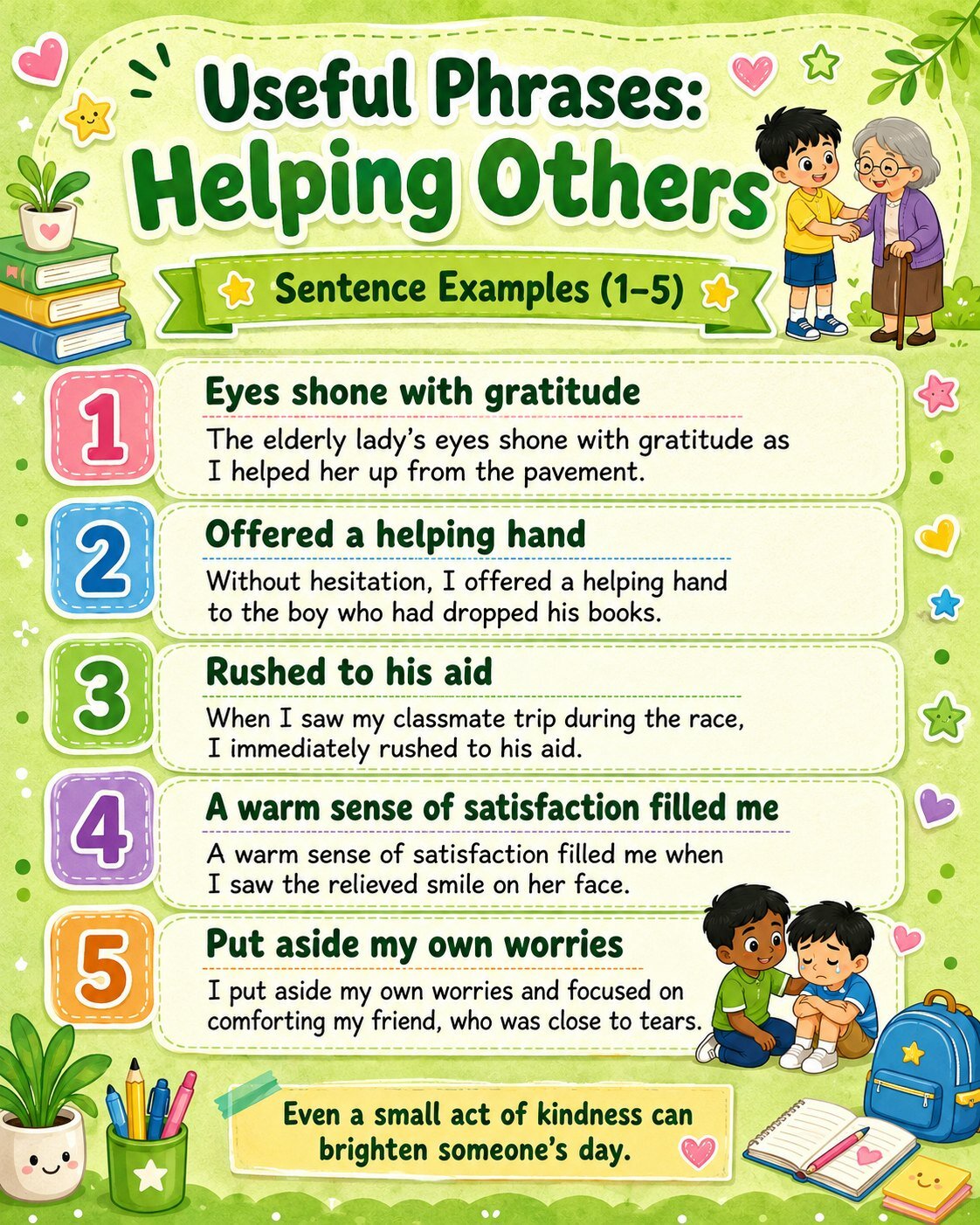
| Eyes shone with gratitude | To show that someone is thankful | The elderly lady’s eyes shone with gratitude as I helped her up. |
| Offered a helping hand | To show willingness to help | Without hesitation, I offered a helping hand to the boy who had dropped his books. |
| Rushed to his aid | To show quick action | When my classmate tripped during the race, I immediately rushed to his aid. |
| A warm sense of satisfaction | To describe the good feeling after helping | A warm sense of satisfaction filled me when I saw the relieved smile on her face. |
| Put aside my own worries | To show selflessness | I put aside my own worries and focused on comforting my friend. |
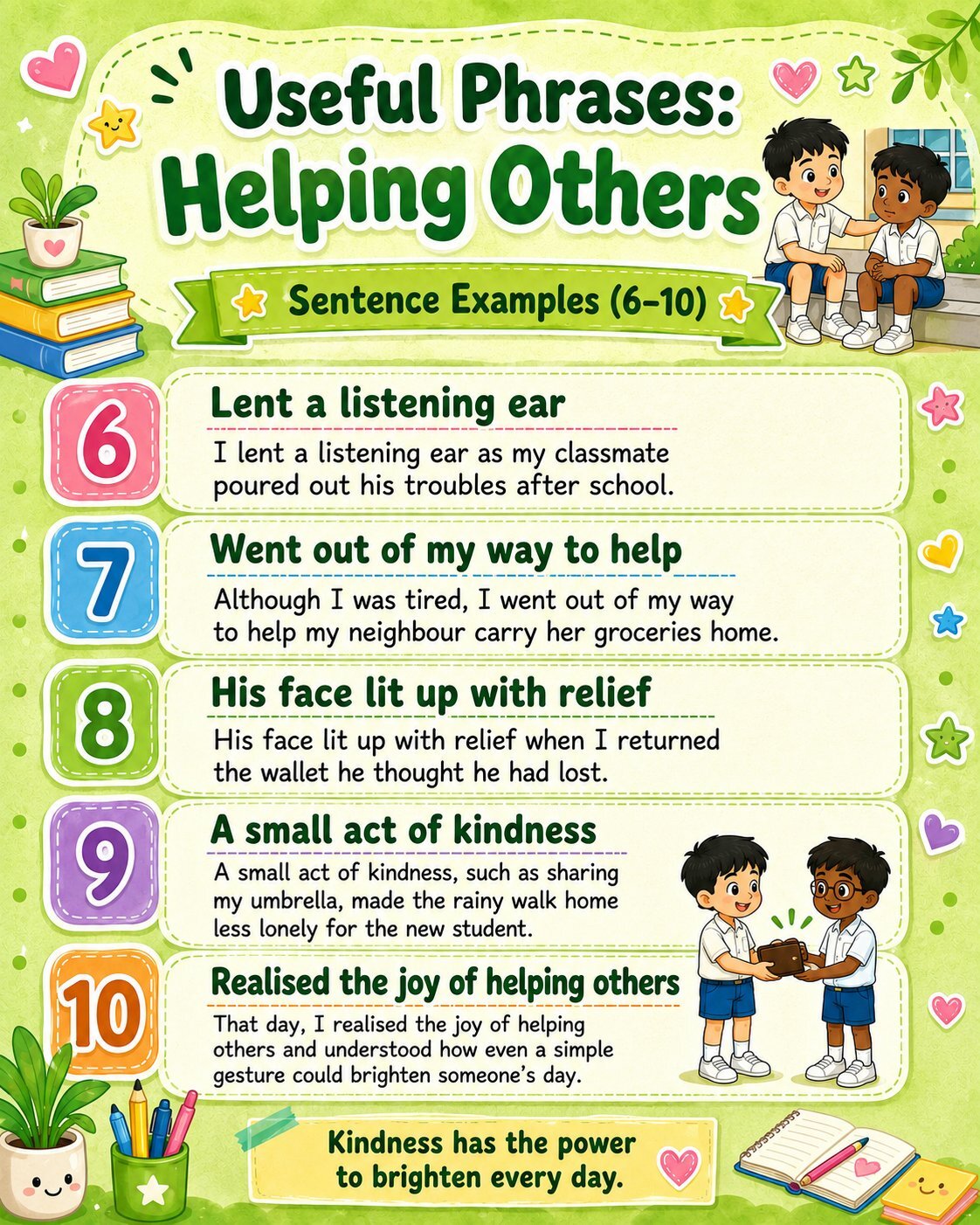
| Lent a listening ear | To show emotional support | I lent a listening ear as my classmate poured out his troubles after school. |
| Went out of my way to help | To show extra effort | Although I was tired, I went out of my way to help my neighbour carry her groceries home. |
| His face lit up with relief | To show sudden comfort or happiness | His face lit up with relief when I returned the wallet he thought he had lost. |
| A small act of kindness | To show that simple actions matter | A small act of kindness, such as sharing my umbrella, made the rainy walk home less lonely. |
| Realised the joy of helping others | To use in a reflective ending | That day, I realised the joy of helping others and understood how even a simple gesture could brighten someone’s day. |
Students should not force every phrase into one composition. Instead, they should choose phrases that match the story situation.
For example, “rushed to his aid” works well in an urgent scene, such as when someone falls down or gets hurt. “Lent a listening ear” works better in an emotional scene, such as when a friend is upset. “A warm sense of satisfaction filled me” is useful near the ending, when the main character reflects on the value of kindness.
Good phrases for composition writing are most effective when they help the reader feel the moment. A kind action should not be described only as an action. It should also show the character’s thoughts, emotions and growth.
Instead of writing a full composition immediately, try this short activity. It helps students build a stronger helping-others scene step by step.
Step 1: Choose a Situation
Pick one helping situation from the table below.
| Situation | Possible Problem |
|---|---|
| A classmate drops his books | He feels embarrassed as others stare |
| An elderly neighbour carries groceries | The bags are too heavy for her |
| A friend looks upset after school | She is close to tears |
| A student loses his wallet | He panics because it contains his allowance |
| A lonely student walks home in the rain | He has no umbrella and feels left out |
Step 2: Choose 3 Phrases
Choose one phrase from each column.
| Beginning Phrase | Helping Action Phrase | Ending Reflection Phrase |
|---|---|---|
| I noticed the worry on his face | offered a helping hand | a warm sense of satisfaction filled me |
| She looked close to tears | lent a listening ear | I realised the joy of helping others |
| He looked around anxiously | rushed to his aid | his face lit up with relief |
| I hesitated for a moment | went out of my way to help | even a small act of kindness mattered |
| My own worries weighed heavily on me | put aside my own worries | kindness had brightened someone’s day |
Step 3: Write a 5-Sentence Kindness Scene
Use this structure:
| Sentence | What to Write |
|---|---|
| Sentence 1 | Introduce the problem |
| Sentence 2 | Describe how the person felt |
| Sentence 3 | Show what you did to help |
| Sentence 4 | Describe the person’s reaction |
| Sentence 5 | End with a reflection |
Sample Answer
I noticed the worry on my classmate’s face as he searched frantically through his bag. His hands trembled, and he looked close to tears because his wallet was missing. Putting aside my own worries, I helped him retrace his steps around the canteen. When we finally found it under a bench, his face lit up with relief. At that moment, I realised the joy of helping others and understood how a small act of kindness could brighten someone’s day.
Helping others is a simple but powerful theme because it teaches students to write with empathy. Whether the story is about returning a wallet, comforting a friend or helping someone in need, students should focus on the emotions behind the action.
At WRITERS AT WORK, students learn how to use vocabulary meaningfully, build strong storylines and apply good phrases for composition writing in a natural way. With guided practice, they learn that strong writing is not about using the fanciest words. It is about choosing the right words for the right moment.
Parents who want structured writing support can explore our English tuition for primary students, browse our free model compositions, or learn more at WRITERS AT WORK.
Family and friendship topics help students write about emotions, relationships and character growth. These themes allow students to show kindness, conflict, forgiveness and gratitude in a meaningful way.
Students can memorise useful phrases, but they should also understand how to use them naturally. A phrase should match the situation, emotion and character in the story.
Start with a focused vocabulary bank. Practise using words such as “supportive”, “loyal”, “trustworthy” and “considerate” in short paragraphs before applying them to full compositions. Guided feedback can help students learn which phrases sound natural and which ones feel forced.

Jemmies Siew, Managing Director and Co-Founder of WRITERS AT WORK Enrichment Centre. With over 15 years of experience in education, entrepreneurship, and marketing, Jemmies has helped shape Singapore’s English enrichment landscape through her vision for transformative learning.
She is passionate about connecting real-world issues with language learning, helping students think critically and express themselves clearly. Connect with her on LinkedIn to follow her insights on education, content marketing, and thought leadership.




Start practising and learning

