
School life is one of the richest themes for composition writing because it is familiar, emotional and full of meaningful turning points. Students can write about making new friends, feeling left out, apologising after a quarrel, working together as a class or remembering treasured school days.
However, many students struggle to move beyond simple words such as “happy”, “sad”, “angry” or “scared”. To make their compositions more vivid, they need precise vocabulary, natural collocations and good phrases for composition writing that show emotions, actions and character growth.
This vocabulary bank is grouped according to common school-life situations that students may write about in their compositions. Each word is paired with a realistic school-based example to show how it can be used naturally. Rather than memorising phrases just because they sound impressive, students should build a practical collection of useful phrases that suit different parts of a story.
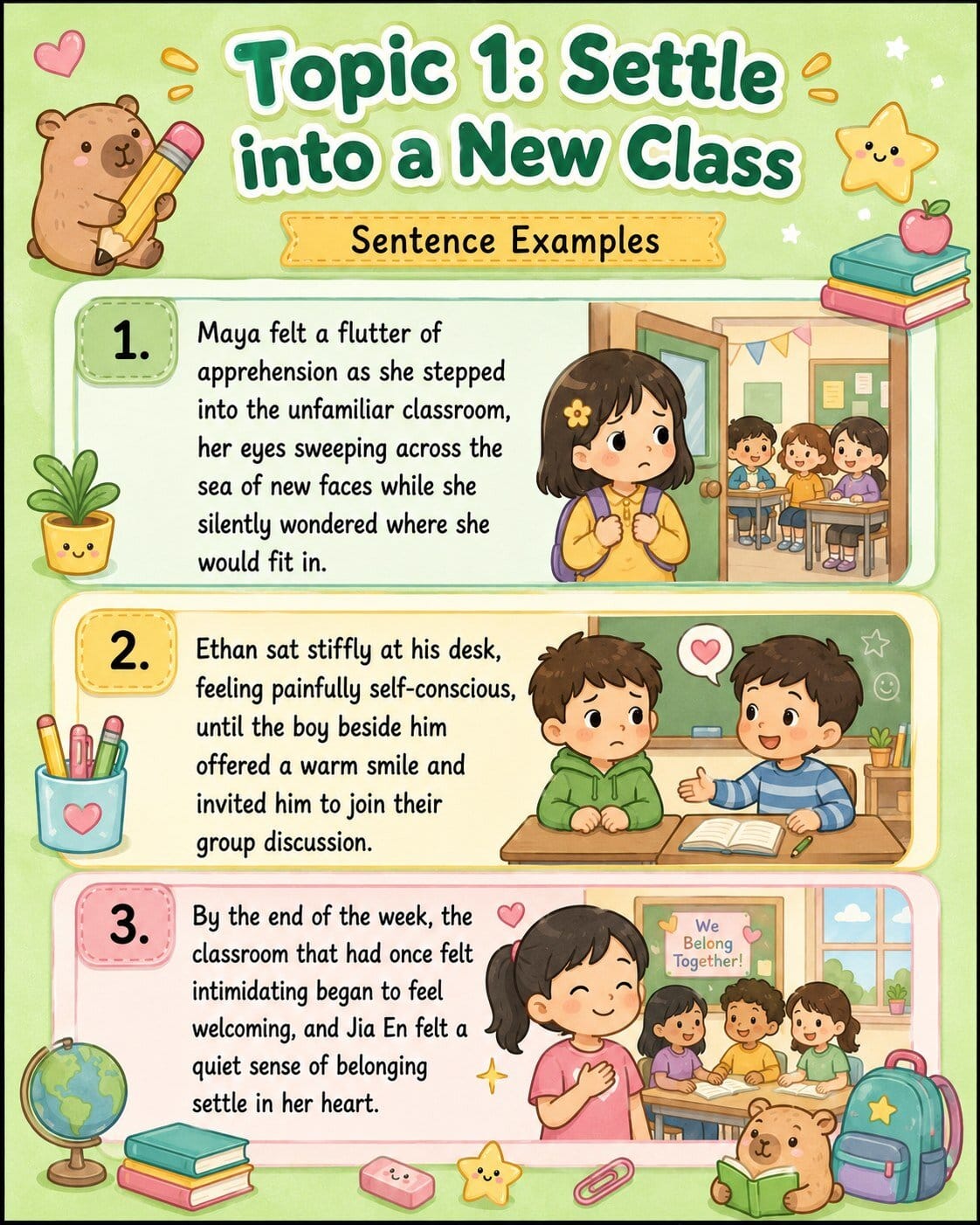
Starting in a new class can be both exciting and intimidating. A student may feel shy, nervous or unsure of where he or she belongs. This topic is useful for stories about first days, new schools, unfamiliar classmates and gradually gaining confidence.
Vocabulary Bank
| Useful Words | Meaning or Use |
|---|---|
| Apprehension | A feeling of worry about what may happen |
| Unfamiliar | New or not known |
| Intimidating | Frightening or making someone feel nervous |
| Self-conscious | Feeling awkward or overly aware of oneself |
| Hesitant | Unsure or slow to act |
| Reassured | Made to feel less worried |
| Belonging | A feeling of being accepted |
| Relieved | No longer worried or afraid |
Collocations
| Collocation | How to Use It |
|---|---|
| A flutter of apprehension | To describe nervousness |
| An unfamiliar classroom | To describe a new environment |
| A sea of new faces | To describe many unknown people |
| A warm smile | To show friendliness |
| A hesitant introduction | To show shyness |
| A quiet sense of belonging | To show growing comfort |
Short Useful Phrases
| Phrase Bank |
|---|
| felt painfully self-conscious |
| wondered where she would fit in |
| offered a warm smile |
| began to feel less intimidating |
| a quiet sense of belonging settled in his heart |
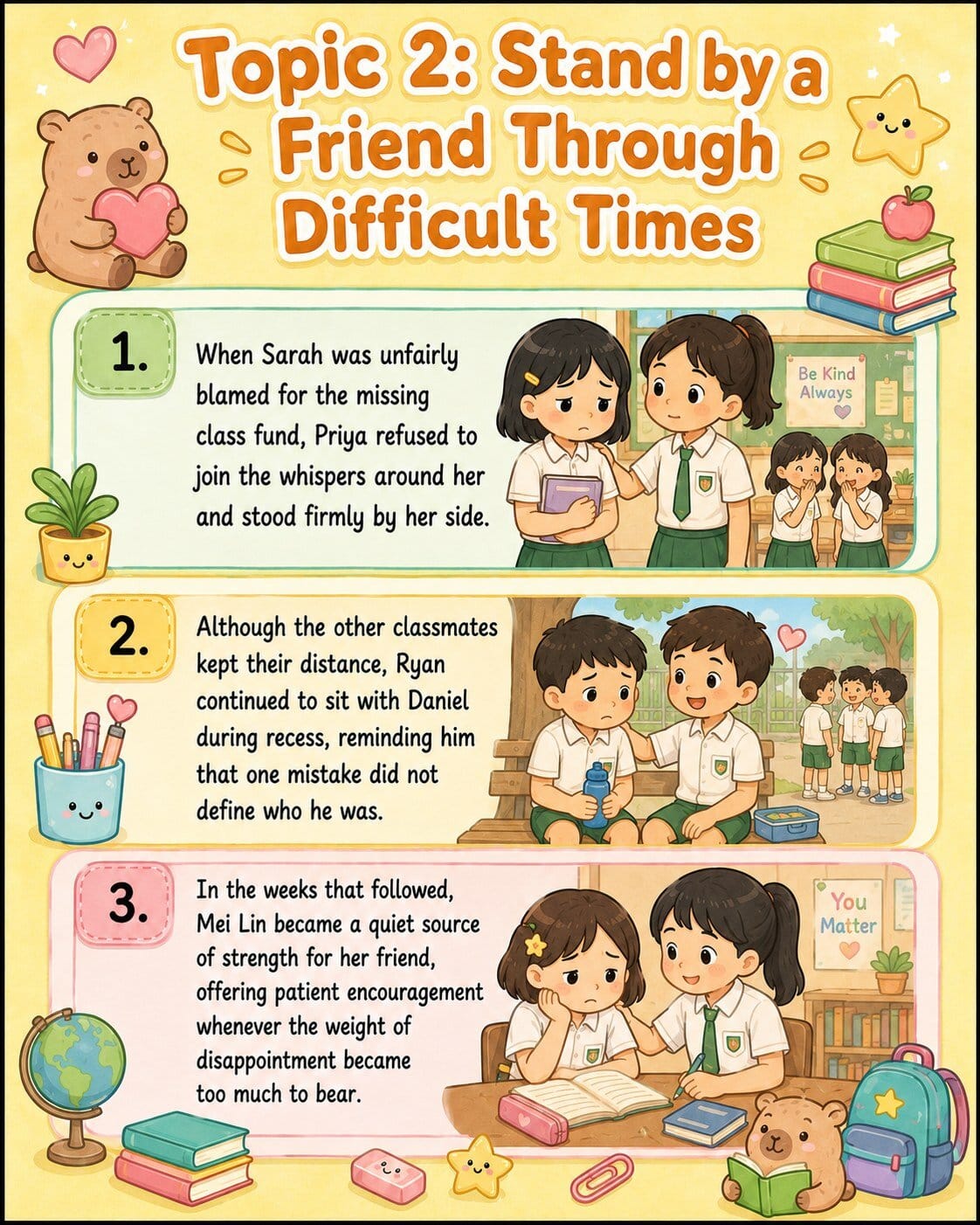
Friendship is often tested when someone is misunderstood, blamed or left out. This topic helps students write about loyalty, kindness and courage. It is especially useful when the story involves a character choosing to support a friend instead of following the crowd.
Vocabulary Bank
| Useful Words | Meaning or Use |
|---|---|
| Loyal | Staying faithful to someone |
| Supportive | Giving help or encouragement |
| Isolated | Feeling alone or separated from others |
| Humiliated | Feeling ashamed or embarrassed |
| Misunderstood | Not correctly understood by others |
| Compassion | Care and concern for another person |
| Reassure | To make someone feel less worried |
| Strength | Emotional courage or support |
Collocations
| Collocation | How to Use It |
|---|---|
| Unfairly blamed | To describe someone accused wrongly |
| Whispers spread | To show gossip or rumours |
| Stood firmly by her side | To show loyalty |
| Kept their distance | To show rejection or avoidance |
| A quiet source of strength | To describe steady support |
| Patient encouragement | To show gentle, repeated support |
Short Useful Phrases
| Phrase Bank |
|---|
| refused to join the whispers |
| stood firmly by her side |
| reminded him that one mistake did not define him |
| became a quiet source of strength |
| offered patient encouragement |
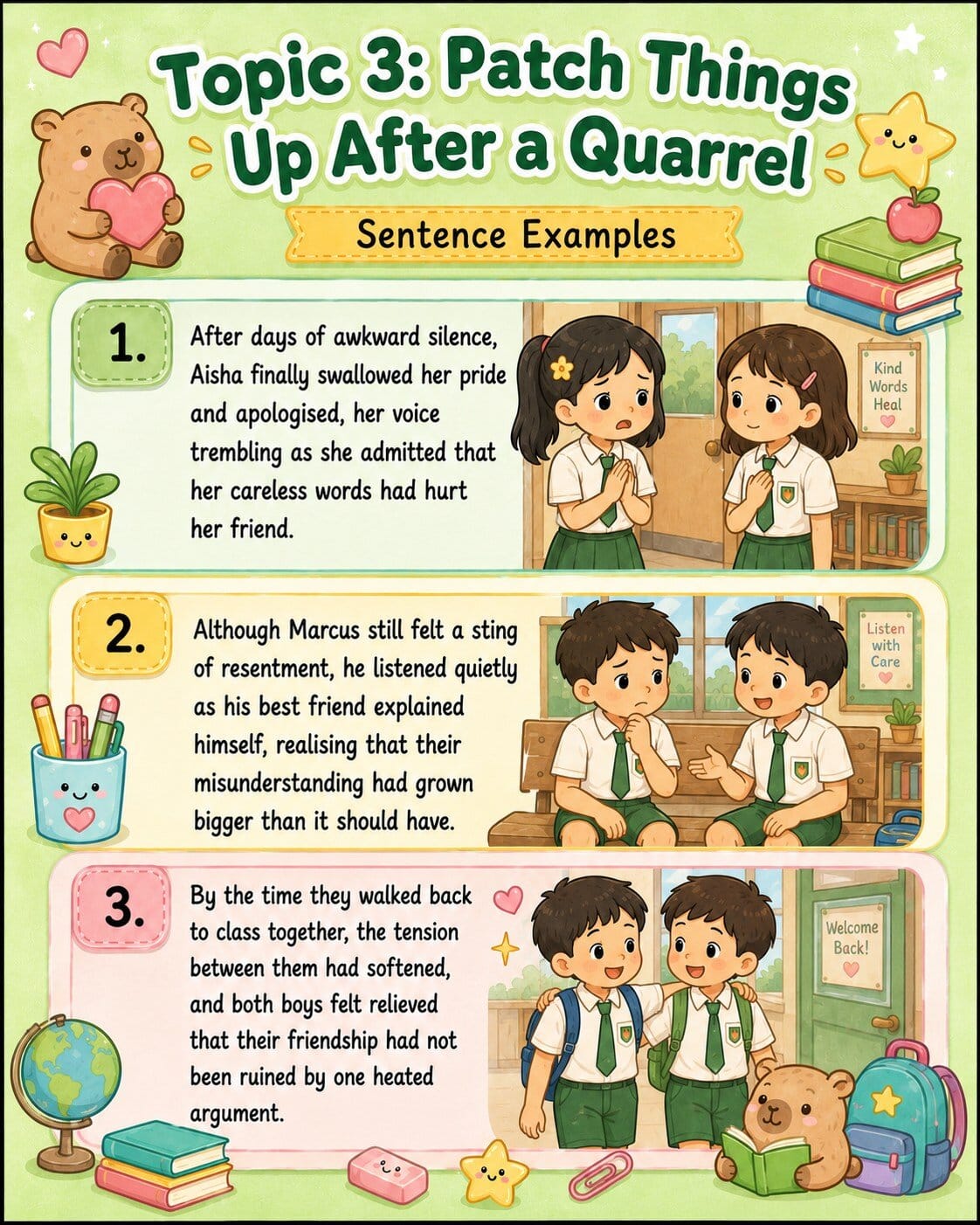
Quarrels are useful in composition writing because they create conflict. A strong story can show how pride, anger or misunderstanding damages a friendship, and how apology and forgiveness help repair it. This topic allows students to show emotional growth clearly.
Vocabulary Bank
| Useful Words | Meaning or Use |
|---|---|
| Resentment | Anger that remains after being hurt |
| Regret | Sadness over something one has done |
| Apology | Saying sorry sincerely |
| Tension | An uncomfortable feeling between people |
| Misunderstanding | A wrong idea about a situation |
| Forgiveness | Choosing not to remain angry |
| Remorseful | Feeling deeply sorry |
| Reconciled | Became friendly again after a quarrel |
Collocations
| Collocation | How to Use It |
|---|---|
| Awkward silence | To describe discomfort after a quarrel |
| Swallowed her pride | To show someone choosing to apologise |
| Her voice trembled | To show nervousness or emotion |
| A sting of resentment | To show lingering hurt |
| Listened quietly | To show patience |
| The tension softened | To show conflict easing |
Short Useful Phrases
| Phrase Bank |
|---|
| admitted that her careless words had hurt her friend |
| still felt a sting of resentment |
| listened quietly as his friend explained |
| realised the misunderstanding had grown too large |
| felt relieved that their friendship had not been ruined |
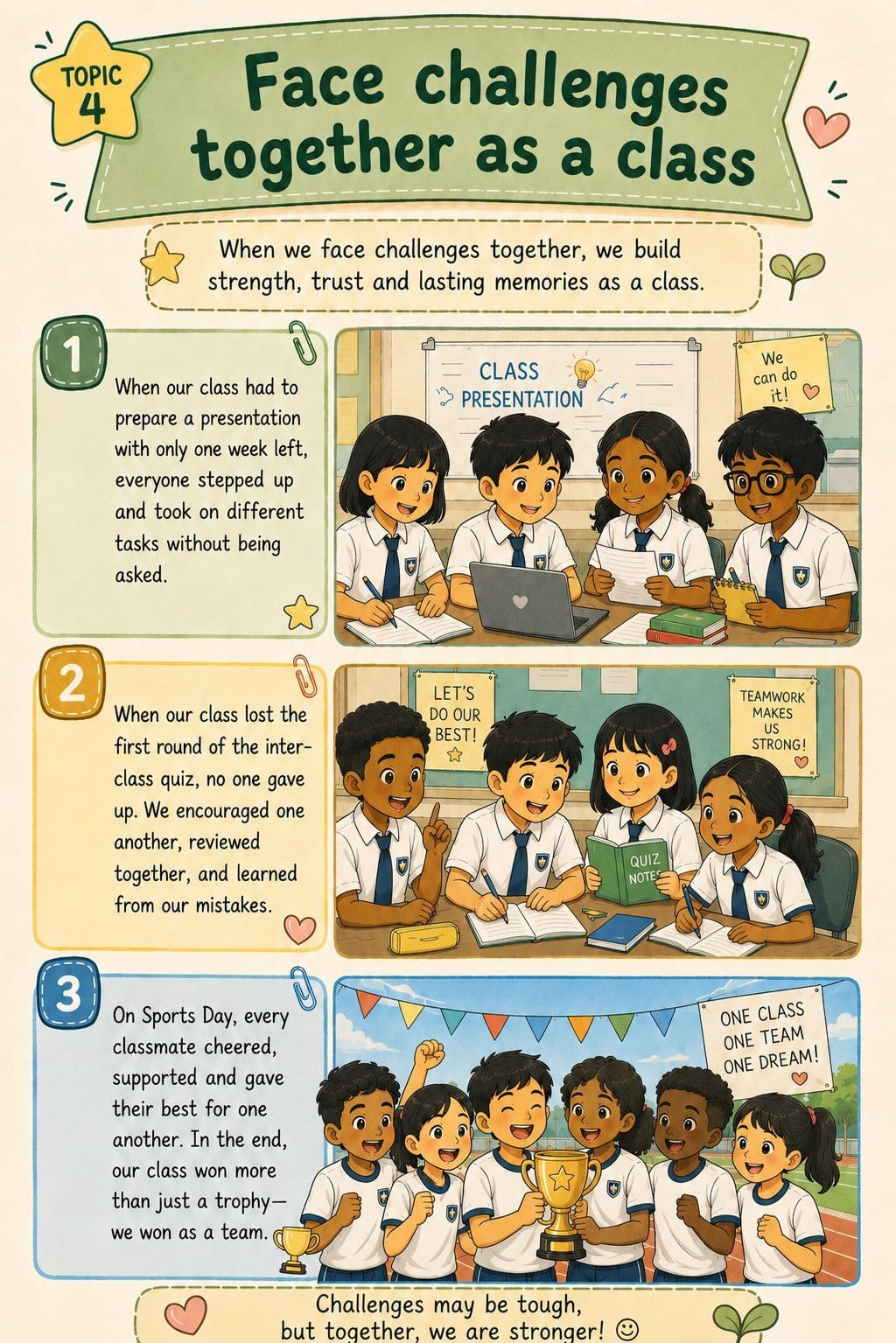
Some school-life compositions focus on teamwork rather than one individual. A class may need to prepare for a presentation, join a competition, recover from a mistake or support one another on Sports Day. This topic is excellent for showing unity, resilience and cooperation.
Vocabulary Bank
| Useful Words | Meaning or Use |
|---|---|
| Teamwork | Working together towards a goal |
| Determination | Not giving up easily |
| Resilience | The ability to recover from difficulty |
| Responsibility | Being trusted to do something properly |
| Cooperation | Working well with others |
| Encouragement | Words or actions that give confidence |
| Unity | Togetherness |
| Perseverance | Continued effort despite difficulty |
Collocations
| Collocation | How to Use It |
|---|---|
| Stepped up | To show taking responsibility |
| Divided the tasks | To show teamwork |
| Took on different roles | To show organisation |
| Encouraged one another | To show support |
| Reviewed our mistakes | To show learning from failure |
| Worked as a team | To show unity |
Short Useful Phrases
| Phrase Bank |
|---|
| everyone stepped up without being asked |
| divided the tasks fairly |
| encouraged one another to keep going |
| learned from our mistakes |
| challenges may be tough, but together we are stronger |
This topic is useful for reflective compositions, graduation stories and last-day-of-school endings. It allows students to write about memories, friendship and the bittersweet feeling of saying goodbye. Good phrases for composition writing are especially helpful here because the ending should feel warm and meaningful.
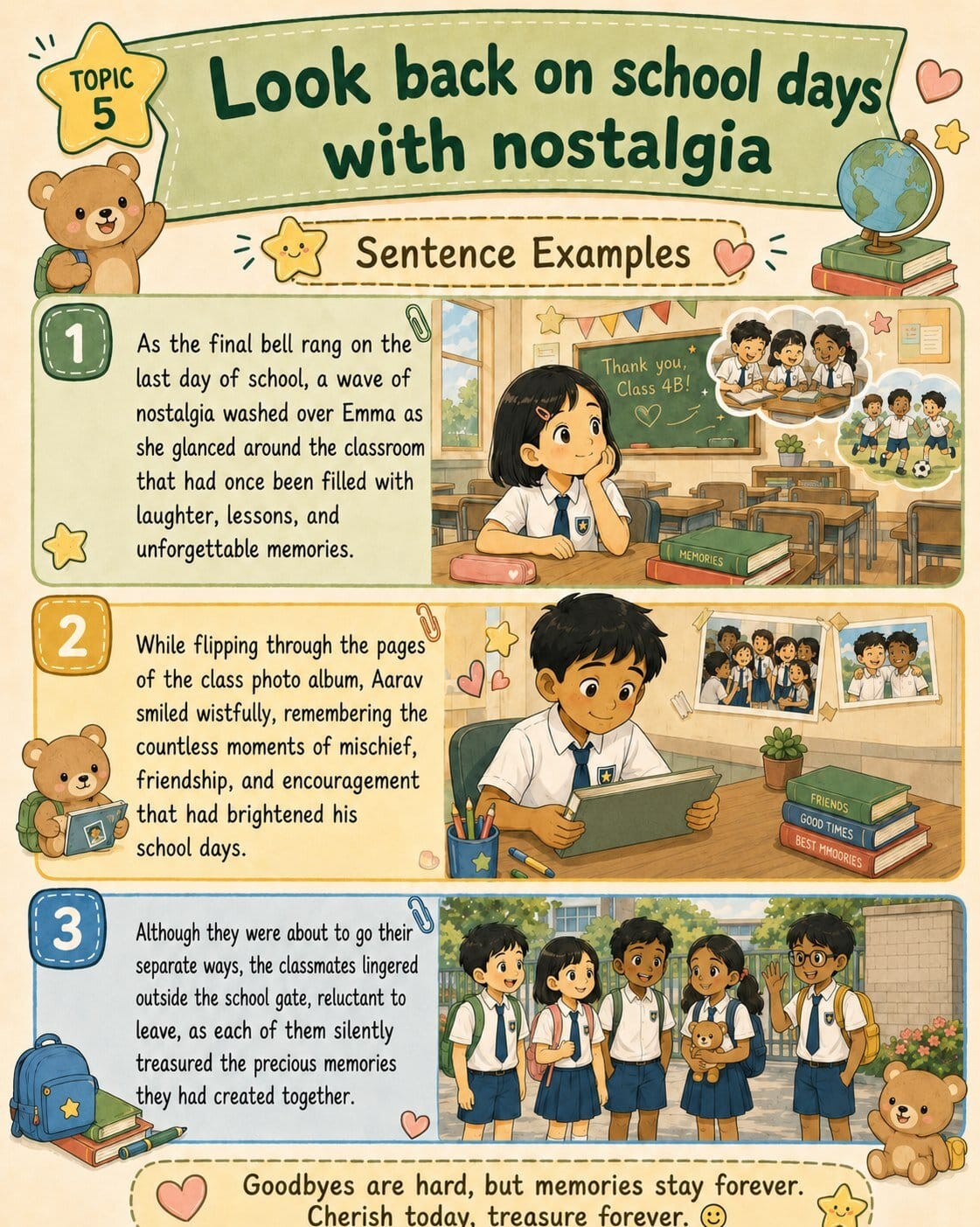
Vocabulary Bank
| Useful Words | Meaning or Use |
|---|---|
| Nostalgia | A fond feeling when remembering the past |
| Treasured | Valued deeply |
| Cherished | Loved and remembered |
| Unforgettable | Impossible to forget |
| Reluctant | Unwilling or hesitant |
| Farewell | Goodbye |
| Bittersweet | Both happy and sad |
| Grateful | Thankful |
Collocations
| Collocation | How to Use It |
|---|---|
| A wave of nostalgia | To describe sudden memories |
| The final bell rang | To mark the end of school |
| A classroom filled with laughter | To describe happy memories |
| Countless moments of mischief | To describe playful memories |
| Precious memories | To show value |
| A bittersweet goodbye | To show mixed emotions |
Short Useful Phrases
| Phrase Bank |
|---|
| a wave of nostalgia washed over her |
| smiled wistfully at the memory |
| treasured the memories they had created together |
| reluctant to leave the school gate |
| goodbyes are hard, but memories stay forever |
Choose one of the five topics and write a paragraph of 80 to 100 words.
| Topic Choices |
|---|
| 1. Settling into a new class |
| 2. Standing by a friend through difficult times |
| 3. Patching things up after a quarrel |
| 4. Facing challenges together as a class |
| 5. Looking back on school days with nostalgia |
Writing Requirements
| Requirement | Examples |
|---|---|
| Use one emotion word | apprehension, regret, relief, nostalgia |
| Use one collocation | a warm smile, awkward silence, a quiet source of strength, a wave of nostalgia |
| Use one useful phrase | swallowed her pride, stood firmly by her side, worked as a team |
| Show character growth | The character should learn, change or become more confident |
Sample Paragraph
At first, Ethan sat silently at the back of the classroom, feeling painfully self-conscious as his classmates chatted around him. The unfamiliar faces made the room feel cold and intimidating. Just as he lowered his gaze, a boy beside him offered a warm smile and invited him to join their discussion. Slowly, Ethan’s nervousness faded. By the end of the week, he no longer felt like an outsider. A quiet sense of belonging had begun to settle in his heart.
Students should not simply memorise phrases and force them into every composition. Instead, they should learn how each phrase works.
A phrase like “a flutter of apprehension” fits a nervous beginning. “Swallowed her pride” fits a quarrel or apology scene. “A wave of nostalgia washed over her” works best near a reflective ending. When students understand the purpose of each phrase, they can use vocabulary naturally and effectively.
At WRITERS AT WORK, students are taught to build strong storylines, develop believable characters and use vocabulary with purpose. Through guided writing practice, students learn how to turn everyday school-life situations into meaningful compositions.
Parents who want structured writing support can explore our English tuition for primary students, browse our free model compositions, or learn more about WRITERS AT WORK at writersatwork.com.sg.

Good phrases help students express emotions, actions and changes more clearly. They make a composition more vivid and help readers understand what the character is feeling.
Memorising useful phrases can help, but students should also understand when to use them. A phrase should match the character’s emotion and the situation in the story.
Students can start by writing short paragraphs based on one school-life topic at a time. They should use one emotion word, one collocation and one useful phrase before moving on to full compositions.

Jemmies Siew, Managing Director and Co-Founder of WRITERS AT WORK Enrichment Centre. With over 15 years of experience in education, entrepreneurship, and marketing, Jemmies has helped shape Singapore’s English enrichment landscape through her vision for transformative learning.
She is passionate about connecting real-world issues with language learning, helping students think critically and express themselves clearly. Connect with her on LinkedIn to follow her insights on education, content marketing, and thought leadership.



Start practising and learning

