Have you ever noticed how a single word can change the entire “vibe” of a sentence? Compare “I can finish my homework” with “I must finish my homework.” One sounds like a proud boast, while the other sounds like a very serious rule! These special “helper” words are called Modal Verbs.
For students in lower primary English tuition, mastering these is the first step toward moving beyond simple sentences. Modal verbs allow us to express ability, permission, probability, and obligation, which are essential skills for excelling in English enrichment for primary school.
At WRITERS AT WORK, we believe that even the trickiest grammar rules can be mastered with the right strategy. Here are the essential tips to help your child use modal verbs like a pro.
The most important thing to remember about modal verbs is that they are incredibly stubborn. They never change their form! This is a common area where students often get tripped up.
No “-s” for Third Person: Even if the subject is “he,” “she,” or “it,” the modal verb stays the same. We say “She can sing,” never “She cans sing.”
No “-ed” for Past Tense: Modal verbs don’t use typical past tense endings. To talk about the past, we usually use a different modal (like “could” instead of “can”).
No “-ing” for Continuous Tense: You will never see a word like “musting” or “shoulding.” They simply do not exist!
When you use a modal verb, the “main” verb that follows it must always be in its simplest, barest form. Think of the modal verb as a shield that protects the main verb from changing.
Always use the Base Form: It is “I should study,” not “I should studied” or “I should studies.”
Forget the “To”: Unlike verbs like “want” or “need,” modal verbs are a “To-Free Zone.” Example: Say “I might go to the park,” instead of “I might to go to the park.”
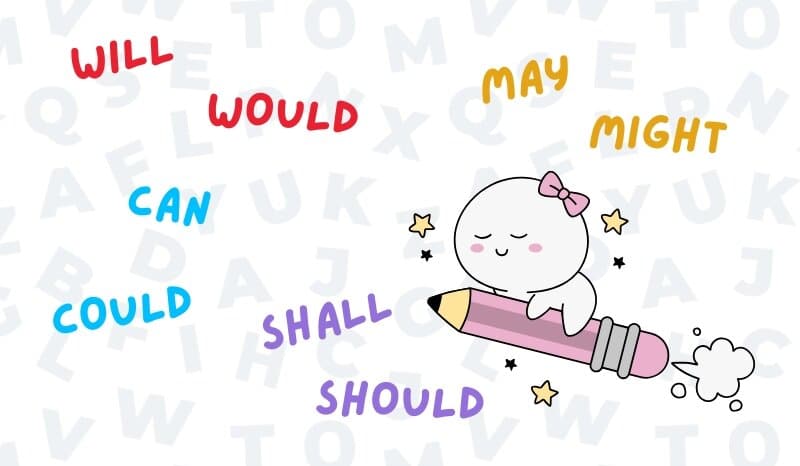
In our English enrichment for primary school, we teach students that every modal verb has a specific “superpower.” Choosing the wrong one can change your meaning entirely!
For Ability: Use Can or Could. (“I can swim across the pool!”)
For Strong Rules: Use Must. (“You must stop when the light is red.”) This shows a mandatory obligation.
For Advice: Use Should. (“You should eat more vegetables.”) This is a suggestion, not a strict command.
For Possibility: Use May or Might. (“It might rain later, so bring an umbrella.”)
For Future & Politeness: Use “Will” or “Would”. “Will” is used to show a certain future action or a firm promise. (“I will hand in my journal tomorrow.”) “Would” is used to make a request sound much more polite or to talk about a hypothetical “what if” situation. (“Would you please open the door for me?”)
Using modal verbs correctly is also about knowing how to be polite, which is a great skill for the Oral examination.
Softening your Tone: Using “Could” or “Would” instead of “Can” or “Will” makes a request sound much more respectful. Example: “Could you please pass the salt?” sounds much better to a teacher or parent than “Can you pass the salt?”
Polite Permission: “May I leave the room?” is the gold standard for asking permission in a formal classroom setting.

Grammar is the skeleton of the English language. It holds everything together! Our English tuition in Singapore focuses on building a strong foundation from a young age, ensuring that students are ready for the challenges of the PSLE and beyond. Whether you are curious about What is PSLE? or looking to master the 80 Most Common Phrasal Verbs, our expert teachers are here to help.
Check out our Unlocking Success with PSLE Oral Tips to see how these grammar rules can help your child shine in person as well as on paper. Sign up for our English programmes today and discover the difference!
To use “shall” correctly in your writing, primarily pair it with the first-person pronouns “I” or “We” to either make polite suggestions or express firm determination. When phrased as a question, such as “Shall we begin?”, it acts as a formal offer or invitation, whereas in a statement, it functions as a strong, certain promise like “I shall succeed,” which adds a sophisticated flair to your writing. While it is increasingly rare in casual conversation, sticking to these “first-person only” rules ensures your writing remains grammatically precise.
Absolutely! Just add “not” after the modal: “I cannot (can’t) go,” “You must not (mustn’t) forget.” Notice that “cannot” is usually written as one word!
The word comes from “mood.” These verbs change the “mood” or “mode” of the sentence by adding meanings like possibility or necessity!

Jemmies Siew, Managing Director and Co-Founder of WRITERS AT WORK Enrichment Centre. With over 15 years of experience in education, entrepreneurship, and marketing, Jemmies has helped shape Singapore’s English enrichment landscape through her vision for transformative learning.
She is passionate about connecting real-world issues with language learning, helping students think critically and express themselves clearly. Connect with her on LinkedIn to follow her insights on education, content marketing, and thought leadership.



Start practising and learning

