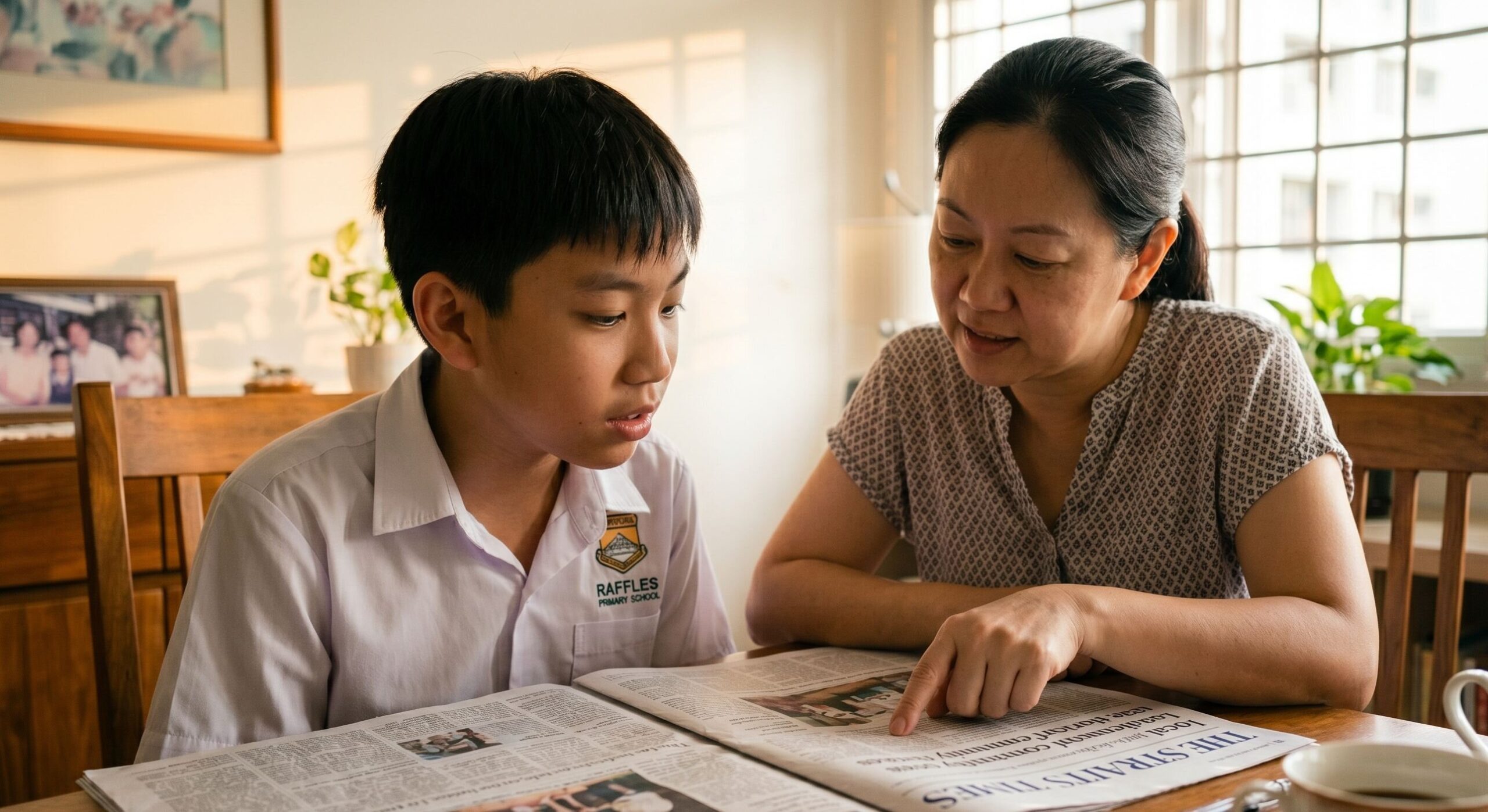
Most Singapore parents already know that conversation at home shapes a child’s English. What is less often said is that the topic of the conversation matters as much as the language of it. A child whose conversations revolve around school and homework has limited material to draw on when the oral examiner asks for an opinion on something happening in the world. A child who has discussed a Straits Times piece about hawker centres, a CNA article on screen time or a Newsround feature on a global event walks into the exam with a steady supply of ideas, real-world examples and useful vocabulary they have already practised out loud.
This post is for the parent who wants to make that habit real at home, without turning every dinner into a quiz. The research is encouraging. Done well, ten minutes of news discussion a few times a week measurably lifts vocabulary and speaking confidence over a school term. For broader context on the oral exam side, our PSLE Oral Topics 2025 Guide is a good place to start.
The first thing to understand is that the news article is the trigger, not the lesson. The language work happens in the talking afterwards. A landmark study published in ERIC found that participation in everyday dinner table conversations gives children “opportunities to acquire vocabulary, practice producing and understanding stories and explanations, acquire general knowledge, and learn how to talk in culturally appropriate ways.” A University at Buffalo study published in Social Forces went further and found that families who chat about societal issues, including current events, raise children with stronger reasoning skills and better academic performance than peers whose home talk stays casual.
None of this requires the parent to be an expert on the news. What matters is that the conversation is real, that the child is treated as a capable contributor, and that the questions push the child to express ideas in full sentences rather than one-word answers. News articles are useful precisely because they give the family fresh material to think about together, week after week, instead of cycling through the same school-and-tuition exchanges.
A short news article does three things at once that most worksheets cannot.
It introduces vocabulary in context. A child who reads the word “biodiversity” on a flashcard might recognise it next week. A child who reads “the loss of biodiversity in the South China Sea is harming coastal communities” in a real article, then discusses what that means with a parent, will use the word in conversation a month later. Research on vocabulary acquisition consistently finds that words encountered in authentic, narrative contexts are retained far better than definitions memorised in isolation. Our post on improving vocabulary to prepare for PSLE covers more practical strategies for parents who want to support this.
It builds background knowledge. A peer-reviewed study published in PMC examined newspaper reading inside families with school-age children and found a clear indirect effect on academic achievement, mediated through stronger reading motivation. The mechanism is simple. The more topics a child knows something about, the easier the next text becomes, the more interesting reading becomes, and the more willing the child is to engage with new material.
It invites real opinions. Unlike a comprehension passage, where the question always has a right answer, a news article on a community issue or a global story has room for a child to disagree, qualify, change their mind. That is the kind of speaking practice oral examiners are looking for, and it cannot be drilled from a worksheet.
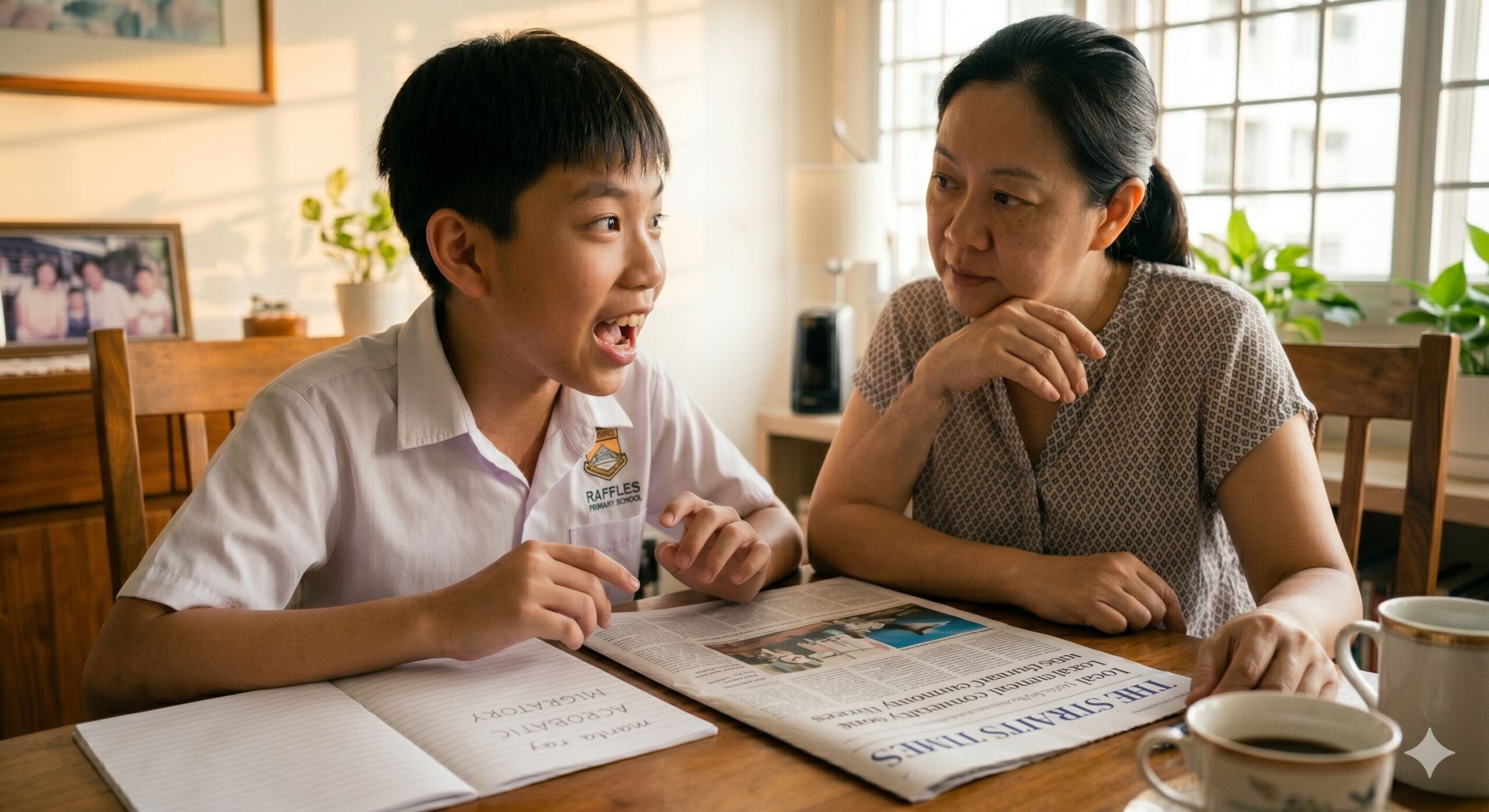
The routine that delivers most of the benefit is short and repeatable. Twenty minutes is great. Ten minutes, three times a week, is plenty.
Here is the shape of a session that works:
The closing retelling is the most underrated step. Research on home literacy environments confirms that consistency matters more than length: a habit of ten minutes three times a week beats a single weekend hour. The retelling locks in what was said and gives your child the practice of explaining ideas in their own words, which is exactly what oral examiners are listening for.
For Primary 3 to Primary 6 readers, the best sources are those designed for the age range. What’s Up is Singapore’s student-focused monthly publication, used in dozens of local primary schools and aligned with the MOE curriculum. BBC Newsround offers short, well-written news stories aimed at children aged 6 to 12. Time for Kids and Newsela both let you adjust the reading level of the same article, which is useful if your child is reading above or below their year.
The single most important shift at primary level is to ask open questions instead of closed ones. “Did you like the article?” leads to a yes or no. “What is one thing you would tell your cousin about this?” leads to a full answer with a reason. Research from the National Association for the Education of Young Children identifies open-ended questions as the strongest driver of language output in children. Parents who start their questions with “What do you think”, “Why do you suppose” or “How would you feel if” tend to get richer answers than those who ask for facts.
A short bank of question stems that work for almost any primary-level article:
Six minutes of discussion using these questions is enough to get a primary student speaking in full, organised sentences on a real-world topic. That habit, repeated across the school year, is what gives an oral student something to say in the exam room when the photograph appears.
Singapore’s GCE O-Level English oral examination was overhauled in 2023, replacing the Read Aloud component with a Planned Response format. Students now watch a short video clip, plan for ten minutes, then deliver a two-minute structured response before moving into a Spoken Interaction segment with the examiners. CNA reported that Singapore schools have stepped up public speaking and critical thinking activities to prepare students, and that the new format asks students to speak about “real-world issues.”
This is where regular news discussion at home becomes a serious asset. O-Level oral topics consistently draw from the same domains the news covers: environment, technology, education, social issues, housing, employment, community life. A secondary student who has been reading and discussing news articles weekly walks into the Planned Response with both content and opinions already shaped.
Two shifts matter at this level. The first is that secondary students should be forming opinions and defending them with evidence from the text, not just summarising. The questions to ask move from “what happened” to “what do you think and why.” The second is that students should start noticing how the news itself is constructed. Asking your teenager “Did this article only quote one side?” or “What is missing from the article that you would want to know?” builds the kind of analytical depth that oral examiners reward.
A short bank of question stems that work for almost any secondary-level article:
That last prompt is the cleanest form of practice you can do at home. Set a timer for two minutes and let your child speak without interruption. The first few attempts will be uneven. By the end of a school term, the difference in fluency is usually obvious.
Many parents stop short of having these conversations because they feel they should know the topic well enough to be the authority in the discussion. The opposite is true. The best news discussions at home happen when the parent is genuinely curious and does not have a fixed view. Research from Emory University found that families who regularly share meals and conversation, including about world events, raise children with stronger communication skills and higher self-esteem. The shared conversation itself is the language lesson. The expertise is optional.
When your child says something you disagree with, push back gently and ask for the reason. When you do not know what to make of an article, say so and ask your child what they think. That kind of honest exchange is closer to the Spoken Interaction component of the O-Level oral than any rehearsed practice answer can be.
The reason news discussion at home works is the same reason our classroom approach works. The disciplined approach that powers our composition programmes through STORYBANKING® is built on the principle that strong speaking comes from a deep bank of real content and structured practice, not from memorised templates. We apply that thinking to oral too, and our Primary 5 and Primary 6 English programmes give students weekly speaking practice with feedback, on the kinds of real-world topics that come up in both PSLE and O-Level oral assessments.
If you would like your child to practise oral with structure every week, alongside the news habit you are building at home, get in touch through our website. Our piece on reading more effectively and efficiently is also a useful companion for parents who want to build the reading half of the habit. Follow us on Instagram, Facebook and YouTube for weekly tips.
Pick the topic first, the article second. If your child loves football, start with a piece on the Premier League. If they are into K-pop, find a feature about a tour or an industry story. CNA Insider has profiled hawker stalls, scams, ageing and the lives of migrant workers in the city. The first few articles you read together should be on subjects your child already cares about. The current-affairs habit grows from there.
That is a feature, not a problem. Scan the article before you read together and pick two or three words to teach in advance. Use them in a sentence each. Then encourage your child to use them again during the discussion. Vocabulary that appears in a real article and then in a real conversation tends to stick far better than a word memorised from a list.
You can start at around Primary 1 with very short, age-appropriate sources like What’s Up or BBC Newsround. At Primary 1 to 3, the discussion will be shorter and more concrete: “What animal was the article about? What did it do?” By Primary 5 and 6, you can move into opinion questions and let your child take the lead. The earlier the habit is built, the more natural it feels by upper primary.
Yes. The discussion does not have to happen entirely in English. The most useful part is the engagement with the article, the curiosity about the topic, and the practice of forming and expressing an opinion. Even if some of the conversation is in another language, your child is still building the background knowledge that makes English oral answers stronger. Where you can, pull out two or three English phrases from the article and use them in the discussion, even within a mixed-language exchange.

Agnes Ng, Co-Founder and Teaching & Curriculum Director of WRITERS AT WORK. An NUS Honours graduate and published author with over 30 years of experience, Agnes has been the architect of the organization’s student-centric curricula since 2012.
Dedicated to teacher mentorship and academic excellence, she has guided hundreds of students to achieve outstanding results. Her expertise and commitment to high-quality education remain the cornerstone of WRITERS AT WORK’s success in empowering every learner.



Start practising and learning

