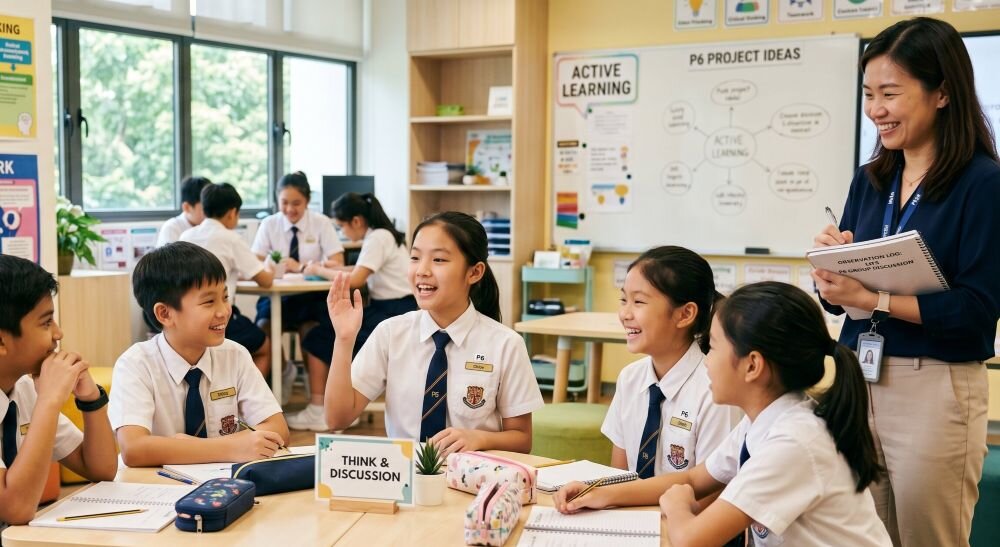
The Singapore parent who watches their child freeze during oral practice usually notices the same thing. The English is not the problem. The vocabulary is there. The grammar is mostly correct. The fluency in casual conversation is fine. What stops their child is a different thing. It is the feeling of being watched, the fear of saying something wrong in front of a roomful of classmates, the worry that the next sentence will come out shaky.
That fear is the real opponent in any oral examination, and worksheets cannot fix it. Practising alone in a bedroom does not fix it either. The most reliable way to build genuine speaking confidence is to give a child many low-stakes turns in front of a small, friendly group of peers, with a skilled teacher guiding the room. The research on this is unusually consistent, and so are the results on the ground. This post explains why small group learning works and how parents and educators in Singapore can put it to use, with the research evidence to back the argument. For broader context on the oral exam, our PSLE Oral Topics 2025 Guide is a useful starting point.
Most students who hesitate to speak in English are not held back by lack of knowledge. They are held back by something quieter and harder to fix.
The first cause is the fear of judgement. A child who has been laughed at once in front of the class for getting a word wrong will hesitate the next ten times, even if no one would actually laugh again. The brain remembers the social cost.
The second cause is simple arithmetic. In a Singapore primary classroom of 30 to 40 students, no individual child gets more than a minute or two of speaking time in any given lesson. Speaking confidence is built through repetition. The classroom format, by design, does not deliver enough of it.
The third cause is the way these first two compound over time. A child who has rarely spoken in class develops a quiet, settled belief that they are not good at speaking. The belief becomes self-fulfilling. Research from the American Educational Research Journal published in 2025 confirmed that shy students are significantly less likely to raise their hands in large classes, and a long-standing line of research from ERIC has found that girls in particular speak much less than boys when the floor is managed by a teacher in front of the whole room.
The traditional classroom format, in other words, systematically disadvantages the children who would benefit most from speaking practice. The fix is not to demand they speak more often in the same setting. The fix is to change the setting.
The first thing that changes is the maths. In a group of four to six students, every child speaks in every session. Not one minute. Not two. Several minutes of real, productive talk, several times a week, across a school term. That alone produces visible gains.
The second thing that changes is what researchers call psychological safety. The cost of getting a word wrong in a group of five is not what it is in a group of thirty-five. The audience is small and familiar. A student who fumbles a sentence receives a gentle correction from a classmate or teacher and tries again. Over the weeks, the repeated experience of stumbling through a sentence and having it pass without consequence rewires the relationship a child has with speaking. The same child who used to clam up at the start of a lesson begins to put their hand up first.
The third thing that changes is the quality of the modelling. Students learn pronunciation and natural sentence rhythm by listening to other people speak well. In a small group, every student is hearing every other student answer real questions in real time. The peer-modelling effect is one of the most powerful drivers of language acquisition, and it can only happen in a setting where everyone is actively talking.
The fourth thing that changes is the feedback. A teacher in front of a class of forty cannot track each child’s speaking development with any precision. A teacher in a group of six can. They can hear the hesitation patterns. They can spot the consistent mispronunciation. They can correct it before it becomes a habit. This is the kind of targeted coaching that no one-to-one drill at home will ever replicate, because the moments that actually count are the spontaneous ones.

The evidence base for small group learning as a confidence-builder is unusually consistent across age groups and countries.
A widely cited academic study comparing small-group and whole-class discussions found that 32.9 per cent of students reported high levels of participation in small groups, against only 23.9 per cent in large-class discussions. The same study found students in small groups expressing their thoughts more freely (53 per cent vs 45 per cent) and forming stronger peer connections (42 per cent vs 30 per cent). Crucially, the gap was widest for the students who had previously been silent in larger settings.
A 2024 mixed-methods study published in Ciencia y Reflexión applied cooperative learning strategies, including Think-Pair-Share and role-play, over eight weeks with primary-level English students. Mean total speaking scores rose from 6.47 to 8.87 across the period. Pronunciation showed the largest gain because of the peer-modelling effect. Statistical analysis confirmed the results were highly significant, with p less than 0.001.
A 2025 review of speaking anxiety in polytechnic students in Malaysia found that incorporating small-group discussions and peer mentoring directly reduced performance anxiety in language learners. The research from FILOLO Language Camps, drawing on ACTFL data, concluded that 15 hours per week of small-group practice can produce the equivalent speaking progress of five weeks in a traditional classroom.
The pattern is the same across all of these studies. Smaller groups give every student more time on the floor, lower the social stakes of mistakes, and create the conditions for peer learning that a large class structurally cannot.
If you are looking for a single concrete answer to the question of what good small-group teaching looks like, here are the four activities with the strongest evidence base.
The first is Think-Pair-Share. Each student thinks privately about a question for 30 seconds, then discusses it with one partner, then shares with the small group. The graduated exposure from private thought, to one trusted listener, to a wider audience progressively desensitises students to the anxiety of speaking. A 2024 peer-reviewed study confirmed that Think-Pair-Share increased participation and improved discussion quality, with students reporting that the thinking and pairing phases were the most valuable.
The second is role-play. Students play a character rather than themselves, which lowers the personal stakes of making a linguistic error. A student playing a shopper at a hawker stall, or a young volunteer interviewing an elderly resident, is not exposing their own ego when they fumble a line. The lowered stakes free them to take risks with language they would otherwise avoid.
The third is small-group presentation, with the audience being the other four or five students in the group rather than the whole class. Research from Ontario teacher-educators found that after small-group presentations were introduced, whole-class discussions also saw a significant increase in participation. The confidence built in the small group transferred to the larger room.
The fourth is the structured conversation circle. Four to six students sit together with a prepared question or news article. There is no formal speaker; the discussion flows naturally, with each student building on the last. This is also the format that most closely mirrors the O-Level Spoken Interaction component, which since 2023 has tested the natural, conversational speaking style that small-group practice cultivates. Our piece on speaking on the spot in oral exams covers how this style of practice translates into exam performance.
You do not need a classroom to build small-group speaking into your child’s week. A handful of simple routines work surprisingly well.
The first is the family discussion round. Once or twice a week, pick a question over dinner and ask everyone at the table to share an opinion in turn. The question can be a current news story, a school issue, or something as light as which hawker stall the family should visit on Sunday. The structure matters more than the topic. Everyone speaks. Everyone listens.
The second is the sibling pair or friend pair. Two children with a picture prompt or a short article can practise the Think-Pair-Share rhythm without any adult involvement. Five minutes, twice a week, builds the kind of habit that pays off across the year.
The third is the small video-call group. If your child has two or three friends preparing for the same oral exam, organising a weekly 20-minute video call where they take turns discussing topics is one of the highest-value habits you can set up. It costs nothing and gives the children the small-group structure that no classroom worksheet can.
The fourth is the teach-back. Ask your child to teach you something they learned in school as if you were a student. This is one of the simplest and most powerful speaking exercises in the educational research, because it requires the child to organise their thinking on the fly and explain it in their own words. Our post on boosting speaking confidence goes deeper into specific techniques that build on the same habit.
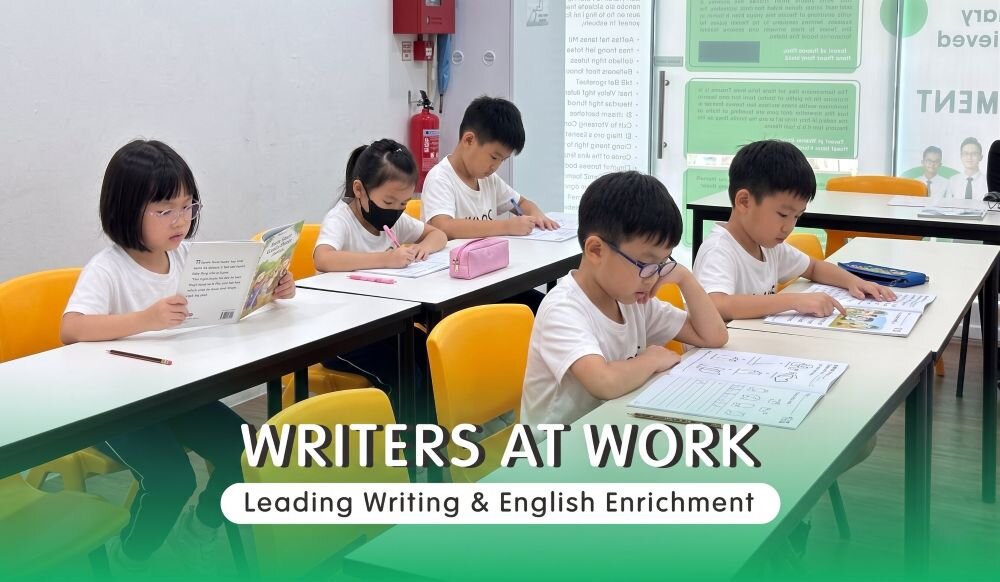
The reason small-group teaching works is also the reason we have built every WRITERS AT WORK programme around it. Our Primary 5 and Primary 6 English programmes run as small classes by design, so every child speaks in every session, every child receives targeted feedback, and every child gets the peer modelling that the large-class format cannot provide. The same disciplined approach that powers our composition work through STORYBANKING® shapes how we coach oral too. We help students observe carefully, build their own bank of personal examples for each major theme, and express opinions in a way that sounds natural rather than rehearsed.
The result is that a child who used to freeze at the question “do you think school days should be shorter” will, after a school term in our classroom, give a structured opinion, support it with a personal example, and field a follow-up question without flinching. That kind of change is what the small-group format buys you. The classroom routine and the small-group practice at home work best together.
For speaking confidence, almost always yes. One-to-one tutoring is excellent for closing specific knowledge gaps. It is less effective at building speaking confidence because it removes the peer audience that the oral exam actually replicates. A student who has only ever spoken with one adult tutor will find the exam-room environment unfamiliar. A student who has been speaking with three or four peers every week in a small group walks in already practised in the social shape of the conversation.
Four to eight students is the range with the strongest research support for speaking confidence. Below four, the peer-modelling and peer-encouragement effects weaken. Above eight, individual speaking time and feedback time both fall off sharply. Most established Singapore enrichment centres pitch class sizes in this range for exactly these reasons.
The research is unusually clear on this. Shy and introverted students are the biggest beneficiaries of small group learning, not the most disadvantaged. The 2025 research on speaking strategies among introverted students found that they thrive in structured, smaller-group settings that accommodate their reflective learning styles. The Singapore oral examination, with its small audience and conversational format, actually suits introverted learners well once those learners have built confidence through small-group practice.
Most parents notice a visible change in their child’s willingness to speak within four to six weeks of consistent small-group practice, both in class and at home. The deeper shift in speaking confidence, the kind that carries through to the exam room, builds over a full school term. Speaking is a habit, and habits take their time. But the gains compound, and a child who has put in the term of practice walks into the oral exam with a steadiness that no last-minute drilling can replicate.

Jemmies Siew, Managing Director and Co-Founder of WRITERS AT WORK Enrichment Centre. With over 15 years of experience in education, entrepreneurship, and marketing, Jemmies has helped shape Singapore’s English enrichment landscape through her vision for transformative learning.
She is passionate about connecting real-world issues with language learning, helping students think critically and express themselves clearly. Connect with her on LinkedIn to follow her insights on education, content marketing, and thought leadership.



Start practising and learning

