W@W Blog

O-Level Oral: 5 Ways to Ace Your Planned Responses

Background of an examiner. The topic reads: O-Level Oral: 5 Ways to Ace Your Planned Response
Oral examinations can be stressful. The fear of forgetting what you wanted to say, stuttering, or blanking out in front of the examiner is real. But fret not, the Planned Response segment is designed to work in your favour!

Your O-Level Oral exam consists of two parts: Planned Response and Spoken Interaction. For the Planned Response section, you will watch a one-minute video and then have 10 minutes (including the viewing time) to prepare your response to a question shown at the end. This preparation time is your secret weapon. It gives you the chance to organise your thoughts and create a strong, impressive answer.

Ready to ace this segment? Here are 5 steps that will help you score high in Planned Response.
1. Analyse the video

Yes, you are supposed to watch a video, but don’t just passively watch it. Be sure to analyse it! Take note of what seems important and identify details that could support your answer. Pay close attention to the visuals, dialogue, and any important elements that might help to strengthen your response.
If you are unsure what to look for, start with the basics: engage your five senses. What do you see? What do you hear? What might you smell, touch, or taste if you were actually in that scene? This sensory approach helps you notice details you might otherwise miss and makes your response more convincing.

Remember, you can watch the video multiple times, pause it, and rewind as needed. Use this flexibility to your advantage and don’t rush through your first viewing.

2. How to Plan Your Response

Once you have finished watching the video, it’s planning time. You don’t have much time. With only about 5 minutes left for planning, writing in full sentences is a waste of precious seconds! Use short forms and abbreviations instead. For example:

✗ = no/negative
✓ = yes/positive
& = and
bc = because
w/ = with
w/o = without
∴ = therefore/conclusion
→ = leads to/results in
↑ = increase/improve
↓ = decrease/worsen
🙂 = positive/good/happy
🙁 = negative/bad/sad
esp = especially
eg = for example
govt = government
ppl = people
info = information
impt = important
diff = different

No one else will see your notes. Not your teacher, not the examiner. These notes are purely for your eyes, so as long as you understand what you have written and can speak confidently from them, you’re good to go.

3. Have a Structure for Your Response

You absolutely need a structure for your response. Without one, you risk running out of things to say, rambling off-topic, or losing your train of thought mid-speech. A good structure keeps your ideas organised, ensures your points are well-developed, and helps you deliver a coherent response that directly addresses the question.

The PEEL Structure:

This is a reliable framework that works for most Planned Response questions:
  • Point: Start with a direct, clear response to the question. Make sure your main idea is immediately obvious to the examiner.
  • Explanation: Expand on your point by explaining it in more detail. Why do you hold this view?
  • Evidence: Support your answer with concrete evidence. This could be a fact, a statistic, a current event, or a relevant personal experience.
  • Link: Connect your point back to the question or transition smoothly to your next point.

The SCARE Structure:

This structure works particularly well for questions that require you to take a stance or present an argument (common in expository or argumentative type of oral questions):

  • Stand: Clearly state your position on the issue.
  • Counter-argument: Acknowledge an opposing viewpoint. This shows the examiner that you’ve considered multiple perspectives and aren’t just presenting a one-sided argument.
  • Rebuttal: Explain why your position is stronger than the counter-argument.
  • Link: Reinforce your original position and connect back to the question.

4. Rehearse your Response

Now that you have your structure and abbreviated notes ready, it’s time to practise your delivery. Set aside about 3 minutes for this. This step is absolutely important because what looks good in your notes doesn’t always sound good when spoken aloud. You have to speak softly to yourself and listen to how your response sounds. Does it flow naturally? Does it make sense? Are your transitions smooth?
As you practise, you might notice that some points sound awkward, don’t connect well, or just not as strong as you thought. That’s perfectly fine because this is your chance to adjust.
Most importantly, time yourself. Your response must not exceed the 2-minute time limit. Going over will cost you marks, no matter how good your content is. If you’re running over, you need to cut something. Look for:
  • Repetitive points that can be merged
  • Overly detailed explanations that can be simplified
  • Weaker arguments that can be dropped entirely
  • Unnecessary filler words

Remember, a good response is not necessarily a long one. As long as you directly answer the question, develop your ideas clearly with evidence, and stay within the time limit, you’re on track for a strong score.
5. Body Language Matters

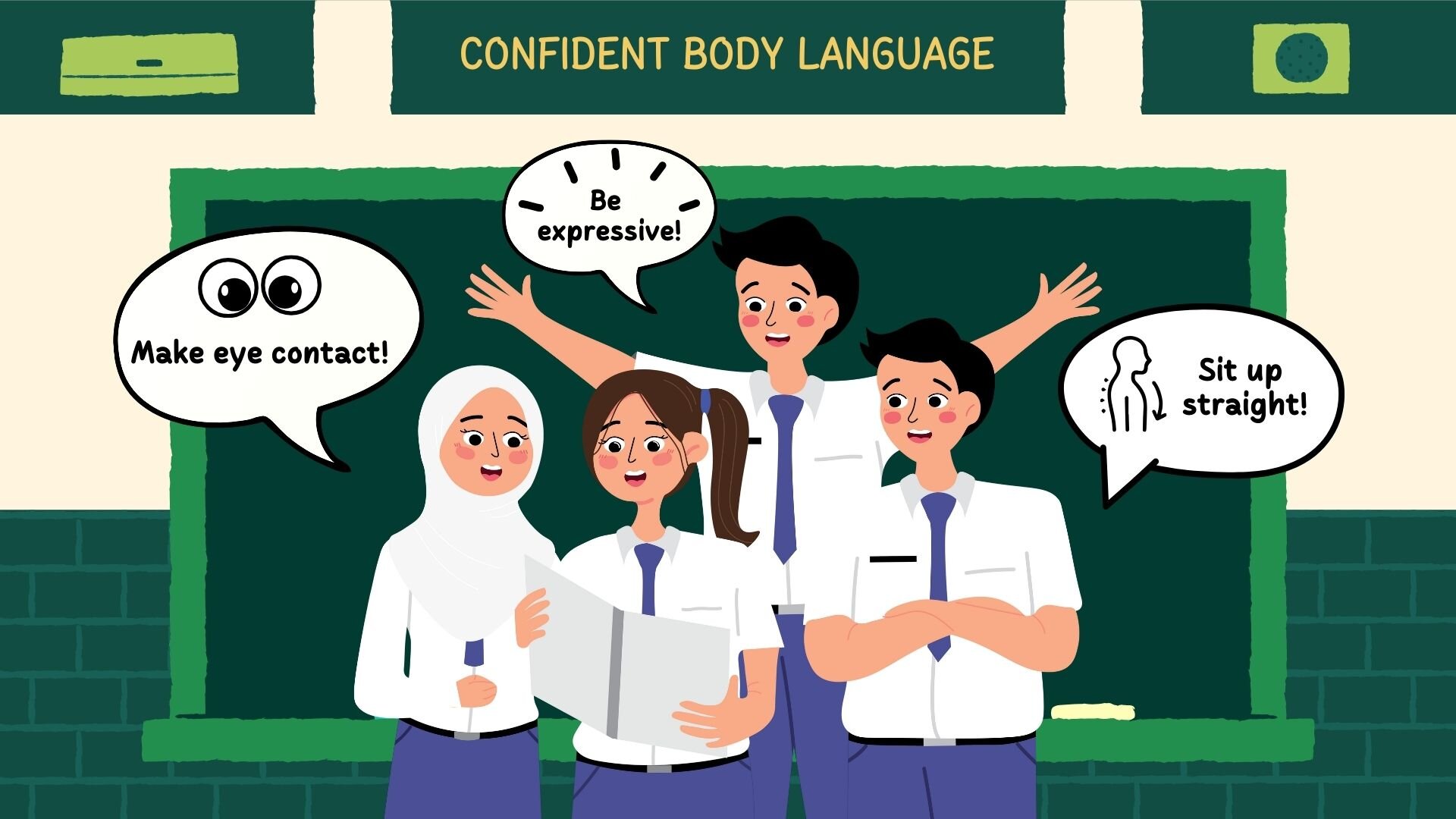
Once your 10 minutes of preparation are up, it’s showtime! Preparing for good content is only half the battle. The other half is delivering your content effectively. Examiners observe your body language, eye contact, and tone of voice, all of which contribute to a strong overall impression. They want to see you succeed, so take a deep breath and give it your best.

Present yourself confidently:

  • Posture: Sit up straight with your shoulders back. Good posture naturally projects confidence and helps you breathe better.
  • Eye contact: Maintain natural eye contact with the examiners. You don’t have to stare intensely as that would be uncomfortable for everyone. Just look at them regularly as you speak.
  • Use your notes wisely: Your notes are there to guide you, not to be read verbatim. Glance down occasionally to remind yourself of your next point, but don’t bury your face in them.

Speak Effectively:

  • Pace: Speak at a steady pace. If you find yourself speeding up, take a breath and consciously slow down.
  • Tone and expression: Vary your tone to match your content. Sound enthusiastic when discussing positive points, concerned when addressing problems, etc. Monotone delivery, even with great content, is less engaging.
  • Clarity: Enunciate clearly. Don’t mumble or let your voice trail off at the end of sentences.

Final Tips

Prior to exam day, you should familiarize yourself with common themes that frequently appear in the Planned Response section, such as technology, environment, education, health, social issues, and youth development. The more you expose yourself to these topics, the more comfortable you’ll feel discussing them under exam conditions.

One of the best ways to prepare is to review past years’ O-Level oral questions. We’ve even included model responses for the 2024 O-Level Oral here! Practicing with real exam questions helps you understand the format, identify patterns in what’s being asked, and develop your ability to think critically about various topics.

Need guidance on how to craft strong responses? We’ve got you covered. Our O-Level Oral e-book provides model responses that show you exactly how to structure and deliver excellent answers. Even better, there is an audiobook version available, so you can listen on the go whether you’re commuting, exercising, or just relaxing.

Want expert guidance? WRITERS AT WORK offers enrichment programmes specifically designed to help you excel in your O-Level oral examination. Our experienced teachers provide targeted guidance, practice opportunities, and feedback to ensure you’re fully prepared and confident on exam day. Learn more about our programmes here.

Frequently Asked Questions

Q1. Are Oral marks really important for English O-Levels?

Yes. Oral examinations make up 20% of the total English O-Level assessment, which means doing well for Oral can meaningfully improve your final grade.

Q2. Is it okay to pause while speaking?

Yes. Natural pauses are better than filler words like “um” or “err”. A brief pause shows control and helps you gather your thoughts.

Q3. Which structure is better: PEEL or SCARE?

Both work well. PEEL is ideal for explanatory or descriptive type of oral questions. SCARE is especially effective for argumentative or opinion-based questions where you need to show critical thinking.

Q4. How can I boost my confidence for oral examinations?

Confidence comes from preparation and practice. You can also go in with a simple mantra to steady your nerves and focus your thoughts.
Jemmies Siew
Article Written By

Jemmies Siew

Jemmies Siew, Managing Director and Co-Founder of WRITERS AT WORK Enrichment Centre. With over 15 years of experience in education, entrepreneurship, and marketing, Jemmies has helped shape Singapore’s English enrichment landscape through her vision for transformative learning.

She is passionate about connecting real-world issues with language learning, helping students think critically and express themselves clearly. Connect with her on LinkedIn to follow her insights on education, content marketing, and thought leadership.

Share

2026 Registration
W@W-LOGO-WRITERS-AT-WORK
Promotional Popup
Primary 4 model compositions

Unlock Our Free Resources Today

Start practising and learning
