The release of End-of-Year Examination (EOY) results often brings a mixture of emotions. Some parents are pleased to see their child’s efforts reflected in the final grade, while others may be concerned about areas where their child struggled. Regardless of the result, however, the most important question is not whether the grade was good or bad, but what it reveals about your child’s learning needs.
Here is a simple framework for turning your child’s EOY English results into a meaningful action plan.
The first and most important step is to look beyond the total score and understand exactly where the marks went.
Sit down with your child and look at the components separately:
Also, pay attention to recurring comments in marked scripts. Remarks such as “develop your ideas further”, “answer in your own words”, or “be more precise” often point to weaknesses that appear throughout your child’s work.
Once you have identified the areas where marks were lost, the next step is to understand why those marks were lost.
Many parents assume that a poor result automatically means their child lacks ability or knowledge. In reality, English performance is influenced by a combination of knowledge, technique, and habits.
🧠Knowledge gaps occur when students lack the language skills required for a task. This may include limited vocabulary, weak grammar foundations, or difficulty understanding more complex texts.
🎯Technique issues arise when students understand the content but do not know how to demonstrate their understanding effectively. For example, a student may understand a comprehension passage but struggle to explain their inference clearly.
⏰Habit-related issues are often the easiest to overlook. These include careless spelling mistakes, poor time management, incomplete answers, or a tendency to rush through questions without checking their work.
Understanding the nature of the problem is important because different problems require different solutions. A child who struggles with vocabulary needs a different improvement plan from one who frequently loses marks due to careless mistakes.

Now combine what you found in Steps 1 and 2. The same weak component needs a different fix depending on whether it’s a knowledge, technique, or habit issue. For example:
📖 Comprehension
✍️ Composition/Writing
🔤 Grammar & Vocabulary
🗣️ Oral
A good diagnosis is only useful if it turns into consistent action. Rather than an ambitious overhaul, break each fix into small, repeatable habits your child can sustain.
Keep it realistic. For example:
❌ Do 2 hours of full assessment papers every day (leads to burnout).
✅ Do 20 minutes of targeted practice, 3 times a week
When practice is consistent and focused on their specific weakness, progress follows naturally.
Set a review session about a month later to see whether the plan is working.
Keep in mind that different gaps improve at different speeds:

EOY results are not simply a measure of how well your child performed this year. They are valuable feedback that can help identify strengths, uncover weaknesses, and guide future improvement.
Rather than focusing solely on the final score, take time to understand where marks were lost, why they were lost, and what can be done next. When parents and students approach results in this way, examination papers become more than report cards — they become roadmaps for improvement.
Empower your child to achieve their academic goals with WRITERS AT WORK.
From mastering comprehension, grammar, and oral communication in our Comprehensive English Programmes to honing creative flair in our Upper Primary Pure Composition Writing Programmes, we build lasting confidence at every stage.
You can also make the most of the year-end break with our dedicated holiday programmes, giving your child a head start so they can return to school truly prepared and confident.
Drop us a message today to find out more about our programmes. Follow us on TikTok and Facebook for regular tips, resources, and a closer look at what goes on inside our classrooms.
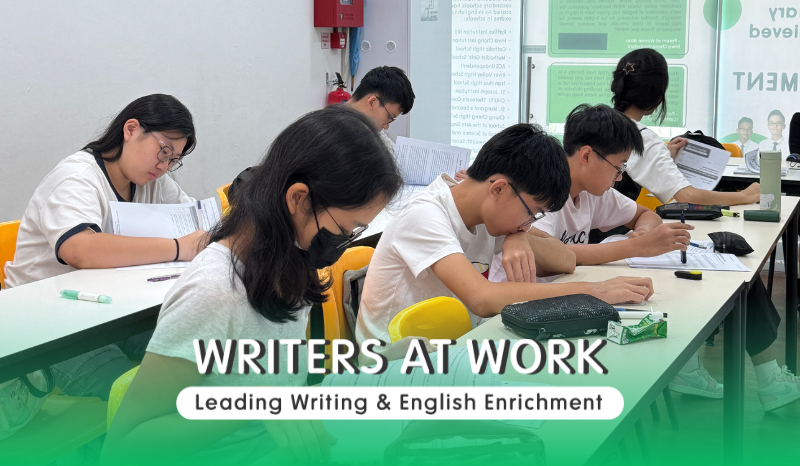
The students who improve the most are not always the ones who scored the highest in their EOY examinations. They are the ones who take the time to learn from their mistakes and work on them systematically.
If you are unsure where to begin, guidance from an experienced teacher can make the process much clearer. At WRITERS AT WORK, we help students identify their key weaknesses, develop effective examination strategies, and build the skills needed to perform confidently in both Paper 1 and Paper 2.
The EOY papers have already shown you where the gaps are. The next step is deciding what to do about them.
Join WRITERS AT WORK and start turning this year’s feedback into next year’s success. Don’t forget to follow us on TikTok and Facebook for regular exam tips, useful resources, and a closer look at what goes on inside our classrooms.
The period immediately after EOY results and during the year-end holidays is often ideal. Without the pressure of regular school assignments and examinations, students have more time to strengthen foundations, address weaknesses, and build confidence before the new academic year begins.
Quality is often more important than quantity. Consistent targeted sessions of 20 to 30 minutes, several times a week, are usually more effective.
Tuition can be helpful if your child needs additional guidance, targeted practice, or personalised feedback from a teacher.

Jemmies Siew, Managing Director and Co-Founder of WRITERS AT WORK Enrichment Centre. With over 15 years of experience in education, entrepreneurship, and marketing, Jemmies has helped shape Singapore’s English enrichment landscape through her vision for transformative learning.
She is passionate about connecting real-world issues with language learning, helping students think critically and express themselves clearly. Connect with her on LinkedIn to follow her insights on education, content marketing, and thought leadership.




Start practising and learning

