One of the most overlooked tools for making your writing feel more natural, vivid, and expressive is something you already use every day in conversation: phrasal verbs.
A phrasal verb is a verb combined with a preposition or an adverb that together create a new meaning. For example, “Give up” means something different from “give”. “Break down” means something different from “break”.
This guide covers the most common mistakes students make with phrasal verbs, and then gives you a themed reference list you can use to build your own vocabulary bank. Whether you are in primary school or secondary school, you will find something here to take into your next piece of writing.
Before we look at how to use phrasal verbs well, it helps to know where things go wrong.
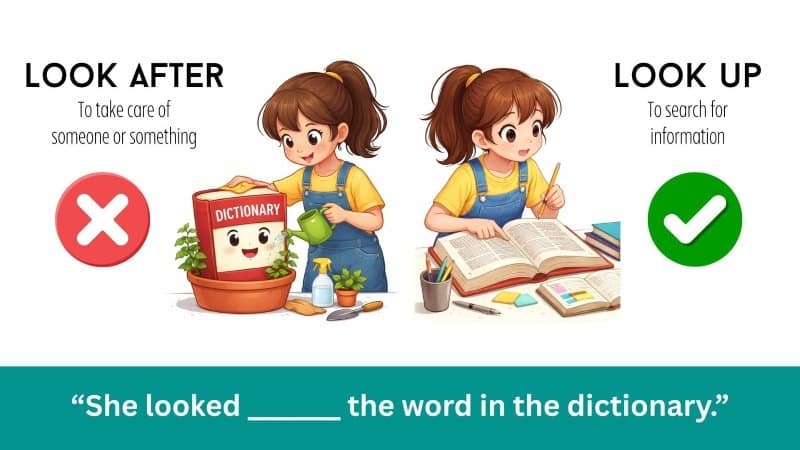
Phrasal verbs are sensitive to their prepositions. Change the preposition and you change the meaning entirely, sometimes to something that does not make sense at all.
“Put up with” means to tolerate something. “Put off” means to delay or postpone. These are two completely different meanings. Always check that the preposition matches the phrasal verb you intend.
“Give in” means to surrender or stop resisting. “Hand in” means to submit something.
Students sometimes place the object in the wrong position, which makes the sentence sound unnatural. To get the word order right, it helps to know whether a phrasal verb is separable or inseparable.
Separable phrasal verbs allow the object to sit between the verb and the particle, or after it. However, when the object is a pronoun (it, them, him, her), it must always go between the verb and the particle. You cannot place it after the particle.
Inseparable phrasal verbs must always stay together as a unit. The object (even if it is a pronoun) always comes after the full phrasal verb, never in between.
Some phrasal verbs are casual and work well in informal writing but feel out of place in formal essays. Others are neutral and can be used anywhere. Knowing which is which helps you make better choices depending on what you are writing.
“Sort out” is fine in informal writing but sounds too casual for a formal argumentative essay. In formal writing, stick to phrasal verbs that feel neutral or slightly formal.
“Figured out” works well in storytelling and personal writing, but in a formal context, a single verb like “developed” or “discovered” is more appropriate.
The best way to build your phrasal verb vocabulary is to learn them in groups rather than one by one. Here are four themes that come up often in both primary and secondary school writing. For each phrasal verb, we have given you the meaning and an example sentence so you can see how it works in context. Some phrasal verbs have more than one meaning but here, we focus on the one most relevant to the theme.
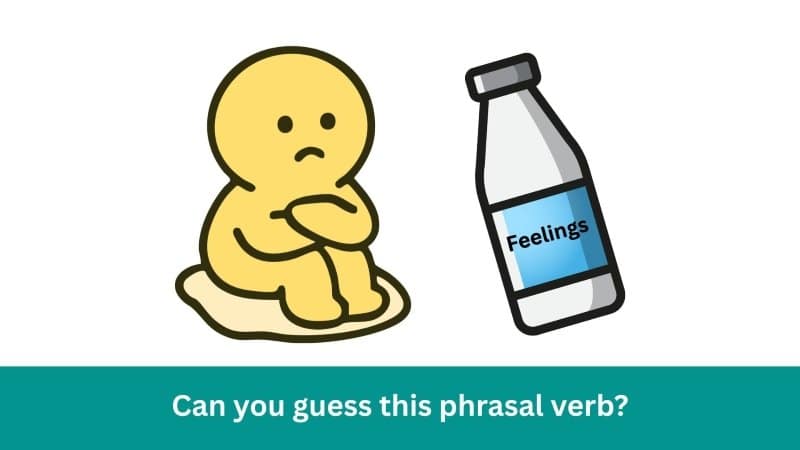
These phrasal verbs are particularly useful in narrative essays and personal reflective pieces where you need to describe how someone feels or how emotions change over time.
break down — to lose control of your emotions and start crying
e.g. He had held it together all week, but at the funeral he finally broke down.
bottle up — to keep emotions hidden/suppressed instead of expressing them
e.g. She had been bottling up her frustration for months before she finally said something.
open up — to start talking honestly about your feelings
e.g. It took him a long time to open up about what he had been going through.
get over — to recover from something difficult or upsetting
e.g. It took her weeks to get over the disappointment of not making the team.
calm down — to become less upset or angry
e.g. He took a few deep breaths and tried to calm down before responding.
brighten up — to become or feel suddenly more cheerful
e.g. Her whole face brightened up when she heard the news.
These phrasal verbs are useful across all essay types, especially when writing about choices, consequences, and how situations unfold. They help your writing feel active and purposeful.
carry out — to do a task
e.g. The students were asked to carry out a survey on their classmates’ reading habits.
come up with — to think of an idea or solution
e.g. It took the team an entire afternoon to come up with a plan everyone agreed on.
back down — to withdraw from a position or argument
e.g. She had made up her mind and was not going to back down no matter what anyone said.
follow through — to complete something you started or promised
e.g. The hardest part was not making the decision. It was following through on it.
put off — to delay doing something
e.g. She kept putting off the conversation she knew she needed to have.
take up — to start a new hobby or activity
e.g. After the exams, she decided to take up photography as a way to unwind.
go ahead — to proceed with something
e.g. Once they had the teacher’s approval, they went ahead with their plan.
These phrasal verbs are particularly useful in narrative writing, personal reflective essays, and any piece that involves other people. They help you describe interactions and relationships with more colour and precision.
fall out — to have an argument and stop being friendly
e.g. The two friends fell out over something small and did not speak for weeks.
make up — to become friendly again after an argument
e.g. By the end of the day, they had already made up and were laughing together.
look up to — to admire and respect someone
e.g. From a young age, she had always looked up to her older sister.
look down on — to think you are better than someone else
e.g. He never looked down on anyone, no matter how different they were from him.
get along with — to have a friendly relationship with someone
e.g. She got along with almost everyone in class, which was why her falling out with Mei was so surprising.
grow apart — to gradually become less close to someone over time
e.g. As they moved into different classes, the two friends slowly grew apart.
reach out — to contact someone, especially to offer or ask for help
e.g. When she heard what had happened, she reached out immediately to check in.
stand by — to support someone even when things are difficult
e.g. No matter what happened, her family always stood by her.
These phrasal verbs are especially useful in personal reflective essays and argumentative writing, where you need to describe transformation, development, or how things evolve over time.
grow up — to develop from a child into an adult, or to become more mature
e.g. Growing up in a small town, she had always dreamed of something bigger.
move on — to stop thinking about the past and focus on the future
e.g. It was not easy, but she knew she had to move on eventually.
catch up — to reach the same level as someone or something after being behind
e.g. After missing a week of school, it took her a while to catch up with the rest of the class.
turn into — to change and become something different
e.g. What started as a small misunderstanding turned into a much bigger problem.
build up — to gradually develop or increase something over time
e.g. She had built up her confidence slowly over years of practice.
break out of — to escape a habit, routine, or situation that is holding you back
e.g. Going on the exchange programme was his way of breaking out of his comfort zone.
look back on — to think about something from the past
e.g. When she looked back on that difficult year, she was surprised to feel grateful for it.
Phrasal verbs are one of the quickest ways to make your writing feel more alive. They are short, precise, and when used correctly, they do the work of much longer phrases in just two or three words. The key is learning to use them with confidence. Start by picking one theme from the list above and spending a week trying to use those phrasal verbs in your writing. You will be surprised how quickly they start to feel natural.
Want to explore more phrasal verbs? Check out our blog on the 80 Most Common Phrasal Verbs. Or, if you prefer a handy A–Z reference, our phrasal verb e-book is just what you need. It comes with clear definitions and real-context example sentences for every entry.
At WRITERS AT WORK, our English programmes help students at both primary and secondary levels build the vocabulary and skills that make their writing stand out. From phrasal verbs to figurative language, our experienced teachers guide students through the tools that make a real difference in their writing.
We offer a Comprehensive English Programme, covering reading, writing, comprehension, and oral communication, designed for students from Primary 1 to Secondary 4. This programme reinforces skills progressively and in line with school requirements. For students who want to focus specifically on composition, our Pure Composition Writing Programme is available for Primary 4 to 6, helping them write with greater confidence, creativity, and colour.
Join us and start expressing yourself more effectively in every aspect of English!
Some are and some are not. Phrasal verbs like “carry out”, “follow through”, and “build up” are neutral and work well in both formal and informal writing. Phrasal verbs like “sort out”, “figure out”, and “come up with” feel more casual and are better suited to personal writing or informal contexts. When in doubt, ask yourself whether the phrasal verb sounds too conversational for the piece you are writing.
The honest answer is that it takes exposure and practice. Reading widely helps a lot because you see phrasal verbs used correctly in context over and over again. Writing them out in sentences, rather than just memorising a list, also helps them stick. When you learn a new phrasal verb, write two or three example sentences using it straight away. That step makes a big difference to how well you retain it.
Yes. Using phrasal verbs too frequently makes your writing feel forced. The goal is to use them naturally, in the places where they genuinely improve the sentence. If a simpler verb works just as well, use it.

Agnes Ng, Co-Founder and Teaching & Curriculum Director of WRITERS AT WORK. An NUS Honours graduate and published author with over 30 years of experience, Agnes has been the architect of the organization’s student-centric curricula since 2012.
Dedicated to teacher mentorship and academic excellence, she has guided hundreds of students to achieve outstanding results. Her expertise and commitment to high-quality education remain the cornerstone of WRITERS AT WORK’s success in empowering every learner.



Start practising and learning

