
The O Level English Oral exam is not just about “speaking English”.
Many students assume that as long as they can answer the question in complete sentences, they will do well. In reality, examiners are trained to assess very specific aspects of a student’s response. These include how well ideas are developed, how clearly opinions are expressed, how confidently the student speaks, and how effectively the student engages the listener. For the Singapore-Cambridge O Level English Language syllabus, Paper 4 Oral Communication carries 30 marks and consists of two parts: Planned Response and Spoken Interaction. Candidates are expected to present ideas and opinions fluently, engage the listener, and communicate ideas clearly in discussion.
Understanding what examiners are really looking for is the first step to preparing well. In this post, we break down the key scoring components for O Level English Oral so students can speak with confidence, clarity, and purpose on exam day.
The Planned Response section requires students to watch a video clip and respond to an accompanying prompt. Students are given preparation time, then deliver a response of up to two minutes. A strong answer is not a memorised speech. It is a clear, relevant, and thoughtful response that shows the student can organise ideas under exam pressure.
Examiners look closely at how well students develop and organise their ideas.
A weak response may sound like this:
A stronger response would include:
Students should avoid going off-track. Examiners are not looking for the longest answer. They are looking for a focused and well-developed response.
The next important area is expression. This refers to how well students use language to communicate their thoughts. Examiners assess whether students can use appropriate vocabulary, varied sentence structures, and clear phrasing. Students do not need to use extremely difficult words, but they should avoid repeating basic words such as “good”, “bad”, “nice”, and “very”.
Instead of saying:
A stronger answer would be:
Students should also use connectors to make their response sound more organised. Useful connectors include:
These simple phrases help examiners follow the student’s thinking. They also make the response sound more mature and coherent. A good Planned Response is usually well-considered, well-developed, and well-organised, with a wide range of well-chosen vocabulary and structures.
A high-scoring Planned Response usually has four qualities. First, the student states an opinion clearly. There is no confusion about where the student stands. Second, the student supports the opinion with relevant examples. These may come from personal experience, school life, current issues, or observations of society. Third, the student develops ideas instead of listing them. For example, rather than saying “teamwork is important”, the student explains why teamwork matters and how it affects people. Fourth, the student ends with a reflection. A final sentence such as “This is why I believe students should be encouraged to participate actively, not just for grades but for personal growth” gives the response a sense of closure. This is what separates a basic answer from a thoughtful one.
Even if the content is strong, delivery matters. In O Level English Oral, examiners are also listening to how the student sounds. This includes pronunciation, fluency, and intonation. A student who speaks clearly and naturally is easier to understand and more engaging to listen to.
Good pronunciation means words are clear, accurate, and easy to understand. Fluency means the student can speak smoothly without too many awkward pauses. It is normal to pause briefly to think, but long silences, repeated fillers, or restarting too often may weaken the impression. Intonation refers to the rise and fall of the voice. This is what prevents a response from sounding flat or robotic. For example, the sentence “That really changed my perspective” should sound reflective and sincere, not rushed or memorised. To improve delivery, students should practise reading and speaking aloud regularly. They can record themselves and listen for unclear words, rushed pacing, or unnatural pauses.
In the syllabus band descriptors, the highest delivery band requires fluent delivery, clear pronunciation, and varied intonation used to good effect.
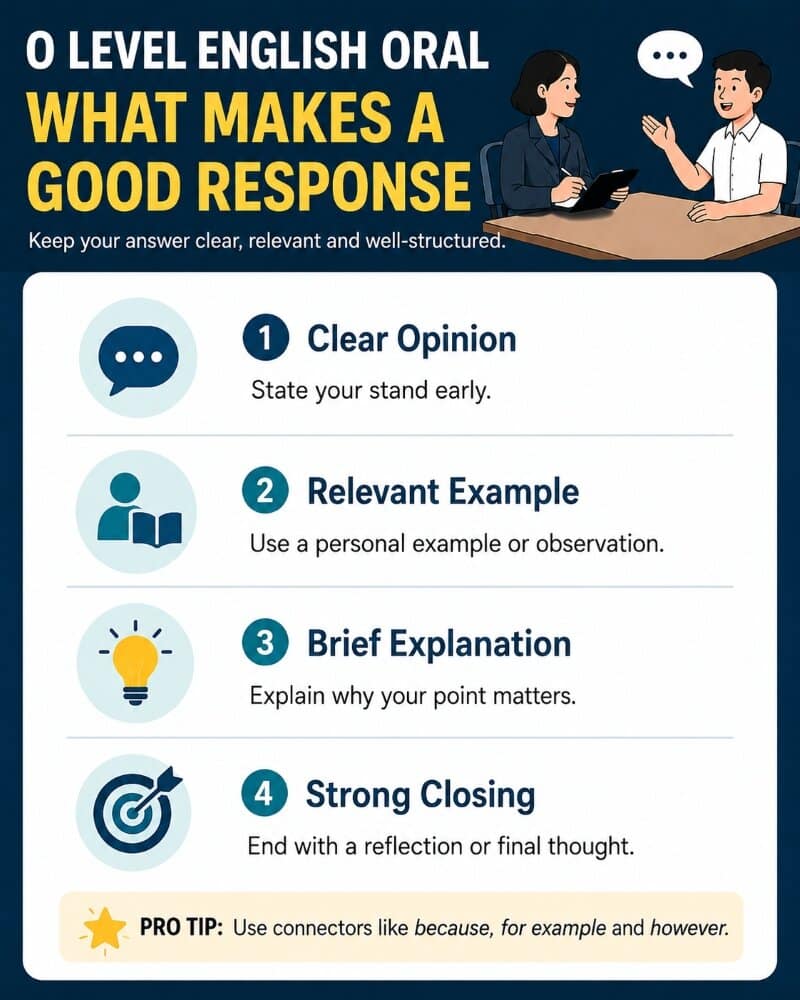
Audience awareness is not always the first thing students think about, but it can make a big difference. The Oral exam is a conversation with real examiners, not a private speech to the wall. Students should sound like they are speaking to a person, not reciting a script. This means students should make appropriate eye contact, sit upright, and use open body language. Natural hand gestures are fine, but they should not be distracting. A student who looks down throughout the response may appear unsure, even if the content is good.
Audience awareness also means adjusting tone. For example, if the topic is about helping the elderly, the student should sound thoughtful and respectful. If the topic is about school activities, the tone can be more energetic and enthusiastic. The goal is to engage the examiner.
After Planned Response, students move into Spoken Interaction. This is a discussion with the examiners on a topic broadly related to the video clip. This section tests whether students can respond thoughtfully and sustain a conversation. A common mistake is giving answers that are too short.
For example:
This answer is too brief. A stronger response would be:
To perform well, students should listen carefully, answer the question directly, and expand their ideas. Strong candidates may even move beyond the prompts by adding thoughtful observations or relevant examples.
At WRITERS AT WORK, we train students to approach O Level English Oral with structure, clarity, and confidence. Oral preparation is not about memorising model answers. It is about learning how to think quickly, organise ideas, speak naturally, and engage the examiner.
Our secondary English programmes help students strengthen their writing, comprehension, and oral communication skills through guided practice and teacher feedback. Students learn how to express opinions clearly, develop examples, improve vocabulary, and speak with greater confidence.
Explore our strategic English for SECONDARY Programme or read more about the new format O Level Oral exams. You can also visit WRITERS AT WORK to find out more about our regular programmes.
The O Level English Oral exam tests a student’s ability to present ideas and opinions clearly, speak fluently, and engage in a discussion. It includes Planned Response and Spoken Interaction.
Students can improve by practising structured responses, using relevant examples, expanding their vocabulary, and working on delivery. Recording oral practice and receiving teacher feedback can also help students identify weak areas.
Yes. WRITERS AT WORK helps secondary students build the skills needed for O Level English Oral, including idea development, expression, fluency, confidence, and audience awareness. Our teachers guide students through structured practice so they can respond more effectively during the exam.

Agnes Ng, Co-Founder and Teaching & Curriculum Director of WRITERS AT WORK. An NUS Honours graduate and published author with over 30 years of experience, Agnes has been the architect of the organization’s student-centric curricula since 2012.
Dedicated to teacher mentorship and academic excellence, she has guided hundreds of students to achieve outstanding results. Her expertise and commitment to high-quality education remain the cornerstone of WRITERS AT WORK’s success in empowering every learner.



Start practising and learning

