Most students think formal email writing is about sounding impressive. They reach for long sentences, elaborate phrases, and sophisticated vocabulary, hoping it will earn them marks. But O-Level examiners are not looking for impressive. They are looking for clear. This guide breaks down exactly what clarity means in formal email writing, and how to achieve it.
Clarity means expressing your ideas in a way that is direct and easy to follow. The reader should understand what you are saying immediately, without having to reread your sentences or guess your meaning.
In a formal email, clarity comes from three things:
Examiners are not looking for complicated vocabulary or elaborate phrasing. They are looking for writing that communicates effectively. If your message is unclear, even strong vocabulary will not save your score.

Many students assume that longer sentences sound more formal. In reality, they often make writing harder to understand. Avoid over-explaining simple ideas, using long phrases where short ones would work, and cramming too many ideas into one sentence.
For example:
If a sentence can be shortened without losing meaning, it should be.
Even good ideas can become unclear if they are not organised properly. Common problems include:
A formal email should maintain a consistent tone throughout (polite and respectful) Slipping into casual language mid-way through feels unprofessional. This often happens when students are writing quickly and reach for familiar, everyday expressions without realising they are out of place. Contractions like “I’ve” or “it’s”, casual phrases like “by the way” or “just wanted to say”, and informal vocabulary like “kids” or “stuff” all break the formal register.
Follow these steps:
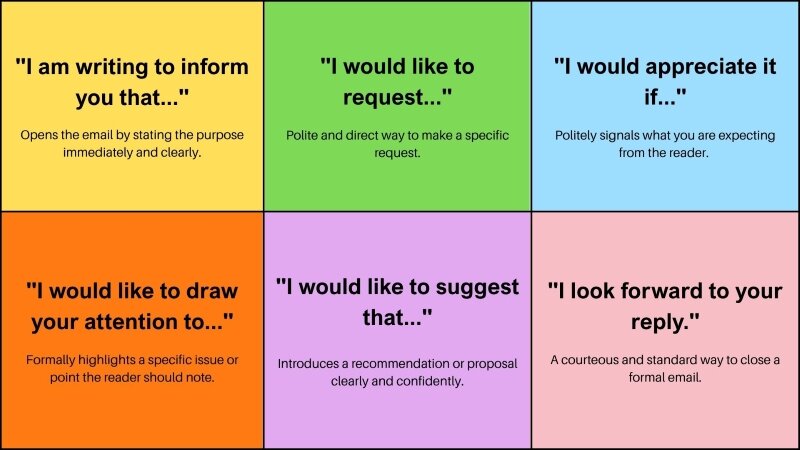
These phrases help you open paragraphs, make requests, and close your email in a way that is clear, direct, and appropriately formal. Keep them in your toolkit and use them where they fit naturally.
Clarity in a formal email is not about using the most impressive vocabulary or the longest sentences. It is about communicating your ideas in a way that is easy to understand, logically organised, and consistent in tone. Every sentence should earn its place. Every paragraph should have a clear purpose. And the reader should never have to guess at what you mean.
The good news is that writing clearly is a habit, and habits improve with deliberate practice. The more you work on keeping your sentences focused, your ideas specific, and your tone consistent, the more naturally these things will come to you, even under exam conditions.
At WRITERS AT WORK, our Comprehensive English Programme helps secondary school students develop the skills needed to write clearly and confidently in every type of Situational Writing, from formal emails to reports and articles. Our lessons focus on practical strategies, and every piece of writing is reviewed with detailed, personalised feedback so students know exactly how to improve. Sign up today and don’t forget to follow us on TikTok and Facebook for more English tips and exam strategies!

For the salutation, use “Dear Mr/Ms [Surname]” if you know the recipient’s name, or “Dear Sir/Madam” if you do not.
Being concise means saying exactly what needs to be said without unnecessary words. Being too brief means leaving out information that the reader needs. The test is whether the reader has everything they need to understand your message and take action. If they do, the length is right. If they are left with unanswered questions, more detail is needed.
Yes. Words like “Firstly”, “Furthermore”, “However”, and “Finally” help organise your ideas and improve clarity when used appropriately.

Agnes Ng, Co-Founder and Teaching & Curriculum Director of WRITERS AT WORK. An NUS Honours graduate and published author with over 30 years of experience, Agnes has been the architect of the organization’s student-centric curricula since 2012.
Dedicated to teacher mentorship and academic excellence, she has guided hundreds of students to achieve outstanding results. Her expertise and commitment to high-quality education remain the cornerstone of WRITERS AT WORK’s success in empowering every learner.



Start practising and learning

