W@W Blog

O-Level Situational Writing: Meeting All Task Points

Cover image of a student writing and the heading "O-Level Situational Writing: Meeting All Task Points"
Besides format and tone, the most important aspect of Situational Writing is how well you address the task points. This is what determines your content marks. If you miss even one task point, you are unlikely to score full marks.

Why Do Students Miss Task Points?

Reading too quickly

Situational Writing prompts contain a lot of parts: the scenario, the context, the format, the audience, and the bullet points. Under exam pressure, students often skim the question, focus on the most obvious requirements, and overlook subtle yet important details. Some bullet points contain more than one requirement, and if you read too fast, you only catch one of them.

Confusing length with coverage

Writing a long paragraph does not mean you have fully addressed a task point. Some students write at length about one bullet point while barely touching another. Length and coverage are not the same thing. Every point needs to be present and every point needs to be developed!

Running out of time

Students spend too long on the first few points and rush through the last one or skip it altogether. Every bullet point carries marks. An unaddressed point at the end of your response is just as costly as one missed at the beginning.

Sample Question

Here is an actual Situational Writing question (without visual stimulus) from one of our lessons. Read through it carefully before we break it down.

As part of your school’s Values-in-Action (VIA) Programme, each Secondary Four class has been given a list of environmental opportunities to volunteer in. The objectives of the VIA programme are to inculcate values and develop leadership in youth through community involvement.

As the Class Chairperson, write a formal letter to your form teacher suggesting:
  • two activities shown in the webpage printout that your class might enjoy participating
  • one non-environmental activity not shown in the printout that may interest them
  • how the three chosen activities will help your class achieve the objectives of the programme

Write your letter in clear, accurate English and in a persuasive tone that will convince your form teacher that these are the best choices.

What the scenario tells you

  • You are the Class Chairperson of a Secondary Four class. This detemines how you introduce yourself in the letter.
  • You are writing to your form teacher. This is a formal letter to someone senior within your school.
  • The purpose of the VIA programme is specifically to inculcate values and develop leadership in youth through community involvement. This is crucial for the third bullet point.
  • The tone required is persuasive as explicitly stated in the question. You must also be respectful and professional since you are writing to your form teacher.

The Bullet Points

Bullet point 1: Two activities from the printout that your class might enjoy participating in

This bullet point has two layers. You need to name two activities AND explain why your class would enjoy them. A response that names the activities without addressing enjoyment has only half-met this point.
How to choose what is enjoyable?
  • Think about interests/what might be relatable
  • Look for activities that are interactive
  • Consider novelty (unique or less common experiences tend to generate more interest)
  • Think about social value (more likely to enjoy activities that allow them to interact, bond, and work together)

Bullet point 2: One non-environmental activity not shown in the printout that may interest them

On the surface, this seems like the easiest of the three points. You just need to come up with an activity, right? Not quite.
Some students might struggle because they cannot think of a suitable idea on the spot. If this happens during the exam, think practically. What kinds of community-oriented activities do students typically organise? Fundraising drives, awareness campaigns, charity sales, and volunteer programmes at community centres are all solid options that are easy to develop with enough detail.
There is also a hidden requirement that students often miss. Students need to explain why the activity would interest your classmates. Simply naming the activity is not enough. You need to show why it would appeal to them, whether through teamwork, meaningful contribution, or opportunities to take on active roles.

Bullet point 3: How the three chosen activities will help achieve the objectives of the programme

For this task, connect back to the specific objectives stated in the question. The VIA programme exists to inculcate values and develop leadership through community involvement. So for each activity, ask yourself: What specific values does it build? What specific leadership qualities does it develop? The more precise you are, the stronger your response.

Organising a bake sale, for instance, develops leadership through planning, delegation, and coordination. Volunteering as a guide at a nature reserve builds confidence in public communication and the ability to manage groups. Interacting with beneficiaries of a cause cultivates empathy and a deeper sense of social responsibility. These are the kinds of connections that earn marks.

What Full Coverage Looks Like

Here is the difference between a response that mentions a task point and one that develops it. We will use bullet point 2 as our example.

“For the non-environmental activity, we would like to suggest a fundraising event. We think this will be a good activity for the class to take part in as it allows us to raise funds for those in need.”

This response technically mentions a non-environmental activity, but it does not name the cause, explain why it would interest the class, describe how it would be carried out, or connect it to the VIA objectives. It has met the point on the surface only.

“For the non-environmental activity, we would like to propose doing a fundraising drive for the Singapore Bone Marrow Donor Programme. [Point] The endeavour is meaningful and fulfils the objectives of the VIA to develop our compassion and leadership traits. [Justification / Link to task requirement] Many patients are urgently waiting for donors to step up to beat the 1-in-20,000 odds of finding a suitable donor, and the funds would greatly help the organisation to pay for tissue typing of new donors and the highly specialised searches that hospitals require to find suitable donors. [Elaboration with facts and figures] The class is keen to take the initiative by leading interested students in planning and organising a bake sale at St. Theresa Church to raise funds and increase public awareness about bone marrow donation. [Elaboration on execution] In doing so, we will have the opportunity to exercise teamwork as we coordinate roles and work together to run the event responsibly. [Evaluation / Benefit]

A Quick Checklist

Once you have finished your response, spend a minute with this checklist:
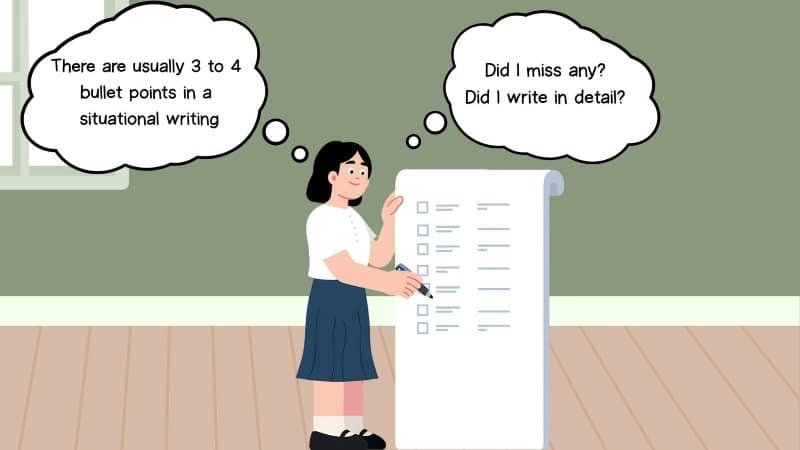
  • Have I addressed every bullet point?
  • Have I checked each bullet point for sub-requirements and covered all of them?
  • Have I developed each point with enough detail, not just mentioned it?
  • Have I written in the right format with the correct header, salutation, and sign-off?
  • Have I written to the right audience and maintained the appropriate tone throughout?

Final Thoughts

Read carefully. Plan before you write. Develop every point, not just the ones that come easily. Check your work before you move on. These are simple habits, but they make a real difference to your score.

At WRITERS AT WORK, our Comprehensive English Programme is designed to help you build exactly these habits through regular practice and honest, detailed feedback from experienced teachers. You will learn to spot every task requirement, develop your points with depth, and write with the kind of confidence that only comes from doing it over and over with the right guidance. Join us and step up your writing game!

Frequently Asked Questions (FAQs)

Q1. Do I need to address the bullet points in the same order they appear in the question?

Generally yes, because the bullet points are usually arranged in a logical sequence that mirrors the natural flow of the writing task. Following the order also makes it easier to check your work afterwards. That said, if there is a genuine reason to address them differently because it makes your response flow more naturally, that is acceptable as long as every point is covered.

Q2. How much time should I spend reading and planning before I start writing?

Aim for around five to eight minutes of reading and planning before you write anything. This sounds like a lot when you are under exam pressure, but it is the most productive time you will spend. A clear plan means you already know what goes in each paragraph before you start, which makes the writing faster and significantly reduces the chance of missing a point.

Q3. What are the situational writing formats?

Situational Writing questions usually come in formats such as formal/informal letters, emails, reports, or speeches. For a quick guide on how each format looks like, check this out.

Jemmies Siew
Article Written By

Jemmies Siew

Jemmies Siew, Managing Director and Co-Founder of WRITERS AT WORK Enrichment Centre. With over 15 years of experience in education, entrepreneurship, and marketing, Jemmies has helped shape Singapore’s English enrichment landscape through her vision for transformative learning.

She is passionate about connecting real-world issues with language learning, helping students think critically and express themselves clearly. Connect with her on LinkedIn to follow her insights on education, content marketing, and thought leadership.

Share

2026 Registration
W@W-LOGO-WRITERS-AT-WORK
Promotional Popup
Primary 4 model compositions

Unlock Our Free Resources Today

Start practising and learning