The O Level English paper is a rigorous test of your communication skills, but the GCE O Level English Oral often feels like the ultimate high-stakes performance. Whether you are tackling the Planned Response or the Spoken Interaction, the difference between a good grade and a distinction lies in your ability to remain coherent under pressure. At our English enrichment for secondary school, we see many students perform brilliantly during the 10-minute prepared speech, only to lose their footing during the spontaneous dialogue. By mastering a few real-time structural blueprints, you can learn how to organise your ideas instantly, handle curveball prompts, and approach the exam with genuine confidence.
The biggest mistake secondary school students make during the Spoken Interaction is trying to write and recite an entire multi-paragraph essay in their heads. When you treat a spontaneous conversation like a rigid written test, your brain experiences cognitive overload, leading to long, awkward silences and a complete loss of fluency.
To score well for interactive capability, you must ditch the essay framework and adopt a nimble conversational architecture. Treat the dialogue as a collaborative exchange with an intellectual peer. Instead of trying to build a complex thesis statement on the spot, focus on giving a direct, immediate answer to the examiner’s specific prompt before building out your supporting points.
When hit with a spontaneous question, your brain will naturally do one of two things: it will either go completely blank, or it will throw out ten different unorganised thoughts all at once. Rushing to state every single minor point that pops into your head results in a scattered, chaotic delivery that leaves examiners confused.
To maintain perfect structural control under pressure, implement the “Two-Idea” rule. The moment a question is asked, deliberately choose only two strong arguments to support your stance. Keep your delivery clean and punchy by focusing entirely on explaining those two core points deeply, backing them up with concrete evidence rather than drifting onto shallow tangents.
Many candidates fall into the filler trap because they feel terrified of silence. When a question catches them off guard, they immediately fill the gap with a stream of nervous mental static like “uhm,” “like,” “basically,” or “actually”, which deeply damages their language precision score.
A distinction-grade speaker knows that silence can actually be used as a tool of authority. Instead of panic-filling gaps with noise, learn to deploy strategic “thinking placeholders.” Using standard exam-ready phrases allows you to buy critical milliseconds to map out your structure while preserving your professional situational register. Phrases like: “That is a highly multi-faceted societal issue; please allow me a brief moment to gather my thoughts,” give your brain the time it needs to organise its points calmly.

If you struggle to find depth or run out of things to say mid-answer, you are likely looking at the topic through a single, narrow lens. Repeating the same idea in different words will not make your argument stronger and will actively penalise your vocabulary and expression scores.
To instantly expand your conversational flow, systematically scale your argument across a rapid “3D” perspective matrix. Train your brain to divide an issue into three expanding layers:
How you close your thought determines the final impression you leave on the oral examiners. Far too many candidates deliver an exceptionally logical argument, only to let their structural control completely dissolve at the end by trailing off into awkward phrases like “so yeah, that’s why” or “basically, that’s all I have”.
Never leave your answer hanging raw or unfinished. The moment you finish explaining your second supporting point, execute a clean, decisive relink. Use a reliable mental blueprint to explicitly tie your conclusion back to the examiner’s original question. This signals to the room that your speech was delivered with absolute intention, structural logic, and professional decorum.
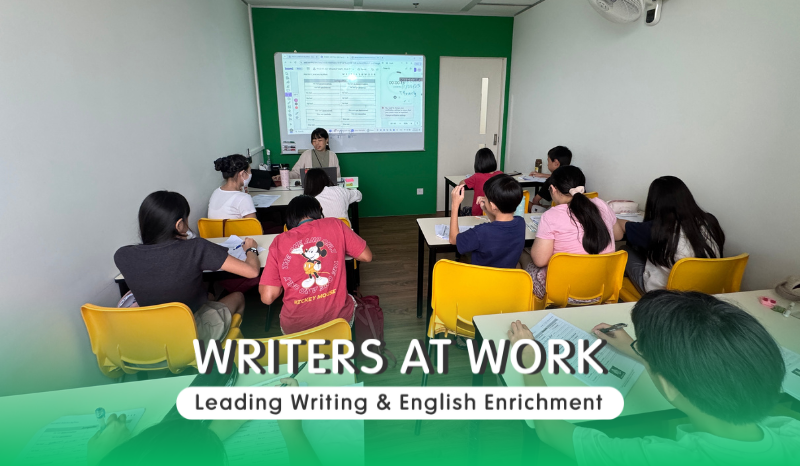
Mastering the O Level English Paper requires more than just memorisation; it demands strategic, hands-on practice under expert guidance. At WRITERS AT WORK, we empower students to transform their oral performances from hesitant to high-scoring. Whether you are looking to master the latest O-Level Oral Topics or want to sharpen your skills with a comprehensive bank of Past-Year O-Level Oral Questions, our curriculum is designed to give you a competitive edge.
To help your child trace and prepare for long-term examination patterns, we have compiled detailed analyses of previous national papers, including the 2019 O-Level Oral Question, the 2020 O-Level Oral Question, and the 2021 O-Level Oral Question. Don’t leave your results to chance. Explore our Secondary Programmes to find the right fit for your academic journey. Secure your spot today and start writing your own success story.
Yes, absolutely. Examiners heavily privilege a measured speaking pace and thoughtful structural control over rushed, erratic speech. Taking a 3 to 5-second active pause to anchor your ideas looks highly professional, provided you maintain an upright posture, keep eye contact, and use an exam-ready placeholder phrase rather than filling the silence with “uhm” or “uh”.
Do not panic or view it as a hostile interrogation. When an examiner introduces an alternative viewpoint, they are testing your critical maturity and interactive capability. Welcome the challenge by delivering a balanced critique. Acknowledge their perspective using formal discourse markers before deploying logic to explain your final stance: “While I completely understand the validity of that point, I am still of the opinion that…”
The best technique is running daily “quick-fire” spontaneity drills. Pick a random theme from a bank of common secondary school oral topics, give yourself exactly 15 seconds to select your two main ideas, and force yourself to speak continuously for one minute using the PEEL framework. Recording these drills allows you to actively monitor your fluency and catch any hidden delivery traps.
While your Planned Response should hit a target length of approximately 2 minutes (roughly 240–360 words), a Spoken Interaction answer needs to feel like a natural, substantial contribution to a dialogue. As a rule of thumb, aim to speak for about 1 minute per response. This allows you enough time to state your view directly, deliver your two well-elaborated reasons with a concrete example, and execute a clean final relink.

Agnes Ng, Co-Founder and Teaching & Curriculum Director of WRITERS AT WORK. An NUS Honours graduate and published author with over 30 years of experience, Agnes has been the architect of the organization’s student-centric curricula since 2012.
Dedicated to teacher mentorship and academic excellence, she has guided hundreds of students to achieve outstanding results. Her expertise and commitment to high-quality education remain the cornerstone of WRITERS AT WORK’s success in empowering every learner.



Start practising and learning

