Have you ever seen a “Story Mountain”? In every primary English composition, your story is like a hiker climbing up a mountain. The Climax is the very top of that mountain. It is the most exciting, scary, or important part of your story!
When you are just starting out in an English writing class for primary school, it is easy to get excited and finish this part too fast. At WRITERS AT WORK, we help students slow down and make this “peak” as exciting as possible.
These 5 tips will help you write a climax that wows your teacher!
Story Secret: Don’t tell the whole climax in one sentence.
Imagine you are a movie director. Instead of saying “He fell down,” show us everything that happened as he fell. Did he trip on a rock? Did his hands scrape the floor? Did his heart go thump-thump-thump? Stretching the moment makes it more exciting!

In a primary English composition, we want to know how the character feels at the top of the mountain.
Instead of saying “I was scared,” use Show, Don’t Tell.
Example: “My knees shook like jelly and my palms were cold and sweaty.” This helps the reader feel scared with you!
Verbs are action words. At WRITERS AT WORK, we teach students to swap “boring” words for “Super” verbs.
Using better verbs makes your writing sound much more mature.
To make your climax feel real, use your five senses.
This is a technique we start building as early as English enrichment for Primary 1.
When things are exciting, we don’t use long, rambling sentences.
Tip: Use short sentences to show speed or fear. “I stopped. I listened. Something was moving in the shadows.” This makes the reader want to keep reading!
The biggest mistake new writers make is having the problem disappear too easily.
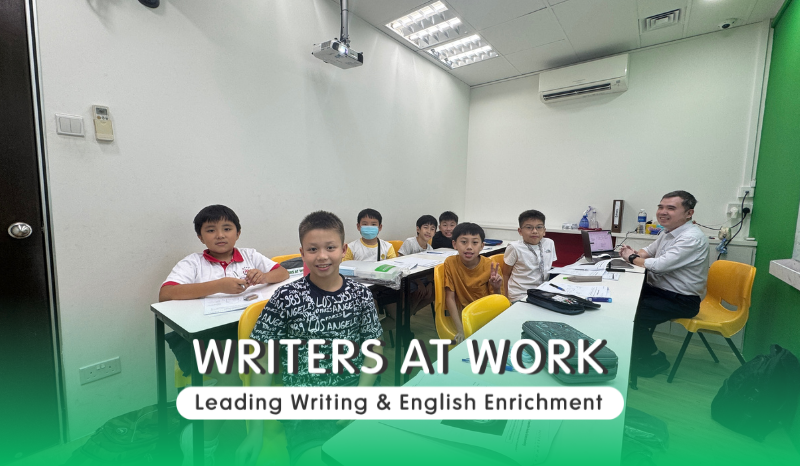
Learning to write a great climax is like learning to ride a bike. It takes practice and the right coach! At WRITERS AT WORK, we specialise in helping students from Primary 1 to Primary 6 find their unique voice.
If you want to see your child’s confidence grow, discover the Benefits of English Writing Classes in Singapore. You can also learn how to keep your writing clear with our Guide to Using Plain Language or discover how to Master Proverbs for Engaging Stories.
Join us and turn every primary English composition into a masterpiece!
Not exactly! The climax is the most exciting part, but the “Ending” (or Resolution) is where everything gets settled and the character learns a lesson.
Yes! But keep it short. A character might shout “Look out!” or whisper “I’m so sorry.” Short dialogue keeps the tension high.
Read it out loud! If you feel excited or a little nervous while reading it, you’ve done a great job.
Yes! The things you learn in P3 and P4 are the “bricks” you will use to build your Primary 5 English tuition and Primary 6 English tuition success. Starting early makes the PSLE journey much easier!

Agnes Ng, Co-Founder and Teaching & Curriculum Director of WRITERS AT WORK. An NUS Honours graduate and published author with over 30 years of experience, Agnes has been the architect of the organization’s student-centric curricula since 2012.
Dedicated to teacher mentorship and academic excellence, she has guided hundreds of students to achieve outstanding results. Her expertise and commitment to high-quality education remain the cornerstone of WRITERS AT WORK’s success in empowering every learner.



Start practising and learning

