If your story is a mountain, the Conclusion (also known as the Resolution) is the path that leads safely back down to the ground. In Composition Writing, many students work hard on the climb but then “jump” off the peak by ending too suddenly!
At WRITERS AT WORK, we teach our students that a good ending is like a neatly wrapped gift. It shouldn’t just stop; it should leave the reader feeling satisfied.
The conclusion is where you tie up all the “loose threads” of your story. It is the moment for the main character to think about what happened and how they have changed after going through some exciting events.
To make your ending shine, try to include one or more of these five elements:
What did the character finally decide to do from that moment on? This can come in the form of a vow or promise they make to themselves.
▶ Example: “With a heavy heart, I vowed to always stay aware of my surroundings so that I would never find myself in such a scary situation again.
This is a small, final action that shows the problem is over.
▶ Example: “Letting out a heavy sigh, I stepped out of the school gates and looked up at the clear blue sky, knowing that I had finally done the right thing.”
How does the character feel now? Relief? Regret? Happiness? Remember to show it, not tell it!
▶ Example: “An immense weight was lifted off my shoulders that day.”
Every story should have a lesson. It shows that your character has changed and grown into a better person!
▶ Example: “That day, I learnt that honesty is always the best policy, no matter how difficult it may seem.”
Leave the reader with a “snapshot” of the most striking scene in your story. Use sensory descriptions to make it as vivid as possible.
▶ Example: “That night, my little brother’s tear-streaked face continued to flash in my mind like a haunting photograph, his wide, disappointed eyes serving as a constant reminder of the trust I had so carelessly broken.”

▶ NO New Conflicts: Do not start a new problem. If your character just got home, don’t suddenly have their kitchen burst into flames!
▶ NO Cliffhangers: In school exams, examiners want to see that you can resolve a realistic story. Avoid ending with “To be continued…” or “Then I woke up and it was all a dream.”
▶ NO New Actions: Don’t start a whole new adventure. Keep the ending focused on the reflection.
This is a “Pro-Tip” from our English tuition specialists. To get the best marks for “Content,” use words from the topic prompt in your last paragraph.
If the topic is “A Brave Act,” make sure you use the word “brave” or “bravery” in your conclusion to show the reader exactly how the story fits the theme.
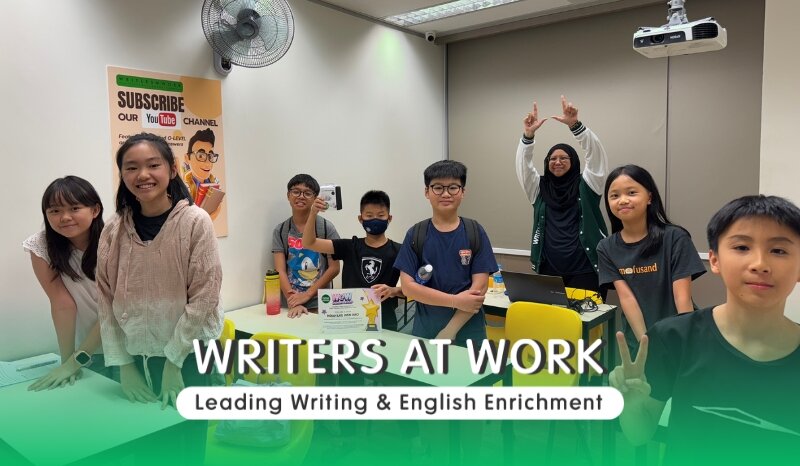
A strong conclusion leaves a lasting impression on your teacher. At WRITERS AT WORK, our English Writing Class for Primary School helps students build the “Thinking Frameworks” needed to write stories that are logical and moving from start to finish.
Ready to take your writing to the next level? Learn more about the different ways to tell a story by exploring What is Point of View? or discover how to use a Flash-Forward to show your character’s future. For parents of older students, don’t miss our Guide to Understanding the Climax.
Join WRITERS AT WORK today and learn to write endings that people will remember!
Yes! A good conclusion is usually 3 to 5 sentences long. It doesn’t need to be a whole page, but it needs to include the character’s feelings and the lesson they learnt.
It makes the reader feel like they wasted their time reading your story! Examiners prefer to see how characters handle “real” situations and learn real lessons.
Not at all! Try to practise quality over quantity. Instead of rushing to check every box, aim for a “Power Pair” or a “Terrific Trio”, which means choosing 2 or 3 elements that best fit the “heart” of your story. It is much better to have a few deeply felt reflections that leave a lasting impression than five short sentences that feel like a list!

Jemmies Siew, Managing Director and Co-Founder of WRITERS AT WORK Enrichment Centre. With over 15 years of experience in education, entrepreneurship, and marketing, Jemmies has helped shape Singapore’s English enrichment landscape through her vision for transformative learning.
She is passionate about connecting real-world issues with language learning, helping students think critically and express themselves clearly. Connect with her on LinkedIn to follow her insights on education, content marketing, and thought leadership.



Start practising and learning

