This matters because a composition is not judged only by whether it is completed. Strong composition writing depends on how clearly ideas are developed, how well they are organised, and how accurately they are expressed. A careful checking routine helps students spot weak points before they cost marks.
Content
Did the composition answer the question properly? Did the story stay focused on the task?
Organisation
Do the ideas flow clearly from beginning to end?
Language
Are the vocabulary, grammar, punctuation, and spelling accurate enough to support the meaning?
Did I use the given pictures meaningfully, if required?
Did I stay focused on the topic?
Did I include a clear main event or message?
Did I go off-topic anywhere?
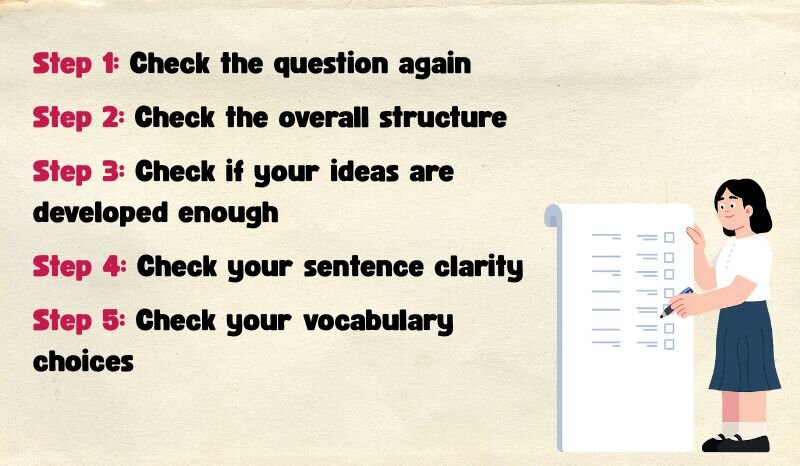
Once the composition is on topic, the next step is to look at the full story.
A clear beginning
This introduces the setting, characters, or situation.
A developed middle
This contains the main action, problem, or turning point.
A meaningful ending
This resolves the story and avoids an abrupt stop.
Does each paragraph have a purpose?
Does the story move forward logically?
Is the ending complete and not sudden?
At WRITERS AT WORK, students are taught to plan before writing and review after writing, so composition becomes a thinking process rather than a one-draft task. Parents who want more focused support can explore our Pure Composition Writing Programmes for Primary 4 to 6 students, where writing structure, development, and editing are taught in a clear and systematic way.
“I was very scared.”
“It was a fun day.”
“She was angry.”
Why was the character scared?
What made the day enjoyable?
How did the anger show in actions, words, or expressions?
After content and structure, students can move to sentence-level editing.
Incomplete sentences
Does every sentence make sense on its own?
Run-on sentences
Are too many ideas joined together with “and”, “but”, or “so”?
Repeated sentence openings
Do too many sentences begin in the same way?
Unclear pronouns
Is it always obvious who “he”, “she”, or “they” refers to?
Students do not need every sentence to sound complex. In fact, clear writing is always better than confusing writing.
Good vocabulary does not mean using the longest or fanciest words. It means choosing words that fit the meaning of the story naturally.
Did I repeat the same words too often?
Is this word suitable for the sentence?
Can I use a more precise verb or description?
For example, instead of “went quickly”, a student might write “hurried”. Instead of “said loudly”, a better choice may be “shouted”.
This is also where strong examples can be helpful. Students often improve faster when they can compare their writing with well-developed model pieces. Families who want extra support at home can explore our Model Composition Book, which gives students useful examples to study while learning how to build stronger ideas, clearer sequencing, and better expression.
Are verb tenses consistent?
Did I leave out any words?
Are full stops and commas used correctly?
Did I spell important words accurately?
Did I use capital letters where needed?
For parents who are considering more structured guidance, a Comprehensive English Programme can support children across multiple areas of the language. Programmes that cover reading, writing, comprehension, and oral communication together are especially helpful for students from Primary 1 to Secondary 4, as they reinforce skills progressively and in line with school requirements.
For upper primary students who need more focused support in writing, a Pure Composition Writing Programme for Primary 4 to 6 can help deepen skills in planning, idea development, structure, and expression. This targeted approach is particularly useful as composition demands increase and students prepare for more complex writing tasks.
Exploring programmes by level and focus allows parents to choose support that best matches their child’s needs, learning stage, and goals for the year ahead. Parents may also find our English e-books helpful for guided practice at home, alongside regular tips and learning insights shared on our TikTok and Facebook pages.

Agnes Ng, Co-Founder and Teaching & Curriculum Director of WRITERS AT WORK. An NUS Honours graduate and published author with over 30 years of experience, Agnes has been the architect of the organization’s student-centric curricula since 2012.
Dedicated to teacher mentorship and academic excellence, she has guided hundreds of students to achieve outstanding results. Her expertise and commitment to high-quality education remain the cornerstone of WRITERS AT WORK’s success in empowering every learner.



Start practising and learning

