Every year, markers read thousands of predictable scripts about returning lost wallets or performing simple “good deeds”. While those narratives are perfectly pleasant, the compositions that truly capture attention are the ones that catch the reader completely off guard.
Introducing a well-timed plot twist can elevate an ordinary piece of writing into an absolute standout. At WRITERS AT WORK, we show students that an effective twist is never just a “random accident”, but a cleverly structured surprise.
Here is your step-by-step roadmap to mastering the art of the plot twist.

A story twist is a sudden change in the direction or expected outcome of the plot. It makes the reader go, “Wait, I didn’t see that coming!” followed immediately by, “But it makes total sense now!”
A good twist must be “hidden in plain sight.” You must give the reader tiny clues (foreshadowing) early in the story.
The Trick: If your “kind stranger” is actually the school principal in disguise, mention a familiar-looking ring on their finger or a specific way they clear their throat early on.
In composition writing, a “Red Herring” is a clue that is intended to be misleading.
The Trick: Make the reader think the “villain” is the grumpy neighbour, while the real problem is actually caused by the “helpful” best friend. Lead the reader down one path so the twist hits harder!
The twist should happen at the highest point of tension.
The Trick: Use short, punchy sentences during the reveal to increase the shock factor. “I reached for the mask and pulled. The face underneath was not a stranger’s. It was my brother.”
This is the most important step we teach in our classes. Your twist must be logical.
The Trick: After the reveal, the reader should be able to look back at your story and see the clues you left. If the twist is too random (e.g., “And then aliens landed”), you will lose marks for “Cohesion.”
A twist should change how the character feels.
The Trick: Don’t just end with the surprise. Show the character’s shock, regret, or relief. This connects your twist to a meaningful “Lesson Learnt” in the conclusion.
Many students like to use something called a “Magic Fix” twist.
The Mistake: The character is about to fail an exam, but then they suddenly remember they are a secret genius and finish in five minutes.
The Fix: This feels “cheap” to a marker. A twist should be the result of a character’s choices or a secret that was hinted at from the beginning, not a lucky accident.
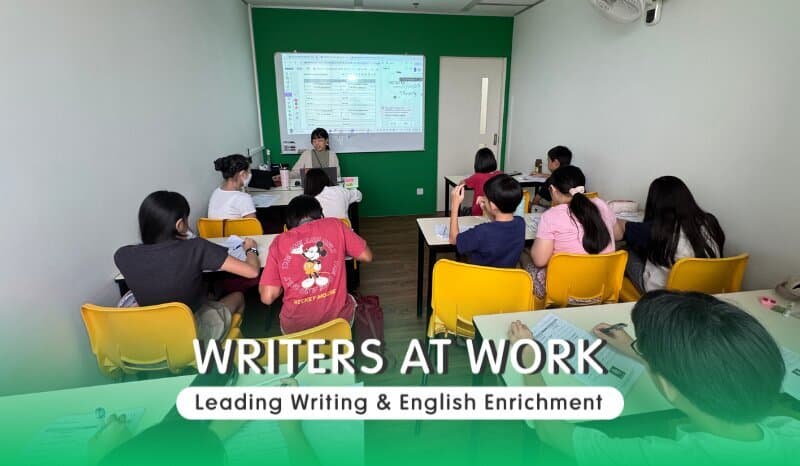
Mastering the “Story Twist” is a hallmark of a great writer. At WRITERS AT WORK, our English Composition Writing Classes in Singapore are designed to help students think like authors, moving beyond basic plots to create high-level, engaging narratives.
Ready to sharpen your storytelling tools? Start by understanding What is Point of View? to see how a narrator can hide the truth. You can also learn how to use a Flash-Forward to hint at a twist, or check out our Guide to the Climax for P5 and P6 students.
Join WRITERS AT WORK and learn how to keep your readers on the edge of their seats!
Generally, no. A plot twist works best when it happens during the climax or just before the resolution. If you reveal the surprise at the very beginning, it becomes the baseline premise of your story rather than a twist. The first few paragraphs should be used to build a normal expectation so that your sudden change of direction packs a real punch.
The secret lies in keeping it simple. A red herring should be a small, misleading clue—like a character looking nervous or holding a mysterious object—not an entirely separate, massive subplot. If your misleading path is too complicated, it will distract from the main exam topic and cause you to lose marks for organisation.
A random accident happens out of nowhere without any warning or reason (such as a sudden lightning strike solving the character’s problem). A proper story twist relies entirely on character choices, hidden motivations, or secrets that you have already dropped hints about. When a twist happens, the reader should feel a wave of realization, not confusion.
Focus your descriptions on the immediate emotions and actions rather than the identity of the secret. For example, if a character is secretly looking at a stolen item in their bag, describe the racing thump of their heartbeat and the way their eyes darted around the quiet classroom. This allows you to build intense atmosphere and tension without giving away the exact surprise too early!

Jemmies Siew, Managing Director and Co-Founder of WRITERS AT WORK Enrichment Centre. With over 15 years of experience in education, entrepreneurship, and marketing, Jemmies has helped shape Singapore’s English enrichment landscape through her vision for transformative learning.
She is passionate about connecting real-world issues with language learning, helping students think critically and express themselves clearly. Connect with her on LinkedIn to follow her insights on education, content marketing, and thought leadership.



Start practising and learning

