Many students walk into the Primary English Oral examination believing they need to memorise “good answers” to score well. Parents, too, often worry when their child freezes or gives very short responses during practice.
The truth is this: examiners are not testing memory. They are testing how well a student can think, respond, and communicate ideas clearly. Strong Primary English Oral practice focuses on adding relevant details, not rehearsed speeches.
In the stimulus-based conversation, students are assessed on how clearly they can express opinions, ideas, and experiences related to a visual stimulus. This means examiners are listening for:
A memorised answer often sounds unnatural and may not even fit the question asked. That is why students who rely on scripts tend to struggle when examiners rephrase questions.
Memorisation gives students a false sense of security. The moment the question changes slightly, they panic. Instead of listening carefully, they try to force a pre-learned answer into the conversation.
This usually leads to:
Primary English Oral practice should train students to think on their feet, not recite.
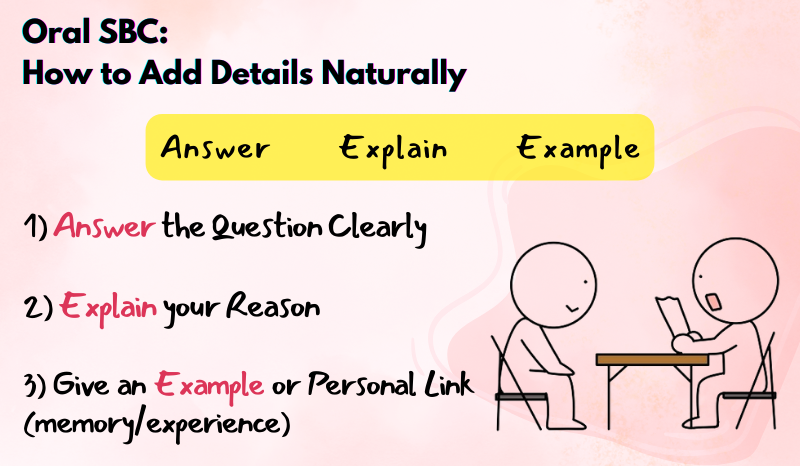
One effective strategy we teach students is a simple expansion structure. Think of it as Answer, Explain, Example.
Always start by addressing the question directly. This shows the examiner you understand what is being asked.
Example:
“Yes, I think that children should engage in sport activities in their free time”
Next, explain why you think so. This is where details start to come in.
“Recreational sports is a great way to maintain our physical and mental health.”
Finally, add a personal experience or a concrete example.
“Personally, I also enjoy physical activities like football and sepak takraw as I can stay fit while having fun with my friends.”
This structure works for almost every Primary English Oral question and removes the need to memorise fixed answers.
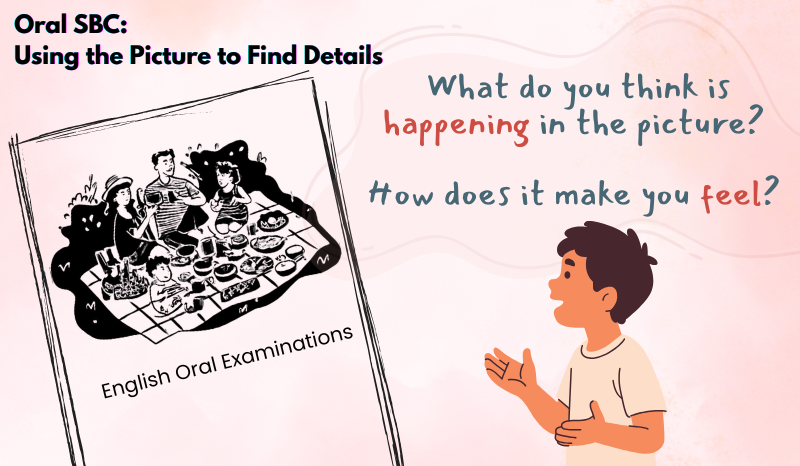
Many students run out of things to say because they do not know how to “read” the picture. A good habit during Primary English Oral practice is to scan the picture carefully and ask:
Even simple observations can become strong details when explained clearly.
One reason some students struggle with oral elaboration is that they lack language resources. Students who are exposed to good writing models often find it easier to speak with clarity and structure.
At WRITERS AT WORK, we see a strong link between oral performance and composition skills. When students learn how to develop ideas in writing, they naturally become better at explaining ideas verbally. This is why many parents exploring oral improvement also check out our Pure Composition Writing Programmes, where idea development and clarity are trained systematically.
Instead of giving students “model answers” to memorise, our teachers guide them to practise thinking aloud. Students are prompted to:
Over time, this builds confidence and flexibility. For upper primary students preparing for PSLE English Oral, exposure to well-written examples also helps. Check out our English Programme, which include regular Oral lessons that equip students with frameworks that they can utilise in their Oral examinations.
Parents play an important supporting role. Instead of asking children to memorise answers, try this:
These small habits reinforce good Primary English Oral practice without pressure.
Doing well for the Primary English Oral is not about saying impressive words or memorising scripts. It is about responding naturally, adding relevant details, and showing clear thinking.
With the right strategies and regular guided practice, students can learn to speak confidently and adapt to any question thrown their way. At WRITERS AT WORK we teach the MEET method- tested and proven to give results. We firmly believe that these skills are built, not memorised.
Focus on structured thinking. Teach your child to answer, explain, and give examples. Regular conversation practice works better than rote learning.
Useful phrases can help, but they should be flexible. Students must know how to adapt them to different questions, not recite them word for word.
We train students to develop ideas clearly through both speaking and writing. Our lessons emphasise thinking skills, language clarity, and confident expression, supported by structured programmes and strong model examples.

Agnes Ng, Co-Founder and Teaching & Curriculum Director of WRITERS AT WORK. An NUS Honours graduate and published author with over 30 years of experience, Agnes has been the architect of the organization’s student-centric curricula since 2012.
Dedicated to teacher mentorship and academic excellence, she has guided hundreds of students to achieve outstanding results. Her expertise and commitment to high-quality education remain the cornerstone of WRITERS AT WORK’s success in empowering every learner.



Start practising and learning

