A cartoon explorer sliding down a smooth rainbow back to the ground with the title “COMPOSITION TIPS: A PERFECT ENDING!”
Imagine you have just spent a lot of time climbing up a big, exciting mountain. You made it all the way to the very top! Instead of walking back down safely, would you just jump off the peak? Of course not!
In primary school composition writing, many students do exactly that. They work incredibly hard building up an exciting climax, but then they “jump” off the mountain by ending their story too suddenly with a rushed sentence like: “Then, I went home and slept.” At WRITERS AT WORK, we teach our students that a great ending should feel like a beautifully tied ribbon on a gift package. It should not just stop out of nowhere; it needs to leave your reader feeling completely satisfied.
Think of the conclusion as the “Cool Down” phase of your story. The big problem has already been solved in your climax, so now it is time to tidy up all the loose threads. The ending paragraph is a special quiet moment for your main character to pause, look back at the chaotic events that just happened, and reflect on how they have changed as a person.
To make your final paragraph shine, follow this easy step-by-step recipe to blend your reflections naturally:
Start your paragraph with a small, physical action that proves to the reader that the danger or worry is officially over. Show your character finally releasing a breath they did not know they were holding, stepping out into the fresh air, or watching a situation calm down.
Example: “Letting out a long, slow sigh of relief, I walked out of the principal’s office and into the quiet corridor.”
How does your character feel right now? Are they full of regret? Are they bursting with relief? Remember the golden rule: Show, Don’t Tell! Instead of writing, “I felt happy,” paint a picture of that emotion inside their body.
Example: “It felt as though a massive, heavy boulder had finally been lifted off my fragile shoulders.”
Every good story needs to show character growth. Your main character should look back at their choices and state the exact moral lesson they are taking away from this experience.
Example: “That afternoon, I learned the hard way that true friendship requires absolute honesty, no matter how difficult the truth might be.”
Wrap up your recipe by having your character look toward the future. What will they do differently from this exact day onward? Write this down as a serious vow or promise they make to themselves.
Example: “As I headed home, I made a silent promise to myself that I would never let peer pressure cloud my judgment ever again.”
To keep your marks high, make sure you never break these three golden rules:
NO New Disasters: Do not introduce a brand-new problem in the last paragraph. If your character just survived a scary dog chase, do not suddenly have an alien spaceship land in their backyard!
NO Lazy Dream Twists: Avoid ending your story with “Suddenly, I woke up and realized it was all a bad dream!” This makes the examiner feel like they wasted their time reading your plot, and it prevents you from showing real character growth.
NO Unresolved Cliffhangers: School compositions are meant to test your ability to complete a realistic narrative. Never write “To be continued…” because it leaves your story incomplete.
Want to secure the highest possible marks for “Content”? Our English tuition specialists always recommend dropping your specific topic keywords directly into your final paragraph.
If your composition topic is “An Unforgettable Lesson,” do not just hope the examiner guesses the link. Write the word “unforgettable” or “lesson” explicitly in your conclusion to prove that your story fits the exam theme perfectly.
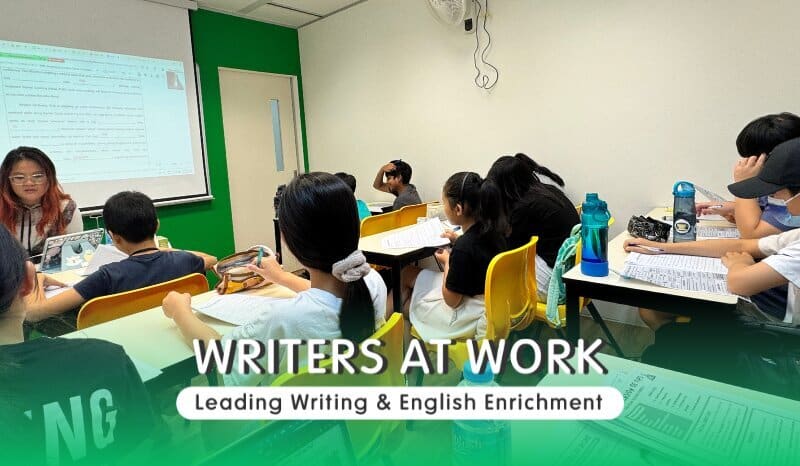
A beautiful, well-crafted ending leaves a fantastic lasting impression on your school teacher. At WRITERS AT WORK, our English Writing Class for Primary School helps students build the essential “Thinking Frameworks” needed to write stories that are logical, structured, and moving from the very first sentence to the final line.
Ready to take your primary school writing to the next level? Learn more about the different ways to look at a narrative by exploring What is Point of View? or discover how to jump forward in time to show your character’s future by reading our guide on Flash-Forward Techniques. For parents of older students preparing for the national exams, do not miss our comprehensive Guide to Understanding the Climax.
Join the WRITERS AT WORK enrichment family today and learn how to write story endings that people will remember forever!
A fantastic primary school conclusion does not need to be a whole page long. In fact, the sweet spot is usually between 3 to 5 sentences. It just needs to be long enough to cover your character’s physical relief, their internal emotions, and the lesson they learned.
Not necessarily! It is always better to focus on quality over quantity. Instead of panicking to check every single box, aim for a “Power Pair” or a “Terrific Trio”. Choose 2 or 3 steps from the recipe that best fit the emotional heart of your specific plot. It is much better to have a few deep, meaningful reflections than a long list of short sentences that feel rushed!
A conclusion can absolutely be sad or bittersweet! A story where a character loses a competition but learns the value of sportsmanship, or breaks a valuable object but learns to take responsibility, can score exceptionally well. The most important thing is that the character grows wiser from the experience.
You can play the “Mix and Match Ending Game”! Have a parent or tutor write down three random lessons (e.g., “Honesty is the best policy” or “Look before you leap”). Then, practise using our step-by-step recipe to build a 4-sentence conclusion paragraph for each lesson from scratch, focusing entirely on upgrading your action verbs and emotion words!

Jemmies Siew, Managing Director and Co-Founder of WRITERS AT WORK Enrichment Centre. With over 15 years of experience in education, entrepreneurship, and marketing, Jemmies has helped shape Singapore’s English enrichment landscape through her vision for transformative learning.
She is passionate about connecting real-world issues with language learning, helping students think critically and express themselves clearly. Connect with her on LinkedIn to follow her insights on education, content marketing, and thought leadership.



Start practising and learning

