Pronouns are some of the most frequently used words in the English language. They appear in almost every sentence, yet they are also one of the most common sources of grammar mistakes. The good news is that once you understand how they work, they are not difficult to get right. This guide covers everything you need to know: what pronouns are, the different types, the mistakes to watch out for, and practice questions to test yourself.
A pronoun is a word that takes the place of a noun. Instead of repeating a name or thing over and over, pronouns let us refer to it more efficiently and naturally.
For example, instead of writing “Sarah said Sarah was tired and Sarah needed to rest,” we write “Sarah said she was tired and she needed to rest.” The word “she” is doing the work of repeating “Sarah” each time. That is what pronouns do.
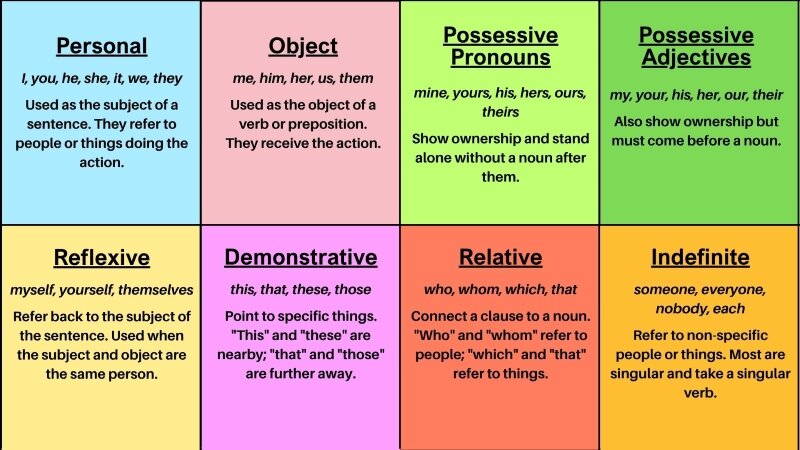
After a preposition like “to”, “for”, or “with”, always use an object pronoun (me, him, her, us, them), not a personal pronoun (I, he, she, we, they).
“My” must come before a noun. “Mine” stands alone. If there is no noun after it, use the possessive pronoun, not the possessive adjective.
Reflexive pronouns like “myself” should only be used when the subject and object refer to the same person (“I hurt myself”) or for emphasis (“I did it myself”). They should not replace “me” or “I”.
Time to put your pronoun knowledge to the test. Give these a go!
1.___ and I went to the library after school.
2. The teacher gave the award to ___ and Marcus.
3. That pencil case is not mine. It must be ___.
4. ___ book is this on the table?
5. She completed the entire project by ___.
6. ___ of the students has submitted the assignment.
7. The class was told to submit ___ assignments by Friday.
8. ___ paintings are displayed in the hall, while ___ are kept in the archive.
9. The student ___ won the competition was from our class.
10. Between you and ___, I think the answer is wrong.
1: She and I went to the library after school.
The pronoun is the subject of the sentence alongside “I”, so a personal pronoun is needed. A quick test: remove “and I” and read the sentence alone. “She went to the library” sounds right; “Her went to the library” does not.
2. The teacher gave the award to me and Marcus.
After the preposition “to”, an object pronoun (“me”) is needed. “I” is a subject pronoun and cannot follow a preposition.
3. That pencil case is not mine. It must be yours.
There is no noun after the blank, so a possessive pronoun is needed. “Yours” stands alone. “Your” is a possessive adjective and must be followed by a noun, as in “your pencil case”.
4. Whose book is this on the table?
“Whose” is the possessive form of “who” and is used to ask about ownership. “Who’s” is a contraction of “who is” and does not make sense here.
5. She completed the entire project by herself.
A reflexive pronoun is needed here because the action refers back to the subject.
6. Each of the students has submitted the assignment.
“Each” is an indefinite pronoun that is always singular and pairs with a singular verb like “has”. “All” and “many” are plural and would need “have” instead.
7. The class was told to submit their assignments by Friday.
A noun (assignments) follows, so the possessive adjective is needed, not the possessive pronoun “theirs”.
8. These paintings are displayed in the hall, while those are kept in the archive.
“These” refers to the paintings nearby (displayed in the hall), while “those” refers to the ones further away (kept in the archive).
9. The student who won the competition was from our class.
“Who” is correct here because it is the subject of the verb “won”.
10. Between you and me, I think the answer is wrong.
After a preposition like “between”, always use an object pronoun.
At WRITERS AT WORK, we help students from Primary 1 to Secondary 4 build a strong foundation in grammar, vocabulary, and composition. Whether you are working on the basics or pushing for distinction-level writing, our experienced teachers guide you through the skills that make a real difference. Join our Comprehensive English Programme today and follow us on TikTok and Facebook for more grammar tips, writing advice, and useful resources.

Remove the other person from the sentence and read it alone. “She and I went to the mall” becomes “I went to the mall”, which sounds right. “She and me went to the mall” becomes “me went to the mall”, which sounds wrong immediately. That simple test works almost every time.
This is one of the trickiest things about indefinite pronouns. Even though “everyone” feels like it refers to a group, it is grammatically singular in English. Think of it as referring to each individual person one at a time, not the whole group at once. The same applies to “nobody”, “someone”, “each”, and “either”. They all take singular verbs and, in formal writing, singular pronouns.
“Their” with a singular noun is widely accepted and very common. “Someone left their bag behind” sounds natural and is understood by everyone.

Jemmies Siew, Managing Director and Co-Founder of WRITERS AT WORK Enrichment Centre. With over 15 years of experience in education, entrepreneurship, and marketing, Jemmies has helped shape Singapore’s English enrichment landscape through her vision for transformative learning.
She is passionate about connecting real-world issues with language learning, helping students think critically and express themselves clearly. Connect with her on LinkedIn to follow her insights on education, content marketing, and thought leadership.



Start practising and learning

