
The wait is over! PSLE 2025 English Paper 1 has just been completed across Singapore.
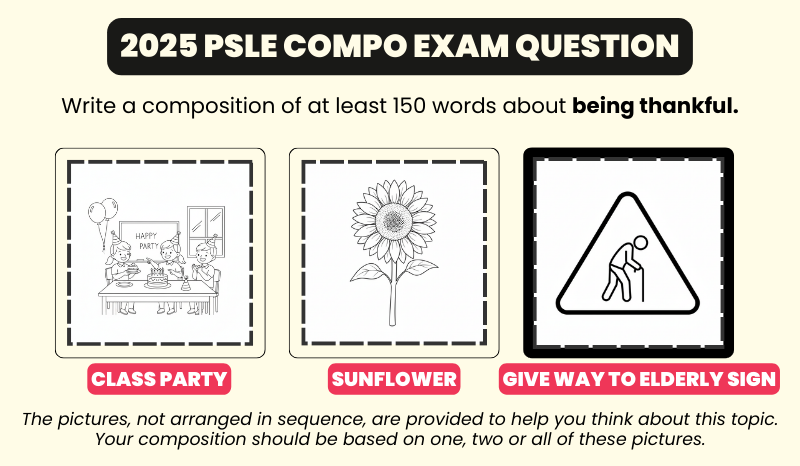
As always, students were tasked with writing a composition of at least 150 words based on one of three picture prompts. Each picture offered a unique angle for storytelling, and students had to choose at least one picture to include in their composition.
The question was:
being thankful
Here were the three picture options:
Picture 1: Class party / students preparing for a party
Picture 2: Sunflower
Picture 3: Give way to elderly sign

🔹 Being
➡️The main character must show/demonstrate gratitude in the story.
🔹Thankful
➡️Recognising and expressing gratitude for help, kindness, or opportunities received.
➡️Expressed through dialogue, actions, emotions.
Important to Cover:
✔️ What good deed/kindness/opportunity was done/given?
✔️ Why was it important to the main character?
✔️ How did the character show thankfulness?
Not all PSLE Composition questions are the same. In fact, the phrasing of the question often gives students valuable clues about how to shape their story. At WRITERS AT WORK, we train students to spot these clues immediately so they can write a story that directly answers the question.
Here are the common types of composition questions and how to tackle them:
Examples: a gift, an adventure, a friendship
These are straightforward. The story must revolve around the given noun. For instance, if the word is a gift, the gift must play a central role in the plot.
Examples: a special gift, an unforgettable experience
Here, the adjective changes everything. Students can’t just write about a gift. They must explain what made it special. If the question is an unforgettable experience, the story must show why it was unforgettable, not just describe the event.
Examples: trying something new, doing your best, making a difference
Notice the -ing word at the start. This is a clue: the main character must be doing the action. The story needs to show the process of trying, doing, or making — not just mention it in passing.
Examples: responsibility, honesty, bravery, kindness
These questions test a student’s ability to show qualities through actions. Instead of simply saying “he was brave,” the story must describe a situation where the character’s bravery is clear through their decisions and behaviour.
👉 By training to recognise these question types, students avoid writing off-topic or shallow stories. They learn to craft exam-smart, relevant, and powerful PSLE Compositions.
I opened the creaky doors of my bus and took a deep breath. Every morning, like clockwork, I would brace myself for the flood of soulless creatures- also known as commuters- to board my bus. Being a bus captain was an important job, but it was also a thankless one. It did not matter if the commuters were over-excited students, or corporate adults; they all boarded with the same robotic precision. No greetings, no smiles- nothing. They filed in, eyes glazed over, fingers swiping endlessly on their phones as if in a trance. Worse still, they would completely ignore the big, bold sign right above their heads that screamed in neon yellow: ‘Give Up Your Seat for Those in Need!’, complete with cartoon-like illustrations of people offering their seats to figures with disabilities, who were pregnant, or the elderly. Maybe child-like drawings were incomprehensible to them, I mused disappointedly. The only time they looked alive was when the scramble for seats occurred- it would be like a scene out of a wildlife documentary- pushing, shoving, elbows flying- all to plant themselves on the seats for their ride, like royalty settled on a throne. Dignity? Non-existent. Courtesy? Out the window! This usually left those in actual need of seats ambling along behind in this race of the fittest and fastest- dejected and defeated. I sighed. This was going to be another long day.
At the third stop, I spotted a familiar duo- old Mr and Mrs Peet- hobbling towards the bus. They were regular commuters on my bus, perpetually attached at their -mildly arthritic- hips. Mrs Peet tapped her cane gently on the steps as she climbed up, while Mr Peet gripped the rails like a lifeline. “Good morning!” I greeted them warmly because, well, no one else did. They grinned gummily at me, but those smiles fell the moment they peered into the packed bus. Rows of stone-faced passengers sat glued to their seats, either pretending to be asleep or staring into the bottomless pits that were their phones. Not a single person moved. Groaning internally, I cleared my throat, put on my best professional voice, and called out, “Could someone please give up their seat for this elderly couple? The sign is right here!” I gestured dramatically towards the large, unavoidable sign for good measure- to no avail.
I smiled apologetically at the Peets, feeling bad for them. “I’ll drive slower,” I offered meekly, “Please hold on tight.” Mrs Peet nodded and grabbed the pole grimly, while Mr Peet gave a grunt that might have meant, ‘thank you, because ‘good manners’ seems to be a mythical creature nowadays’. As I pulled back into traffic, frustration simmered under my collar. This job was like being stuck in a never-ending loop of inconsideration! Day in, day out, I ferried people across the city, and not once did I feel like anyone had a moment to show each other- especially those in need- some care or courtesy!
Just as I was about to let out a long-suffering sigh, a small voice piped up from the back of the bus. “Ex.. excuse me?” A short, gangly boy of about ten years of age stood up and shuffled out of his seat. He looked up at the elderly couple with wide, apologetic eyes. “You can have my seat,” he squeaked, clearly nervous, but resolute. I blinked. Had I imagined it? Through the rearview mirror, I watched gobsmacked as he caught my eye, gestured to the sign and stated loudly, “I saw the sign!” He grinned toothily, chest puffed out and eyes shining like he had just won the Olympics of Kindness. Then, with surprising authority, he elbowed and jostled at his friend who was seated next to him, and gestured pointedly towards the sign. His friend, who looked like he was a perpetual grumpy-face, rolled his eyes and groaned- but eventually acquiesced and stood up too.
Mr and Mrs Peet were stunned into a moment of silence before their faces broke into warm smiles. “Why, thank you, young man!” Mrs Peet beamed, easing into the seat with a relieved sigh. Mr Peet gave a small salute to the boys before plopping down beside her. I felt something crack open in my chest like the first sunbeam after days of gray skies – thankfulness and gratitude. Not just for the boys’ kindness, but for the reminder that not everyone in this bus was emotionally stunted.
For the next few stops, the two boys transformed into the bus’s unofficial Courtesy Captains. They stood with their arms crossed, scanning the crown like pint-sized security guards. If anyone ignored a pregnant lady or an elderly uncle, they nudged them, gesticulating furiously at the sign and whispering commands that made them zoom out of their seats at alarming speed. It was both gratifying and mildly terrifying. One teenage student who refused to budge was subjected to a full five minutes of guilt-laced glares and increasingly exaggerated pointing to the sign until she relented. I nearly cried from how thankful I felt towards them.
Thankfulness and gratitude bloomed in my heart at the scene that unfolded. I felt thankful not just for the boys’ act, but for the chain reaction it set off. I could see Mr and Mrs Peet able to enjoy their ride, and the mood of the bus even felt lighter. Kindness was a communal effort, and I was thankful that the boys took the first step in demonstrating that.
As the boys continued their ‘seat patrol’, I drove around town with a silly grin upon my face. I knew that the good mood would not last forever. Tomorrow, people would probably go back to being their usual self-absorbed selves. However, today I revelled in the feeling of being thankful to the two little champions who reminded me and everyone to do our part for those in need. Perhaps, I thought hopefully, just maybe, the next time someone saw that yellow sign, they would remember the brave little boy who said, “I saw the sign!” – and chose to act.
Looking ahead to PSLE 2026? Our English enrichment programmes are now open for registration — and our proven teaching methods are helping students achieve results year after year.
✔️ Learn to master different types of composition questions
✔️ Weekly practice with personalised teacher feedback
✔️ Small class sizes and structured curriculum
✔️ Early Bird Promo: 20% OFF Term 1 Fees
Secure your child’s spot in our Primary English tuition programmes today.
The PSLE 2025 Continuous Writing question was on the theme “Being Thankful.” Students were asked to write a composition of at least 150 words based on this theme and to use at least one of the three given pictures:
Picture 1: A class party with students preparing for the celebration
Picture 2: A sunflower
Picture 3: A “Give Way to the Elderly” sign
Students could choose to base their story on one picture, two pictures, or even all three, but their composition had to clearly connect to the theme of being thankful.
Because each type requires a slightly different storytelling approach. Spotting the clues in the question ensures the story is relevant, focused, and directly answers what examiners are looking for.
At WRITERS AT WORK, we expose students to a wide range of past-year and specially designed questions. By practising each type (nouns, adjective + nouns, verbs, and qualities) students gain the flexibility to handle any prompt confidently.



Start practising and learning

