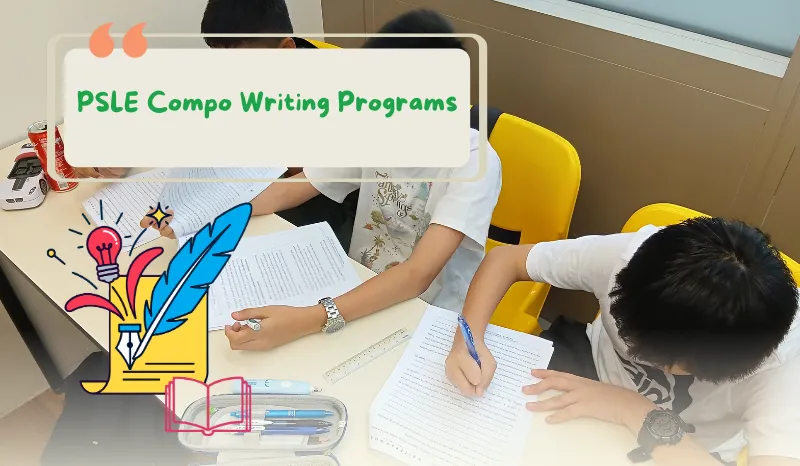
To support this process, WRITERS AT WORK offers a series of year-round PSLE Compo Writing Programmes. Each programme plays a different role at different points of the year, helping students build a strong writing foundation, develop techniques, and refine exam readiness. With a clear roadmap, parents can plan their child’s writing journey with confidence and reduce the stress that often comes during the PSLE year.
PSLE composition writing is one of the most demanding components of the English exam. Paper 1, which covers Continuous Writing under the MOE syllabus, carries a significant 36 marks. To perform well, students must demonstrate a strong command of story planning, picture relevance, narrative flow, character development, and emotional depth. These skills take time to master, and they cannot be built through short-term revision alone.
Many students begin preparing for PSLE writing only in Primary 6 Term 3. By then, the curriculum moves quickly, and students often feel overwhelmed by the expectations placed on them. They struggle with idea generation, organising a story logically, or expressing deeper meaning in their writing. When writing becomes rushed, it shows in the composition: the plot becomes messy, sentences become unclear, and stories feel flat or predictable.
Writing is not a skill that improves overnight. It grows through exposure, practice, and reflection. Good writing habits must be developed step by step, with time to learn different story structures, understand picture links, and improve language accuracy. This is why long-term, structured preparation is essential. A year-round plan allows students to build their foundation early, strengthen their techniques during the school year, and polish their exam skills before the PSLE. It also helps students avoid last-minute panic and gives them confidence throughout the year.
A structured writing journey makes PSLE composition less intimidating and more manageable. When students learn progressively, they begin to write with purpose and clarity, qualities that PSLE markers look for in strong compositions.

Many Primary 5 and 6 students struggle with PSLE composition writing, not because they lack ideas, but because they have not had enough time to build the skills needed for strong narrative writing. PSLE compositions require structure, clarity, and emotional depth. These take time and experience to develop. When students start preparing too late, these weaknesses become more noticeable.
One of the most common challenges is plot organisation. Students often jump into writing without a clear plan. Their stories become messy, with events that do not build naturally or lead to a meaningful ending. Another frequent difficulty is linking the story to the three picture prompts. Some students include only one picture or force a picture into the story, which affects relevance and lowers their content marks.
Character development is another area where students struggle. Many stories feature characters who behave in predictable or unrealistic ways. Without details or emotions, the story feels flat. Students may also rely on the same repeated ideas, for example helping an elderly person, losing a wallet, falling down, or saving a friend. Overused storylines make it harder to stand out.
Language issues often hold students back as well. Simple sentence structures, limited vocabulary, and inaccuracies can affect clarity. Weak paragraph transitions and abrupt endings also reduce the impact of the story. These are not problems that can be fixed in a short period. They require steady exposure to good writing models, guided practice, and time to rewrite and improve.
Understanding these challenges helps parents see why writing needs long-term development. PSLE Composition is not something that can be “crashed” in a few weeks. A strong story reflects planning, maturity, and consistency—skills built over months, not days. With the right guidance and regular practice, students can overcome these issues and gain confidence in their writing.

To support long-term growth in PSLE composition writing, WRITERS AT WORK offers four key programmes spread across the school year. Each programme focuses on a different stage of writing development, and together they form a structured path that helps students build, strengthen, and finally refine their Paper 1 skills. The goal is not to overwhelm students, but to guide them through a clear and manageable progression.
The December PSLE Holiday Writing Camp lays the foundation. It gives students their first strong introduction to PSLE composition structure, story planning, and picture relevance. Many parents choose this camp to give their children a head start before the busy P6 year begins.
The March PSLE Writing Camp supports students after their first school term. This is the stage when strengths and weaknesses become clearer. The March camp helps students refine their planning, strengthen paragraph flow, and gain confidence through more targeted practice.
The June PSLE Writing Camp prepares students for the demanding second half of the year. It reinforces essential skills, exposes students to different story structures, and helps them build exam readiness before entering Term 3, which is often the most academically intense period.
Finally, the September PSLE Compo Writing Intensive Crash Course (ICC) provides fast-paced polishing just before the actual PSLE. It helps students refine relevance, improve clarity, and stabilise their writing under timed conditions. This programme also gives students exposure to PSLE-style prompts, including picture concepts similar to what appeared in the PSLE 2025 paper—an encouraging sign of WRITERS AT WORK’s strong understanding of writing trends.
Each programme is designed with a purpose. When combined, they offer a complete year-round writing journey that supports students at every stage, from foundation building to exam polishing.
(5 days × 3 hours each)
The December holidays are the ideal moment for students to begin their PSLE composition writing journey. With the school year behind them, children are more relaxed and receptive, making it easier to introduce the core building blocks of strong writing. Instead of completing full compositions, students learn through guided modelling and step-by-step practice. They explore narrative structure, story logic, picture relevance, and emotional expression using WRITERS AT WORK’s STORYBANKING® approach.
During the camp, students begin building their personal bank of story elements—characters, conflicts, emotions, and resolutions, which they can later apply to different PSLE-style prompts. This method helps them understand how stories work before they attempt to write a full piece. December provides a calm and unhurried window to develop these essential skills, giving students the confidence they need before Primary 6 becomes more demanding.
(5 days × 3 hours each)
By March, students have completed Term 1 and have a better sense of which writing areas they find challenging. The March camp helps them refine and strengthen these skills in a focused way. Students continue to build on their STORYBANKING® foundation, using it to generate more mature and coherent story ideas. They practise creating smoother paragraph transitions, developing realistic character motivations, and expressing emotions more naturally.
(5 days × 3 hours each)
The June holidays mark a crucial turning point in the PSLE year. Students already understand the basics of PSLE composition writing, but they need to consolidate their skills before moving into Term 3, which is academically the most demanding period. The June camp helps students reinforce picture relevance, narrative consistency, story clarity, and language precision.
All four WRITERS AT WORK PSLE writing programmes follow the same structured and proven approach. Although each camp focuses on a different point in the school year, they all build on the same foundation: a clear writing framework, targeted skill development, and strong guidance in planning and relevance.
At the core of every programme is STORYBANKING®, a method that helps students build their own bank of story elements—emotions, conflicts, character motivations, and resolutions, that they can apply to any PSLE picture prompt. This approach removes the fear of “not knowing what to write” and gives students a reliable way to generate ideas quickly during exams.

👉 Learn more about our PSLE Writing Camps here:
December: PSLE Dec Holiday Writing Camp
March: PSLE Mar Holiday Writing Camp
June: PSLE Jun Holiday Writing Camp
September: September PSLE Compo Writing Intensive Crash Course
Each camp can help students to focus on different stages of the year. December builds the foundation, March strengthens developing techniques, June consolidates exam skills, and September provides a final boost. All camps use the STORYBANKING® method, helping students generate strong story ideas without writing full compositions.



Start practising and learning

