Hello, this is Teacher Jemmies here! I’m an experienced PSLE English teacher who has been guiding countless Primary 6 students through their composition writing journey for more than 25 years. Today, I want to share a powerful technique that can transform your PSLE Composition from ordinary to outstanding, and it is through creating compelling dilemmas in your stories.
• Creates tension and suspense in the story
• Keeps readers curious and engaged in the story
• Shows character’s emotions and internal struggles
• A well designed dilemma can impress your PSLE examiner
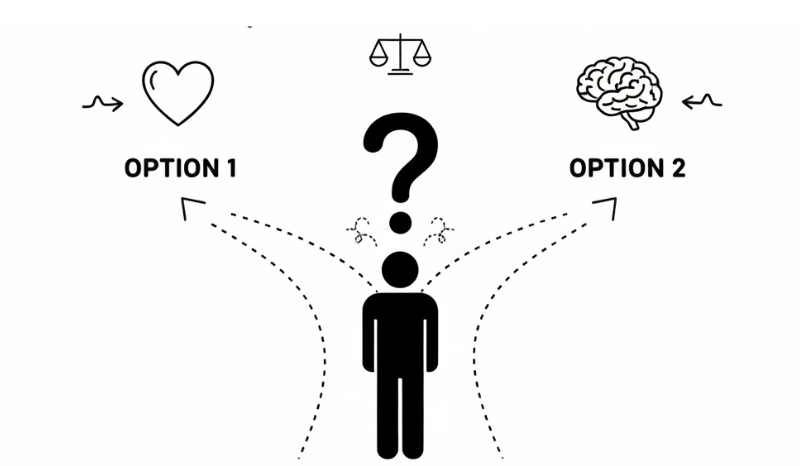
Your character must face exactly two distinct choices with different consequences or personal costs. Remember less is more. There is no added benefit of having more than two options because it can confuse your readers and weaken the impact.
Weak Dilemma: “Sarah didn’t know what to do about the situation. There were so many possibilities.”
Strong Dilemma: “Sarah stared at the exam paper on her best friend’s desk. She could either tell the teacher about the cheating or stay silent to protect her friendship. Sarah felt herself being stranded between the devil and the deep blue sea.”
Both options must have real, meaningful consequences. If one choice is obviously better than the other, there’s no real dilemma. The consequences should matter to your character and affect the story’s outcome.
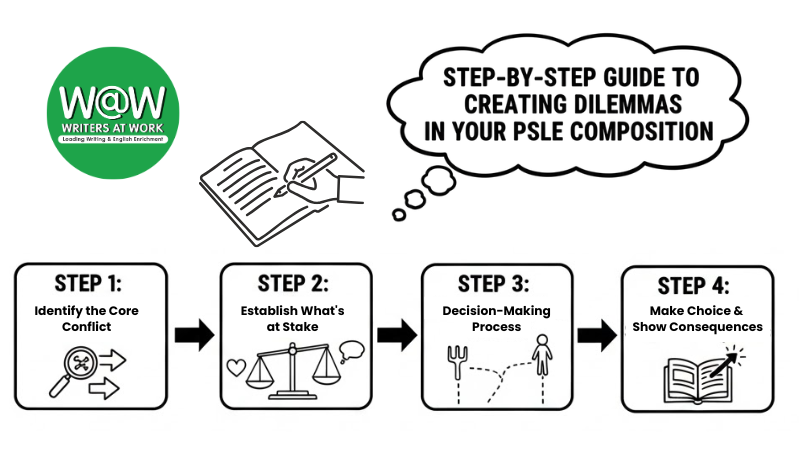
Before you start writing, identify what your character wants and what is preventing him or her from getting it. This becomes the foundation of your dilemma.
Example:
• What the character wants: To win the race
• What prevents it: Discovering that your strongest competitor desperately needed to win this race to gift the trophy to his ailing mother
Make sure readers understand why both choices matter. Use the FATS Framework (Feelings, Actions, Thoughts, Speech) from descriptive writing to show the internal struggle.
Example: “My hands trembled as I held the trophy. (Action) Pride swelled in my chest as the reality of my victory sank in. I had finally won! (Feeling) Just then, I saw Sarah wiping away tears from her eyes as I recalled overhearing her conversation with her ailing mother.. (Thought) ‘What should I do?’ I whispered to myself. (Speech) “
Spend time to create the dilemma. Remember you must show how your character weighs both options.
Example Structure:
• Paragraph 1: Introduce the dilemma and Option A
• Paragraph 2: Present Option B and show internal conflict
• Paragraph 3: Make the decision and explain the reasoning
Teacher’s Analysis: This introduction immediately establishes the problem with a specific, relatable scenario. The situation is genuinely dilemma-worthy for a Primary 6 student.
My first instinct was to pull my school bag around to cover the tear and board the bus as planned. After all, I reasoned desperately, if I stayed at the back and sat down quickly, maybe nobody would notice. The bus was already visible at the end of the street, its brakes squealing as it stopped three houses away. I had maybe thirty seconds to decide. My horrible attendance record flashed through my mind. I had maxed out all my quota of being late for school for this year and there were no more second chances. Missing this bus meant being late, and I would end up in the Disciplinary Master’s office again. Worse still, Mother had warned me just last week, ‘Dylan, if you’re late for school one more time this term, no more weekend gaming sessions for a month.’ One more time. Those words echoed ominously in my head. I’d already been late twice this term, both times because I’d overslept. This would be strike three.
Teacher’s Analysis: This paragraph presents the first option clearly and shows the real stakes involved—attendance record, school consequences, and parental punishment.
Reality crashed down on me like a bucket of ice water. If I boarded that bus, I would have to walk down the narrow aisle past all my classmates, my torn shorts on full display. I could already imagine the pointing, the laughter, the nicknames that would haunt me for the rest of Primary 6. Marcus, the class joker, would definitely have something to say. Probably something like ‘Nice undies, Dylan!’ that would echo through the bus and follow me for weeks, maybe months. My stomach churned at the thought. I glanced back at my house, a mere twenty metres away. I could sprint inside, change into my PE shorts, and be back outside in under two minutes. But two minutes was all it would take for the bus to leave without me. Even if I ran all the way to school, I would be at least ten minutes late. My legs felt rooted to the spot, pulled in two directions like a rope in a tug-of-war match. Face social humiliation, or protect my dignity and face the disciplinary consequences and Mother’s wrath?
Teacher’s Analysis: This paragraph effectively presents the alternative option with equally serious consequences from a twelve-year-old’s perspective. The specific details about potential teasing and the precise timing calculations show realistic problem-solving. The rhetorical question at the end emphasizes the genuine difficulty of the choice.
The school bus pulled up to my stop with a hydraulic hiss, its doors swinging open invitingly. The driver, Mr Kumar, peered out at me expectantly. ‘Coming aboard, Dylan?’ he called out. I stood paralyzed, my mind racing faster than a cheetah chasing its prey. Through the bus window, I could see my classmates settling into their seats, oblivious to my crisis. Then I noticed something that made my decision suddenly crystal clear. There, in the third row, sat Benjamin, the boy who had transferred to our school recently. Last Friday, he slipped and fell in the canteen, spilling curry all over his uniform during recess. The whole class laughed at him for the entire day. I watched him spend the rest of the day trying to hide the stain, his face flushed with embarrassment. If I got on this bus, I would become the day’s entertainment, just like Benjamin had been. Could I really put myself through that? In that instant, I really regretted not standing up for Benjamin that day when he needed help. Taking a deep breath, I made my decision. I could not bring myself to get on the bus. Not like this.
Teacher’s Analysis: This paragraph shows the character’s decision-making process. The connection to another student’s embarrassment demonstrates empathy and maturity. The reasoning is clearly explained and shows personal growth.

This lighthearted dilemma story demonstrates several important PSLE Composition techniques:
Remember, effective dilemmas don’t always need to involve life-changing decisions. Sometimes the most compelling stories come from everyday situations that test our values in small but meaningful ways.

At WRITERS AT WORK, we believe great writing doesn’t happen by chance, it’s the result of structure, strategy, and the right storytelling mindset.
Our PURE Composition Writing Programme is designed to help Primary 4 to 6 students master every element that examiners look for: strong plots, emotional depth, realistic dialogue, and of course, well-crafted dilemmas. Students learn how to apply proven writing frameworks such as the FATS Framework (Feelings, Actions, Thoughts, Speech) and STORYBANKING®, our signature method that builds a library of story ideas, experiences, and moral lessons that can be easily adapted for any composition question.
Through weekly guided writing practice, students learn how to plan faster, write more creatively, and express complex emotions clearly — skills that go far beyond the PSLE. Each class is carefully structured to help students internalise story flow, develop confident language use, and refine their writing voice under the guidance of experienced teachers like Teacher Jemmies.
📘 Register or sign up for trial now for our PURE Composition Writing Programme to help your child build a strong foundation in story planning and composition writing.
A dilemma is a situation where the main character faces two difficult choices, and both have serious consequences. In PSLE compositions, dilemmas make stories more realistic and engaging by showing your character’s emotions, values, and decision-making process.



Start practising and learning

