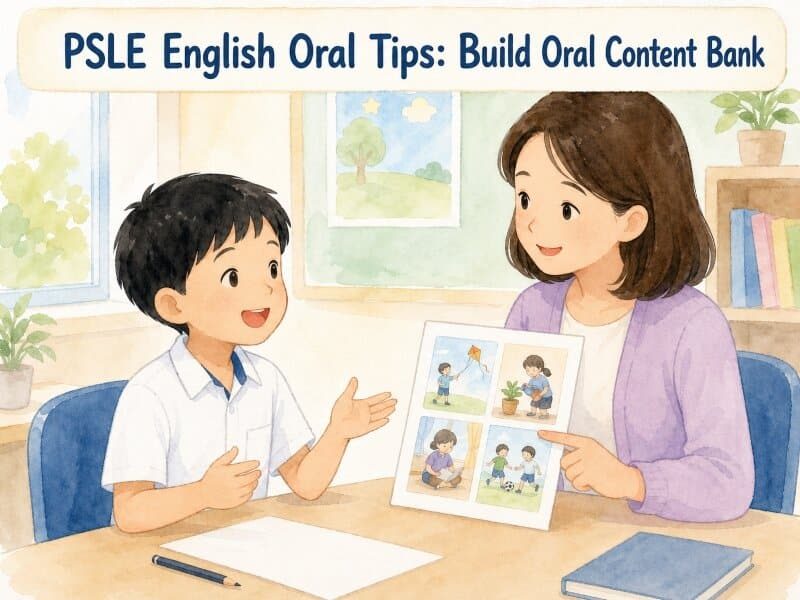
Many students struggle with what to say during the PSLE English Oral exam. Not because they have no ideas, but because they have not built a strong enough content bank before the exam.
During oral practice, students may recognise the topic. They may even have something to say. However, when faced with an examiner, a photo stimulus and a few seconds to organise their thoughts, they suddenly freeze. Their answers become short, vague or repetitive:
“I think it is good.” “I have experienced this before.” “We should help others.”
These responses are not wrong, but they are often underdeveloped. To do well, students need to express personal opinions, ideas and experiences clearly. They also need to speak fluently, use appropriate vocabulary and engage the listener. This is why a content bank matters.
Just like composition writing, oral responses improve with regular exposure to ideas, vocabulary and topics. In this post, we will explore practical ways students and parents can build a rich, ready-to-use oral content bank before the PSLE.
A content bank is a collection of useful ideas, examples, personal experiences, vocabulary and reflections that students can draw from during oral practice. It is not about memorising full answers. In fact, memorised answers often sound unnatural and may not fit the question. Instead, a good content bank helps students respond flexibly to a wide range of topics.
For example, a student who has thought about themes such as kindness, responsibility, environmental care, family bonding and community service will find it easier to answer questions such as:
One of the best ways to build oral content is through daily exposure. Students who listen and read widely tend to have more ideas, stronger vocabulary and better sentence patterns. Parents can encourage their child to spend 10 to 15 minutes a day listening to or reading age-appropriate content. This does not need to feel like heavy revision. It can be done during breakfast, car rides or before bedtime.
Some useful resources include:
Brains On!, TED-Ed, All Ears English Podcast, CBeebies Radio and NewsForKids.
These resources expose students to different topics, from science and society to emotions, culture and current affairs. Over time, students become more comfortable discussing ideas beyond their immediate school life.
After listening to a short episode or reading a simple news article, students should ask themselves:
This reflection step is important. Passive listening is not enough. Students need to turn what they hear into usable oral content. They can also mimic good pronunciation and sentence structure from podcast hosts. For example, they can pay attention to how speakers pause, emphasise key words and link ideas smoothly. This helps students improve both content and delivery.
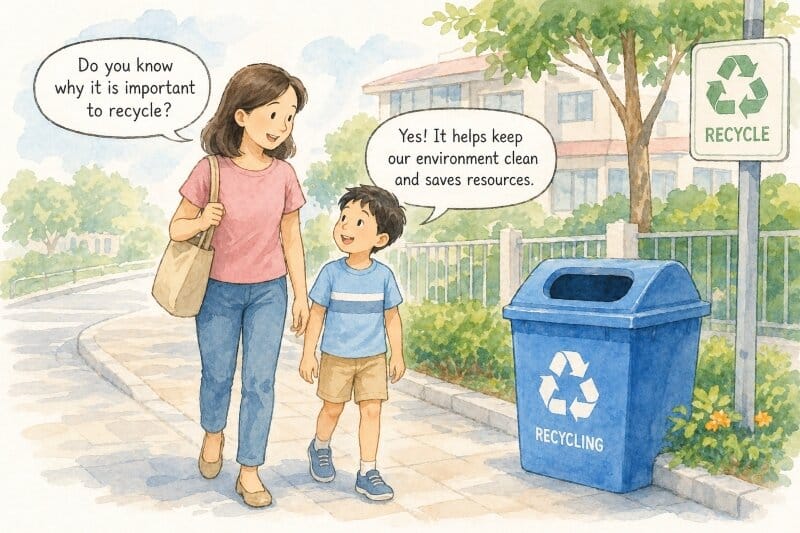
Vocabulary plays a big role in oral communication. However, memorising long lists of impressive words is not the best approach. Students need to know how to use words in context. A better way is to build a thematic word bank. This means grouping useful words and phrases according to common oral themes.
For example:
The goal is not to squeeze difficult words into every answer. Instead, students should learn to use simple but precise vocabulary.
For example, instead of saying:
A stronger response would be:
The second answer is not complicated, but it is clearer and more thoughtful. It shows vocabulary control, observation and personal judgement.
The PSLE English Oral exam includes a stimulus-based conversation. This means students must respond to a visual stimulus and engage in a conversation based on the topic. One simple way to prepare is to turn everyday pictures into oral prompts.
Parents can show their child a simple image, such as:
Then, ask three questions:
These three questions help students move from description to personal experience to opinion. This is useful because strong oral responses are not just about describing the picture. Students must also show reflection and personal voice.
Students can turn this into a weekly routine. Once a week, choose one picture and write down a short oral script or diary-style response.
For example:
“In the picture, I can see a family having dinner together. This reminds me of weekends at home, when my family tries to eat together without using our phones. I think family meals are important because they give us time to talk, share our problems and feel closer to one another.”
This kind of practice builds fluency, depth and confidence. Over time, students become more comfortable linking a visual stimulus to their own experiences and opinions.
At WRITERS AT WORK, we use a strategy called STORYBANKING® to help students collect and organise real-life or imagined stories for future use.
Many parents associate story ideas with composition writing, but the same strategy is extremely useful for oral practice.Why? Because many oral topics overlap with composition themes.
For example:
These topics can appear in different forms across writing and oral. When students have a bank of meaningful experiences, they are less likely to go blank during the exam.
A useful storybank can include:
For example, a student may store a story about helping a new classmate adjust to school. This same story can be adapted for oral topics about kindness, friendship, inclusion, responsibility or school life. The key is flexibility. Students should not memorise one fixed version. Instead, they should understand the main idea of the story and learn how to adapt it to different questions.
Parents do not need to act as examiners every day. In fact, oral practice works best when it becomes part of normal conversation. During dinner, ask your child what they think about a school rule, a news story or a situation they observed. During a walk, ask them to describe what they see and explain how they feel about it. After watching a show, ask them which character made the best decision and why. These small conversations help children practise forming opinions. They also teach children that speaking well is not just for exams. It is a life skill.
Parents can also encourage children to answer in complete thoughts instead of one-word answers. For example, if a child says, “It is good,” gently ask, “Why do you think it is good?” or “Can you give me an example?”
This helps children develop the habit of explaining, elaborating and supporting their views.
The PSLE English Oral exam does not have to feel intimidating. With steady practice, students can build a strong content bank that helps them speak with more confidence and clarity. Daily exposure gives them ideas. Topic-based vocabulary gives them better words. Picture prompts help them practise personal responses. STORYBANKING® gives them a reliable store of experiences to draw from. Most importantly, students learn that good oral answers are not about sounding perfect. They are about communicating clearly, thoughtfully and naturally. Help your child walk into the PSLE English Oral exam with more than memorised answers. With the right content bank, regular practice and guided feedback, students can learn to express their ideas clearly, confidently and naturally.
At WRITERS AT WORK, our Pure Composition Writing Programme and Comprehensive English Programmes help students build the vocabulary, personal examples and speaking structure they need for PSLE success. Through proven strategies like STORYBANKING®, students learn how to organise real-life experiences and useful examples for both oral and writing tasks.
Give your child the tools to speak with confidence, think on their feet and respond with clarity. Explore our PSLE English programmes today at WRITERS AT WORK.
A PSLE English Oral content bank is a collection of useful ideas, personal experiences, topic vocabulary and examples that students can draw from during the oral exam. Instead of memorising fixed answers, students learn to prepare flexible content for common themes such as kindness, responsibility, technology, the environment, family and school life.
Your child can improve by listening to age-appropriate podcasts, reading short news articles, practising pronunciation, building topic-based vocabulary and responding to picture prompts regularly. A simple weekly routine, such as describing a picture and sharing a personal experience related to it, can help build fluency and confidence over time.
At WRITERS AT WORK, students are taught to organise their thoughts clearly, use appropriate vocabulary and speak with confidence. Through strategies such as STORYBANKING®, students learn to collect and structure real-life or imagined experiences that can be used for both PSLE English Oral and composition writing. This helps them avoid mental blanks and give more thoughtful, well-developed answers.

Jemmies Siew, Managing Director and Co-Founder of WRITERS AT WORK Enrichment Centre. With over 15 years of experience in education, entrepreneurship, and marketing, Jemmies has helped shape Singapore’s English enrichment landscape through her vision for transformative learning.
She is passionate about connecting real-world issues with language learning, helping students think critically and express themselves clearly. Connect with her on LinkedIn to follow her insights on education, content marketing, and thought leadership.



Start practising and learning

