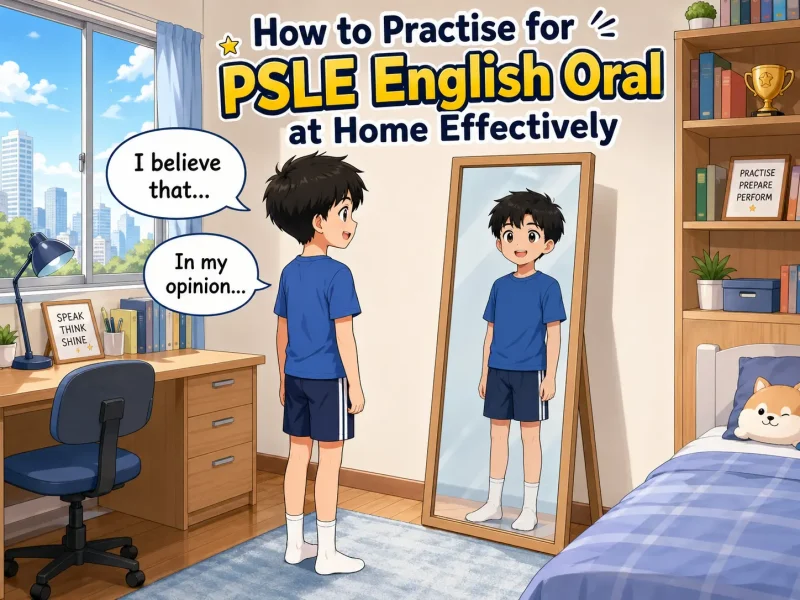
PSLE Oral preparation does not only happen in the classroom. In fact, consistent home practice can greatly improve a student’s confidence, clarity, and fluency over time.
For many students, the challenge is not that they have nothing to say. It is that they may not know how to organise their thoughts quickly, speak clearly, or respond naturally under exam conditions. This is why oral practice should be simple, regular, and focused.
The PSLE English Oral component assesses key skills such as reading aloud fluently and expressively, expressing personal opinions clearly, and speaking with clear pronunciation and grammatical accuracy. These are skills that can be strengthened through steady practice at home.
This article shares four effective methods students can use to practise for PSLE English Oral at home, even without a teacher present.
Mirror practice is one of the easiest ways to begin oral preparation at home. Students simply speak while looking at themselves in the mirror.
This helps them become more aware of how they look and sound when speaking. In oral exams, delivery is not only about the words used. It also involves expression, posture, tone, and confidence.
1. Facial expression
Students should avoid looking blank or overly nervous. A calm, natural expression helps them appear more confident.
2. Eye contact
While the mirror is not the examiner, it helps students practise looking up instead of staring down at notes or the floor.
3. Posture
Sitting or standing upright can make a student sound more alert and confident.
4. Mouth shape and pronunciation
Watching how words are formed can help students notice unclear pronunciation or mumbling.
Start with easy prompts such as:
The goal is not to give a perfect answer immediately. The goal is to help students become more comfortable speaking aloud and noticing their own delivery.
PSLE English Oral is not just about prepared speaking. Students must also respond to questions naturally. This is where simulated conversations can help. Parents, siblings, or friends can role-play as the examiner while the student practises answering questions. A stimulus picture can be used, or the conversation can begin with a simple topic such as school, hobbies, community, technology, or the environment.
It helps students adapt to new questions. Students learn not to memorise fixed answers, but to listen carefully and respond to what is being asked. It improves elaboration. Many students give answers that are too short. Conversation practice teaches them to explain their ideas more fully. It builds confidence in follow-up questions. Oral examiners may ask students to explain, give examples, or share opinions. Practising with others helps students become more flexible.
Parents do not need to be English experts. They can ask open-ended questions such as:
These questions encourage students to go beyond one-word or one-sentence answers.
Students often do not realise how they sound when they speak. They may think they are speaking clearly, but when they listen to a recording, they may notice pauses, repeated words, or unclear pronunciation. Recording and replaying oral responses is a practical way to build self-awareness.
When replaying a recording, students should check for:
1. Unclear pronunciation
Are words being swallowed, rushed, or mispronounced?
2. Filler words
Words such as “like,” “um,” “you know,” or repeated “then” can make answers sound less fluent.
3. Awkward pauses
Pauses are natural, but too many long pauses may show that the student needs more practice organising ideas.
4. Gaps in content
Does the answer include a clear point, reason, and example? Or does it stop too quickly?
Students can keep one recording each week and compare their progress over time. This helps them notice improvements in fluency, confidence, and structure. Parents can also listen together with their child and focus on one improvement point at a time. This keeps the practice encouraging rather than stressful.
In the exam, students need to think and speak within a limited time. One-minute timed practice helps students get used to this pressure in a manageable way. The aim is not to rush. Instead, students learn how to give a complete answer within a short time.
Students can use this structure:
1 main idea
1 reason
1 example
For example, if the question is, “Do you think students should read more books?” a student might answer:
“I think students should read more books because reading improves vocabulary and imagination. For example, when I read storybooks, I learn new words and see how writers describe characters and settings. This can also help me when I write compositions.”
This structure helps students avoid giving answers that are too short or too disorganised.

Rotate topics daily so students build content knowledge and speaking flexibility. Possible topics include:
Short, regular practice is more effective than occasional long sessions. Even five to ten minutes a day can make oral practice feel more natural.
PSLE English Oral preparation becomes more effective when students practise consistently and know what to focus on. At home, simple habits like mirror practice, simulated conversations, recording responses, and timed speaking drills can help your child build fluency, clarity, and confidence over time.
For students who need more structured support, WRITERS AT WORK helps children strengthen both content and delivery through guided English training. Our Comprehensive English Programme supports key language skills such as writing, comprehension, oral communication, and grammar, while our Holiday Oral Programme gives students focused practice in speaking clearly, organising responses, and handling oral prompts with confidence. With the right guidance and regular practice, your child can learn to speak with greater confidence, express ideas more clearly, and approach the PSLE English Oral exam with a stronger sense of readiness.
Beyond the classroom, students and parents can also tap into our wider learning resources through W@W eSeries, and stay updated with tips, insights, and student support on TikTok and Facebook
Your child can practise by reading aloud regularly, answering oral prompts, and speaking about everyday topics. Simple methods such as mirror practice, recording responses, and timed one-minute answers help students become more aware of their pronunciation, pacing, expression, and answer structure.
Students should focus on speaking clearly, organising their ideas, and giving responses with enough detail. For stimulus-based conversation, they should learn to give a clear opinion, explain their reason, and support it with a relevant example or personal experience.
Parents may consider extra support if their child gives very short answers, struggles to explain opinions, speaks too softly, or feels nervous during oral practice. A structured programme can help students build content, confidence, and clarity through guided feedback and regular practice.

Agnes Ng, Co-Founder and Teaching & Curriculum Director of WRITERS AT WORK. An NUS Honours graduate and published author with over 30 years of experience, Agnes has been the architect of the organization’s student-centric curricula since 2012.
Dedicated to teacher mentorship and academic excellence, she has guided hundreds of students to achieve outstanding results. Her expertise and commitment to high-quality education remain the cornerstone of WRITERS AT WORK’s success in empowering every learner.



Start practising and learning

