The PSLE English Oral exam may be short, but it can make a big difference to your overall result. You are not just being tested on whether you can talk. You are being tested on how clearly, confidently, and naturally you can communicate your ideas.
The good news is that oral skills can be improved with practice. Here are five practical tips to help you make a strong impression during both Reading Aloud and Stimulus-based Conversation.
Before you even begin speaking, the examiner will notice how you carry yourself.
If you slouch, avoid eye contact, or mumble, you may seem nervous or unprepared. On the other hand, if you sit up straight, look attentive, and speak clearly, you will appear more confident.
Sit upright in your chair
Look at the examiner when speaking
Keep your hands still
Start in a calm, clear voice
You do not need to act overly serious. Just look ready and focused.
Some students think they will sound fluent if they speak very fast. Actually, speaking too quickly can make your words unclear.
A better goal is to speak at a steady pace so the examiner can hear every word properly.
Slow down a little
Pronounce the ends of words properly
Pause at full stops and commas when reading aloud
Stress important words instead of making every word sound the same
One of the best ways to make your answer stronger is to include a real example from your life.
This helps your answer sound more natural and detailed. It also shows the examiner that you can explain your ideas instead of giving only a short response.
A weak answer:
“I think exercise is important because it is good for health.”
A stronger answer:
“I think exercise is important because it helps us stay healthy and manage stress. For example, when I play badminton with my cousin on weekends, I feel more energetic afterwards.”
The second answer is better because it explains the point and gives a personal example.
So, when possible, ask yourself:
Can I add an example from school, home, or my own experience?
To make your answer better, always try to add:
a reason,
an example,
or an effect.
A simple way to remember this is:
Point, explain, example.
Point: “Schools should organise more outdoor activities.”
Explain: “This gives students a break from classroom learning.”
Example: “For instance, outdoor learning journeys can help them apply what they learn in real situations.”
This makes your answer sound fuller and more thoughtful.
Whenever you give a point, ask yourself:
Why do I think this?
How does this help?
Can I give an example?
That is how you turn a short answer into a strong one.
During Stimulus-based Conversation, do not sound like you are reciting a memorised speech.
In my opinion, exercise is very important for children.
I think schools should have more outdoor activities.
I feel that reading is a good habit because it improves vocabulary.
Personally, I enjoy group activities more than individual ones.
From my experience, students learn better when lessons are interactive.
These connectors help you continue your answer smoothly:
One reason is that it helps students relax.
This is because they can learn in a more enjoyable way.
For example, my class once visited a museum and I understood the topic better afterwards.
Besides that, it also helps students build confidence.
As a result, they become more willing to participate.
However, some students may prefer quieter activities.
On the other hand, outdoor activities can still benefit them in different ways.
A basic answer:
“Yes, I think schools should organise more outdoor activities because they are fun.”
A better answer:
“In my opinion, schools should organise more outdoor activities. One reason is that students need a break from classroom learning. For example, if they go on learning journeys, they can see how things work in real life. Besides that, outdoor activities also help them relax and enjoy learning more.”
This answer sounds better because it has:
a clear opinion,
a reason,
an example,
and a connector to extend the idea.
Memorising full speeches
Giving one-line answers
Using the same phrase again and again
Panicking when the examiner asks a follow-up question
If the examiner asks a new question, stay calm. Just answer it step by step.
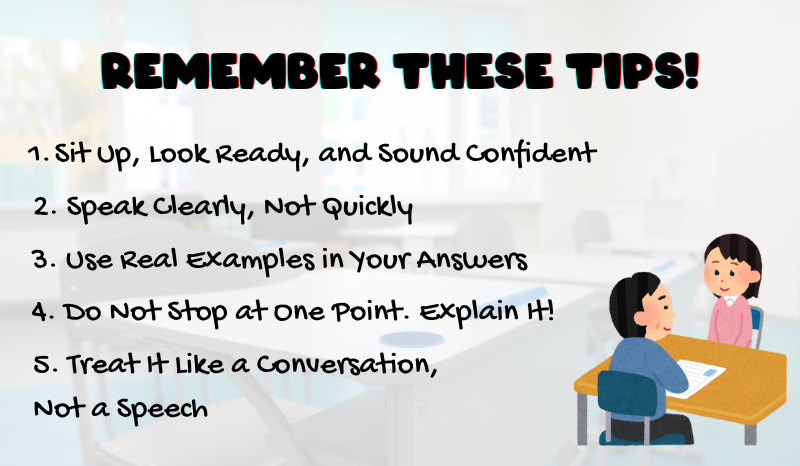
To do well in PSLE Oral, focus on these five habits:
Look ready and confident
Speak clearly
Use real examples
Explain your points
Sound natural, like you are having a conversation
You do not need perfect answers every time. What matters is showing that you can communicate your ideas clearly and confidently.
The more you practise, the more natural it will feel. Good luck!
PSLE Oral becomes easier when students are given regular chances to practise speaking, organise their ideas clearly, and respond with confidence. Instead of relying on memorised answers, they learn how to read aloud with expression and handle Stimulus-based Conversation more naturally.
For students who need more structured support, our Comprehensive English Programme includes guidance in key language areas such as writing, comprehension, and Oral lessons. This helps students build confidence not only for PSLE English Oral, but also for overall English performance.
Exploring programmes by level and focus allows parents to choose support that best matches their child’s needs, learning stage, and goals for the year ahead. Parents may also find our English e-books helpful for guided practice at home, alongside regular tips and learning insights shared on our TikTok and Facebook pages.

Agnes Ng, Co-Founder and Teaching & Curriculum Director of WRITERS AT WORK. An NUS Honours graduate and published author with over 30 years of experience, Agnes has been the architect of the organization’s student-centric curricula since 2012.
Dedicated to teacher mentorship and academic excellence, she has guided hundreds of students to achieve outstanding results. Her expertise and commitment to high-quality education remain the cornerstone of WRITERS AT WORK’s success in empowering every learner.



Start practising and learning

