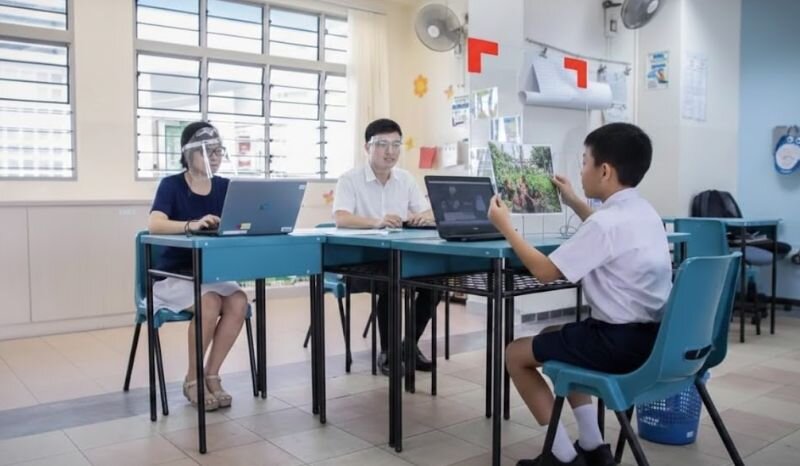
The most common problem in PSLE Oral is not poor grammar or weak vocabulary. It is the one-liner answer. “Yes, I think it is important.” Full stop. Silence. The examiner waits. The student has nothing more to say.
This pattern caps scores regardless of how accurate the English is. The Stimulus-Based Conversation component rewards students who develop their ideas, connect them to personal experience, and show they can sustain a thoughtful discussion. A technically correct but underdeveloped answer signals that the student has reached the limit of what they can express.
The good news is that elaboration is a learnable skill. These five techniques give students a reliable way to extend their responses, add substance, and demonstrate the depth of thinking that examiners look for in higher-band performances.
The PEEL structure works well for oral responses:
1. Point — Answer the question directly. Do not hedge or delay. If the question asks whether you agree, say so immediately.
2. Explain — Give one or two reasons for your answer. This is the “why” behind your position.
3. Example — Share a specific incident, observation, or detail that supports your point. This is where personal experience becomes valuable.
4. Link — Connect back to the question or the picture stimulus. This signals that your response is complete and coherent.
“Yes, I enjoy school celebrations because they give us a chance to relax and bond with our classmates. During Racial Harmony Day last year, my friends and I performed a short skit together. We spent a lot of time rehearsing and laughing at our mistakes. Because of experiences like that, I always look forward to school celebrations.”
The second response takes about 20 seconds longer to deliver but demonstrates far more language ability. The structure makes it easy for the student to keep going without running out of things to say.
Stimulus-Based Conversation requires students to observe and infer from wordless pictures. Many students glance at the image, make one observation, and stop. The 5W1H method turns a single glance into a systematic scan that generates multiple talking points.
“In this picture, I see a family having a picnic in the park. The parents are sitting on a mat while the children are playing with a ball nearby. It looks like a weekend afternoon because the park is bright and there are other families around. They are probably spending quality time together and enjoying the fresh air after a busy week.”
The 5W1H scan takes only a few seconds but produces enough material for a substantive response. Students who practise this technique find they always have something to say about any picture.
Examiners hear hundreds of generic answers. “Reading is important because it helps us learn.” “Exercise is good for health.” These statements are true but forgettable. A personal anecdote makes the same point memorable and demonstrates that the student can connect ideas to real life.
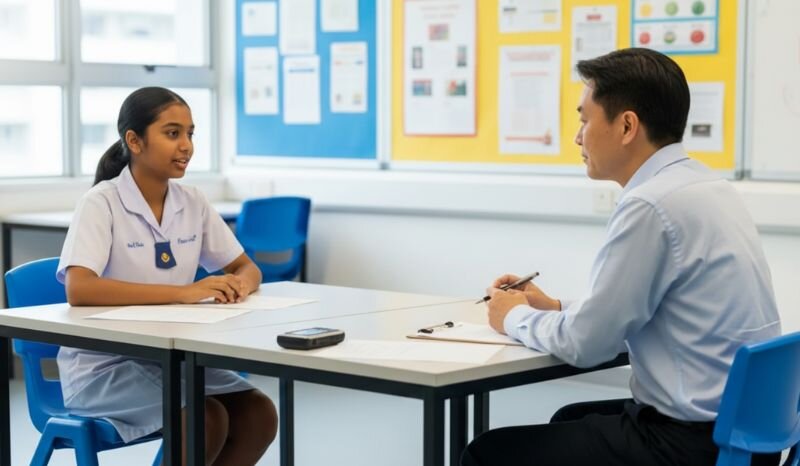
After stating an opinion, students should ask themselves: “When did something like this happen to me?” The answer does not need to be dramatic. Everyday experiences work well:
The anecdote should be brief: what happened, how you felt, and what you took away from it.
“Yes, I think reading is very important. When I was in Primary Four, I started borrowing science books from the library because I was curious about space. Those books taught me things that were not in my textbook, and they made Science lessons much more interesting. I still remember the first time I understood how eclipses work because I had read about it the week before.”
The personal story transforms a generic opinion into evidence that the student genuinely engages with the topic. Examiners reward this because it shows maturity and authentic communication.
This technique works especially well for two common question types:
1. Feelings questions (“Why do you think the people in the picture look happy?”)
2. Opinion questions (“Is it important to help your neighbours?”)
“They look like they are enjoying themselves for a few reasons. First, they are smiling and laughing together, which shows they are having a good time. Second, they are doing the activity as a group, which is usually more fun because you can talk and joke with each other. Third, they seem relaxed, so they are probably free from homework or work stress at that moment. If I were there with my friends, I think I would feel the same way.”
Three reasons require no more effort than one, but they triple the substance of the response and show the examiner that the student can develop an idea systematically.
Many students describe what happened but stop before explaining what it meant. High-band responses include reflection: how the student felt, why they felt that way, and what they learned or how they changed.
This mini-formula works after any anecdote or example:
This layer of reflection signals maturity. It shows the examiner that the student processes experiences rather than simply reporting them.
“Yes, I once helped my elderly neighbour carry her groceries home when it started raining heavily. At first, I felt a bit shy because I did not know her very well. But when she thanked me and smiled, I felt really glad that I could make her day a little easier. From that experience, I learned that even small actions can make a difference to someone else, and now I try to look out for opportunities to help when I can.”
The reflection adds only two or three sentences but elevates the response from a simple anecdote to a demonstration of thoughtful communication.
During practice sessions, students can run through these questions mentally before speaking:
– Did I answer the question directly at the start?
– Did I explain why with at least one clear reason?
– Did I include a specific example or personal experience?
– Did I mention how I felt or what I learned?
– Did I connect back to the question or the picture?
With enough practice, this mental checklist becomes automatic. Students stop giving one-liners not because they are forcing themselves to say more, but because they have internalised a richer way of responding.
These five techniques require practice to become natural. Students who rehearse with a variety of picture stimuli and question types build the habit of elaborating without overthinking. Feedback on pacing, clarity, and relevance helps refine responses before exam day.
For parents considering structured preparation, WRITERS AT WORK offers oral communication training as part of our Comprehensive English Programmes. Our curriculum includes regular Stimulus-Based Conversation practice with feedback on elaboration, fluency, and expression.
Explore our 2025 PSLE Oral SBC Guide for more detailed strategies, or follow us on Facebook and Instagram for oral tips and practice prompts.

You do not need a dramatic story. Everyday observations work well: something you noticed at school, a conversation with a family member, or an activity you did recently. If nothing comes to mind, you can describe a hypothetical situation (“If I were in this situation, I think I would feel…”) or refer to something you read or watched. The key is to make the response specific rather than abstract.
No. Use what fits the question naturally. A simple factual question (“What can you see in the picture?”) needs 5W1H observation, not a personal anecdote. An opinion question (“Do you think this is a good idea?”) benefits from PEEL structure and multiple reasons. Practise different question types so you learn which techniques suit which situations.
Rehearsed answers sound flat because students memorise entire responses and recite them regardless of the actual question. Instead, practise the techniques with many different topics so you build flexible skills rather than fixed scripts. Listen to the question carefully, pause briefly to organise your thoughts, and respond to what was actually asked. Genuine engagement sounds natural; recitation does not.

Agnes Ng, Co-Founder and Teaching & Curriculum Director of WRITERS AT WORK. An NUS Honours graduate and published author with over 30 years of experience, Agnes has been the architect of the organization’s student-centric curricula since 2012.
Dedicated to teacher mentorship and academic excellence, she has guided hundreds of students to achieve outstanding results. Her expertise and commitment to high-quality education remain the cornerstone of WRITERS AT WORK’s success in empowering every learner.



Start practising and learning

