If you want to do well for PSLE Oral, Reading Aloud is one component you should not overlook. Many students assume it is the easier part of the exam because the passage is already given. In reality, it takes practice to read clearly, confidently, and expressively under pressure.
The good news is that Reading Aloud is a skill you can improve step by step. You do not need to sound like a news presenter or an actor. You simply need to show the examiner that you understand the passage and can read it in a smooth, natural, and meaningful way.
In this guide, you will learn how to use your preparation time wisely, improve your pronunciation, read with expression, and stay calm even if you make a mistake. These PSLE Oral Exam Tips will help you walk into the exam room feeling more prepared and more confident.
Before you start reading, you will be given a short time to look through the passage. This is not the time to stare silently at the words and hope for the best. Use it actively! A student who uses preparation time well already has an advantage as they are planning how to deliver it.
First, read through the whole passage quietly and try to understand what it is about. Ask yourself: Is the passage serious, exciting, reflective, or cheerful? This helps you decide the tone you should use.
Then, notice punctuation marks such as commas, full stops, question marks, and exclamation marks. These tell you where to pause, when to stop, and how your voice should sound.
Clear pronunciation is one of the most important parts of Reading Aloud. Even if your expression is good, mumbling your words or dropping sounds can make your reading unclear.
Many students rush through words and forget to pronounce the ending sounds properly. Be especially careful with final consonants like s, d, and t. These sounds may seem small, but they make a big difference.
For example, if you do not pronounce the final d in “walked” or the final s in “students”, your speech may sound blurred. Ensure that you finish each word properly.
If you see a long or unfamiliar word, do not panic. Break it into smaller syllables and practise it slowly first. Then say it again at a natural pace. This will help you sound more confident during the actual reading.
You can also improve faster by reading passages aloud at home and asking a parent or teacher to correct your pronunciation. Small corrections made early can prevent repeated mistakes later.
One of the biggest mistakes students make is reading in a flat, lifeless voice. A passage is meant to communicate meaning, not just words. If you sound bored, it may seem as though you do not understand what you are reading. Read expressively by changing your tone and pitch to match the passage. If the line is exciting, let your voice sound more energetic. If it is thoughtful or serious, slow down slightly and sound more reflective.
This does not mean overacting. You do not need exaggerated drama. Instead, aim for natural expression. Think of how you would read the sentence if you were telling it to someone and wanted them to understand how it feels.
Not every word should sound the same. Emphasise key words that carry the main meaning. This makes your reading more engaging and helps the listener follow the message more easily.
A good way to practise this is by underlining important words (suddenly, cried, apologised, shouted) in a passage and trying the sentence aloud with different emphasis. Over time, this becomes more natural.
Some students read too quickly because they are nervous. Others read too slowly because they are trying too hard not to make mistakes. Neither extreme works well! Instead, aim for a calm, measured pace.
The best reading pace is steady and comfortable. You should sound smooth, not rushed, and clear, not dragging. A good pace gives you time to pronounce each word properly while still keeping the reading natural.
One helpful trick is to breathe at punctuation marks. Commas and full stops remind you to pause briefly and reset your pace. This prevents breathless reading and helps your voice stay controlled.
If you want to improve your pacing, record yourself reading aloud. Then listen back and ask yourself whether you sound rushed, too slow, or balanced.
Even strong students sometimes make mistakes during Reading Aloud. What matters is how you respond. You may say, “excuse me,” go back to the word, and say it correctly. Then, continue with the rest of the passage. Examiners understand that mistakes happen. What they want to see is whether you can stay calm and keep going.
When students panic, one small error often turns into several more. When students stay composed, the mistake passes quickly and the rest of the reading can still go well. Confidence is not about being perfect. It is about recovering well.
You do not need hours of practice every day to improve. What matters more is consistency.
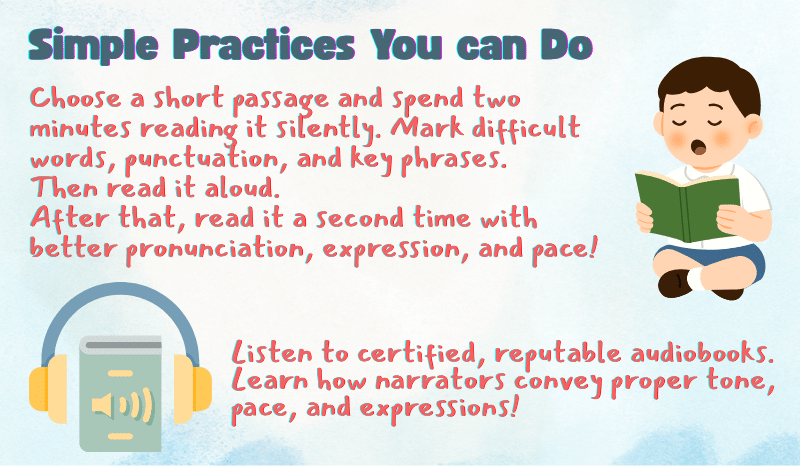
Choose a short passage and spend two minutes reading it silently. Mark difficult words, punctuation, and key phrases. Then read it aloud once. After that, read it a second time with better pronunciation, expression, and pace. This short routine helps you work on several skills at once. Over time, you will notice that you can prepare more quickly and read more confidently.
Another great strategy is listening to certified, reputable audiobooks. By listening to passsages being read, students can better understand pacing, pauses at punctuation marks, expressions, and pronouncing difficult words.
Reading Aloud is not just about sounding confident. It is about understanding the passage, using the right expression, and speaking with clarity under exam conditions. The key is not to wait until the last minute. Start with small, focused practice sessions. Work on pronunciation. Read with expression. Keep a steady pace. Stay calm when mistakes happen. The more you practise these habits, the more natural they will feel in the exam. At WRITERS AT WORK, we help students build these oral skills step by step through guided practice, targeted feedback, and proven PSLE strategies. If your child needs stronger support in PSLE Oral, our programmes are designed to help them speak with greater confidence and perform with purpose.
Ready to help your child grow in English with the right support at every stage?
At WRITERS AT WORK, our programmes are designed to meet students where they are and help them progress with confidence.
For primary students, our PURE Composition Writing Programmes help children build creativity, develop stronger ideas, and learn how to write vivid, well-structured compositions. Our Comprehensive English Programmes support students in key areas such as grammar, comprehension, oral communication, and writing, giving them a strong all-round foundation for school and national exam success.
Beyond the classroom, students and parents can also tap into our wider learning resources through W@W eSeries, and stay updated with tips, insights, and student support on TikTok and Facebook.
The best way to improve in PSLE Reading Aloud is through consistent practice with feedback. Students should learn to pronounce words clearly, pause correctly at punctuation marks, and vary their tone to match the meaning of the passage. Reading aloud daily, even for just a few minutes, can help build confidence, fluency, and expression over time. Another great strategy is listening to reputable audiobooks.
Examiners look for clear pronunciation, smooth pacing, accurate phrasing, and expressive reading that suits the purpose and meaning of the text. A student does not need to sound theatrical, but they should show that they understand the passage and can read it in a natural, engaging way. Good Reading Aloud is not just about saying the words correctly. It is also about reading with understanding and control.
PSLE Oral Exam Tips are helpful because they give students a clear idea of what to focus on, but guided practice often makes the biggest difference. Many students know they should speak clearly or read with expression, yet they may not realise where they are going wrong without expert feedback. At WRITERS AT WORK, we help students turn advice into action through structured oral practice and targeted coaching.

Agnes Ng, Co-Founder and Teaching & Curriculum Director of WRITERS AT WORK. An NUS Honours graduate and published author with over 30 years of experience, Agnes has been the architect of the organization’s student-centric curricula since 2012.
Dedicated to teacher mentorship and academic excellence, she has guided hundreds of students to achieve outstanding results. Her expertise and commitment to high-quality education remain the cornerstone of WRITERS AT WORK’s success in empowering every learner.



Start practising and learning

