
Yet many pupils walk into the exam room with only a vague plan: look at the picture, say something, and hope the examiner moves on. The result is a string of one-line answers that cap their score regardless of how accurate their English may be.
The good news is that strong SBC performance is built on learnable techniques. This guide breaks down seven response strategies your child can practise at home, followed by a preparation plan that turns those strategies into habits before exam day. For a broader overview of the PSLE Oral format and its recent changes, start with our guide to Understanding PSLE English Oral 2025 Changes.
In the SBC, students are shown a real-life photograph—no posters, no text—and asked a series of questions by the examiner. The first question is directly linked to the image. The follow-up questions broaden into personal experience and opinion territory, and they are no longer thematically linked to the Reading Aloud passage.
Examiners assess two main objectives. The first is the ability to express personal opinions, ideas, and experiences clearly (Assessment Objective 3). The second is fluency, grammatical accuracy, and range of vocabulary (Assessment Objective 4). In practice, this means your child needs both substance and delivery. A technically polished but shallow answer scores lower than a well-developed response with minor grammatical slips. For a full list of past questions grouped by theme, visit our Past Years PSLE Oral Questions page.
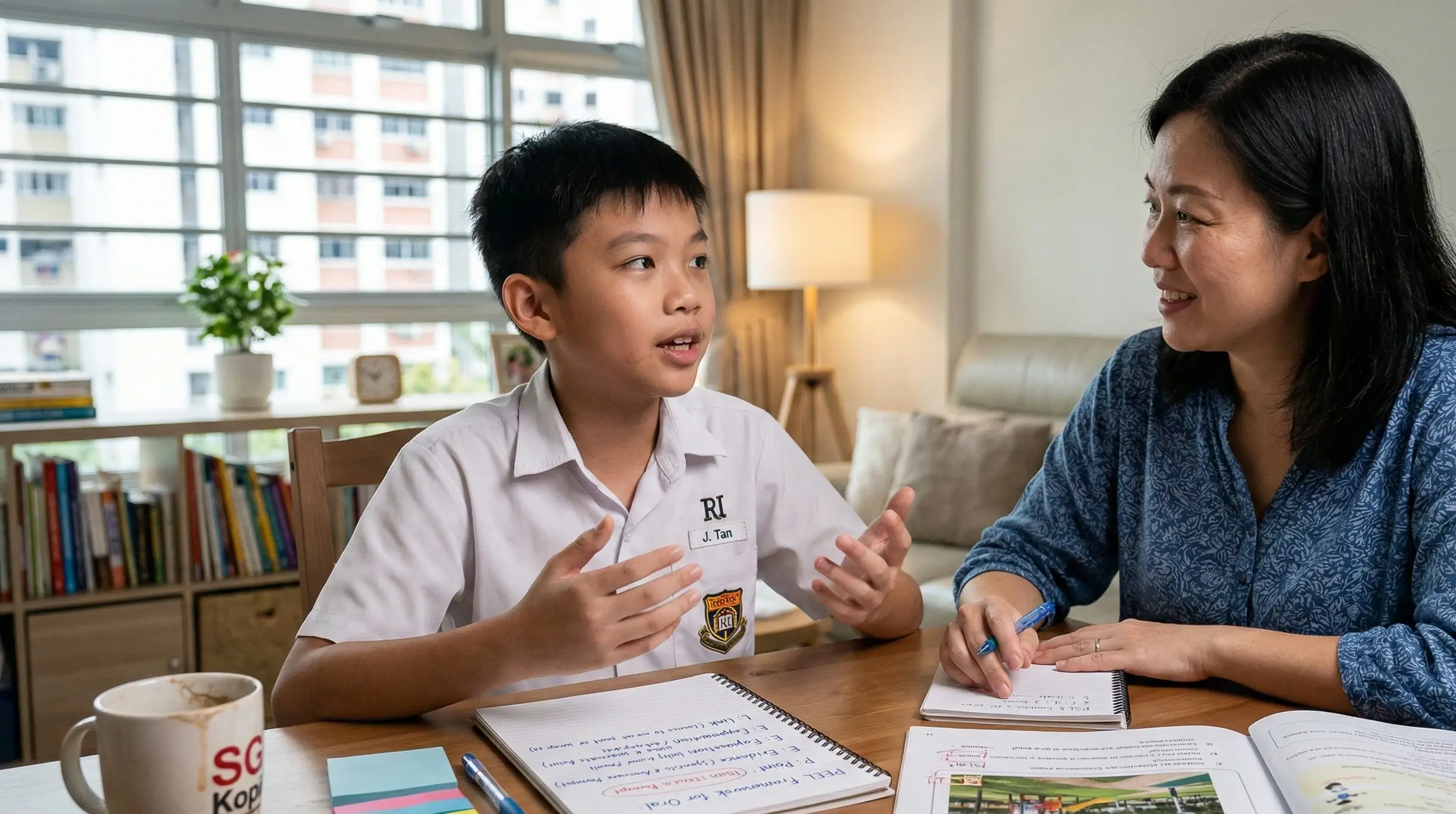
The single most effective upgrade is giving every answer a skeleton. The PEEL framework keeps responses focused and prevents rambling:
• Point – Answer the question directly. If asked whether you agree, say so in the first sentence.
• Elaborate – Explain why. Give one or two reasons behind your position.
• Example – Support your reasoning with a specific incident, observation, or detail.
• Link – Connect back to the question or the photograph to signal that your response is complete.
A student who says “Yes, I enjoy school celebrations because they are fun” scores far less than one who follows up with a reason, a personal anecdote, and a closing link. PEEL takes practice, but once it becomes automatic, students stop giving one-liners without even thinking about it.
Many students glance at the photograph, make one observation, and run out of things to say. The 5W1H method turns a single glance into a systematic scan:
• Who – Children, adults, families, volunteers? How many people and what are their likely relationships?
• What – What is the main activity? Are they playing, helping, celebrating, learning?
• Where – School, park, hawker centre, community centre? What visual clues indicate the setting?
• When – Weekend or school day? Morning or afternoon? Is there a festive or seasonal context?
• Why – What is the purpose of the activity? Staying healthy, bonding, helping others?
• How – What emotions and actions are visible? Smiling, concentrating, rushing, relaxing?
This quick mental scan takes only a few seconds during preparation time but generates enough material for a substantive first answer. For more on how to build rich observations from any photograph, see our PSLE Oral Topics: A 2025 Guide.
Examiners hear hundreds of generic statements: “Reading is important because it helps us learn.” That is true but forgettable. A personal anecdote transforms the same point into something memorable and demonstrates genuine engagement.
After stating an opinion, your child should ask: “When did something like this happen to me?” The answer does not need to be dramatic. Everyday experiences work well—a school event, a family outing, a CCA activity, a conversation with a friend, or something observed in the neighbourhood. The anecdote should be brief: what happened, how they felt, and what they took away from it.
SBC questions fall into two categories. Directly-linked questions ask about the photograph itself: what is happening, who is involved, what the people might be feeling. Broadly-linked questions move into personal experience and opinion. Knowing the difference helps your child shift gears mentally. For the first question, anchor the answer in the image. For the follow-ups, draw on personal stories, feelings, and reasoning. Our Powerful PSLE Oral Tips post walks through model responses for both question types.
When faced with a yes-or-no question, your child should pick the side that gives them more to say—even if it is not their true opinion. If “yes” leads to two strong reasons and a personal story, but “no” leads to a dead end, go with “yes.” The examiner is assessing the quality of communication, not the sincerity of the opinion. Choosing the more developable answer is a strategic decision, not dishonesty.
Body language matters. Sitting upright, maintaining eye contact, smiling naturally, and keeping hands still all project confidence. Speak at a steady pace—not too fast, not too slow. If nerves kick in, taking one slow breath before answering resets the rhythm. Examiners form first impressions quickly, and a composed, engaged student stands out from one who fidgets or mumbles. For a full breakdown of how the current scoring works, refer to our guide on the New PSLE Scoring System.
There is no shortcut. Students who rehearse with a variety of photograph stimuli and question types build the habit of elaborating without overthinking. Parents can help by showing their child any everyday photograph—from a news article, a family album, or a social media post—and asking them to describe it using 5W1H, then answer a follow-up opinion question using PEEL.
Keep a notebook of common themes: family, school life, food, the environment, technology, community, celebrations, and health. Jot down one personal anecdote for each theme so your child has a ready bank of examples to draw from. Regular mock sessions—whether with a parent, a classmate, or a tutor—build fluency, pacing, and the ability to think on the spot. For a curated list of commonly tested themes with vocabulary suggestions, explore our PSLE Oral Topics: A 2025 Guide. You can also practise with real exam questions from our Past Years PSLE Oral Questions page.
• Have I scanned the photograph using 5W1H?
• Am I answering the question directly before elaborating?
• Have I included at least one specific example or personal experience?
• Did I share how I felt or what I learned?
• Am I connecting back to the question or the stimulus?
• Does my answer have a clear ending?
Structured practice is the fastest route to confident oral performance. At WRITERS AT WORK, our curriculum includes regular SBC drills with real-life photograph stimuli, personalised feedback on elaboration and fluency, and coaching on tone, pacing, and body language. If your child needs a clear system for tackling the oral exam, explore our programmes and give them the tools to speak with clarity and confidence.
To understand how the PSLE works overall, visit our complete guide: What Is PSLE in Singapore?. For a breakdown of the latest SBC format with model responses, see our 2025 PSLE Oral SBC Guide.
Since 2025, the stimulus is a real-life photograph with no accompanying text. It typically shows people in an everyday situation—at a hawker centre, a park, a school event, or a community activity. Students must observe and interpret the image independently, without relying on captions or labels.
There is no fixed word count, but a well-developed answer typically takes 20 to 40 seconds to deliver. The goal is substance, not length. A focused 25-second response with a clear point, reason, and example scores higher than a rambling 60-second answer that repeats the same idea. Practise with a timer to develop a sense of appropriate pacing.

Jemmies Siew, Managing Director and Co-Founder of WRITERS AT WORK Enrichment Centre. With over 15 years of experience in education, entrepreneurship, and marketing, Jemmies has helped shape Singapore’s English enrichment landscape through her vision for transformative learning.
She is passionate about connecting real-world issues with language learning, helping students think critically and express themselves clearly. Connect with her on LinkedIn to follow her insights on education, content marketing, and thought leadership.



Start practising and learning

