
Aspirations and role models are some of the most personal topics in the PSLE Oral examination, and the place where examiners can hear most clearly what kind of person your child is becoming. The Stimulus-Based Conversation (SBC) section often draws from this territory because every Primary 6 student has been asked at some point what they want to be when they grow up, and most have an answer that has changed at least once. The question is whether your child can describe a dream, a person they admire, or a small win with the specifics that make those answers their own.
From the 2025 sitting onward, the PSLE Oral is worth 40 marks (20 per cent of the overall English grade), with 25 of those marks allocated to the SBC. The stimulus is a real-life photograph, and your child will be asked three questions: one anchored in the photograph, and two broader questions on personal experience and opinion.
This post breaks the topic into three connected themes, with talking points, vocabulary, sample answer starters, common mistakes and a parent-practice table you can use at home this week. For broader context on the oral exam, our PSLE Oral Topics 2025 Guide is a good place to start.
The SBC rewards children who can observe a photograph carefully and form a clear opinion, supported by personal experience. Aspiration questions invite all of those skills, plus one more: maturity. A child who has practised this topic well can describe a future they are working towards, a real person they look up to, or a moment they kept going when it would have been easier to quit. None of those needs to be grand. The strongest answers come from small specifics.
It is also a topic where memorised lines are easy to spot. “I want to be a doctor because I want to help people” or “My role model is my mother because she is hardworking” are sentences the examiner has heard from every child. The good news is that real material is right there to draw from. Your child has probably watched someone they love work through a difficult week, sat for a difficult test that did not go their way, or seen a Singapore athlete win a medal on television. The work of preparation is connecting those moments to a confident spoken answer.
The blog is organised around three connected themes:
Each theme below uses the same structure: what it covers, possible photo stimuli, likely question angles, three speaking points, useful vocabulary and a sample answer starter.
Future dreams in Singapore have a real foothold in the way the school system is organised. Direct School Admission gives upper primary students a way to apply to secondary schools based on a specific talent or interest. The Ministry of Education’s Applied Learning Programme connects classroom work to real careers from as early as Primary 4. Whether your child is thinking about becoming a doctor, a chef, an engineer or a teacher, the best oral answer is not the most ambitious one. It is the one anchored to something the student has actually noticed about the world. Our post on setting SMART goals is a useful starting point for parents who want to help.
Realistic scenes include:
The photograph is the springboard for the first question. Your child should describe what they see first, then infer the mood of the people in the scene before drifting into personal opinion.
Q1 asks the child to observe and infer; Q2 and Q3 broaden out. Examples:
Point 1: Name the job, then name the reason that came from real life. “I aspire to be a doctor because I want to help people” is the answer the examiner has heard a hundred times. “I aspire to be a doctor because when my grandmother was admitted to hospital last year, I watched her doctor explain things to my family with such patience that we all felt calmer” is a different answer. The reason has to come from somewhere.
Point 2: It is fine not to be sure. A student who says “I am still deciding between teaching and engineering, but both interest me because I like explaining things and I like solving problems” is offering a thoughtful answer. Pretending to be certain when the child is not usually sounds rehearsed.
Point 3: Connect the dream to the next small step. The strongest answers tie a future goal to something the student is doing now. “I want to study marine biology one day, and that is partly why I volunteer with the beach cleanup at Pasir Ris every term.” The link between the long-term and the present is what gives the answer weight.
“Yes, I aspire to be a teacher when I grow up. My P5 form teacher used to stay back after school to help a few of us with our composition writing. She did not have to do that, but she did. I noticed how much it changed the way I felt about English. I have started helping my younger cousin with her spelling on weekends, and I have realised I enjoy explaining things. That is the small first step I am taking now.”
Keep the starter short. The examiner will follow up.
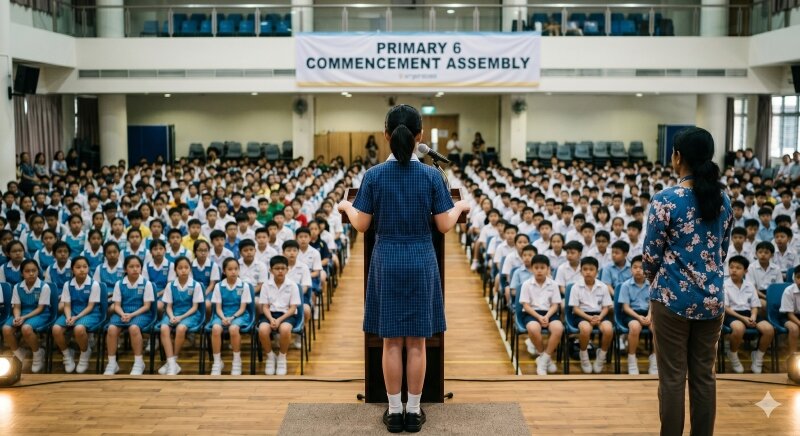
A role model is a person whose actions a student has watched closely enough to learn from. In Singapore, that often means a family member: a parent who has worked long hours without complaining, a grandparent who has lived through hard times with grace, an older sibling who has made it through the same exams the student is facing. It might also be a teacher, a coach, or a Singaporean figure your child has read about. Loh Kean Yew winning the BWF World Championships in 2021, Yip Pin Xiu winning her Paralympic golds in the pool, or Shanti Pereira running her record-breaking 200 metres at the Asian Games are real stories any P6 student can speak about with conviction. The strongest answers name a specific quality and describe a real moment that quality showed up.
Realistic scenes include:
Point 1: Name the quality, not the person. “My mother is hardworking” is a familiar line. “What I admire about my mother is the way she stays calm when she is tired, especially during the weeks she has both a deadline at work and one of us is unwell at home” is a real observation. The quality has to come with evidence.
Point 2: A role model can be someone the student does not know personally. A child who watched Loh Kean Yew lose three matches in a tournament and come back to win the next round, and who can describe what they took away from that, is offering a strong answer. The same is true of a chef they read about, a teacher their cousin had, or a writer of a book they finished last month.
Point 3: End with what the student took from the role model. The most memorable answers do not just describe the person. They describe what changed in the student afterwards. “I have started taking notes after my piano practice the way she takes notes after her training sessions” is a small but very Singaporean P6 example of a lesson actually applied.
“Yes, my role model is my grandmother. What I admire most about her is the way she never wastes anything. She grew up in a kampong in the 1950s, and she still washes and reuses everything she can. Plastic bags get a second life as bin liners. Glass jars become spice containers. The thing that surprised me was how proud she sounds when she explains why. After watching her, I started bringing a reusable bottle to school every day. It is a small habit, but it came from her.”
Singapore primary schools have made resilience and growth mindset a real part of how students are taught. The Ministry of Education’s Social and Emotional Learning framework treats perseverance as a skill to be built, not a personality trait students either have or do not have. Several primary schools, including Woodgrove Primary, run structured growth mindset programmes from P1 to P6. For an oral answer, the most powerful version of this theme is a small honest moment of pushing through. A test that did not go well. A skill that took longer to learn than the student expected. A first time speaking up in class. Our post on breaking down big tasks into achievable milestones is a useful starting point for parents who want to help their child build the habit.
Realistic scenes include:
Point 1: Small moments work better than dramatic ones. A student who describes failing her first Chinese spelling test in P5 and then making a 10-word list every Sunday until the next test came back at 9 out of 10 is offering a perfectly believable answer. Examiners reward honesty.
Point 2: The growth mindset language taught at most Singapore primary schools genuinely lands well. A student who says “I used to think I was just bad at maths, but my P5 teacher kept saying that we had not learned it yet, not that we could not learn it” is showing exactly the kind of self-awareness examiners look for.
Point 3: End with what changed. The most memorable perseverance answers do not stop at the difficult moment. They describe what the student now does differently. “Since then, I check my mistakes the same evening instead of waiting until the next morning” is a small but real shift, and it sounds like a Primary 6 student.
“Yes, the hardest thing I have done was the school debate competition in P5. I had always been afraid of speaking in front of the class. My voice would shake, and I would forget my lines. I almost dropped out twice. My form teacher stayed back after school for three weeks to listen to me practise. On the day of the competition, my voice still shook, but I finished. I lost that round, but I noticed the next time I had to give a presentation in class, my voice was steadier. That experience taught me that confidence is something you build, not something you wait for.”
The most useful thing you can do this week is sit with your child for 15 minutes and walk through one of the prompts below. Aim for a back-and-forth conversation. Skip the recitation drill.
Theme A – Future Dreams and Ambitions
→ Ask Your Child: “What is one job or career that genuinely interests you, and where did that interest come from?”
→ A Good Example to Use: “I want to be a teacher because my P5 form teacher stayed back to help me with composition, and it changed how I felt about English.”
→ Useful Phrase: aspire to
→ What Parents Should Listen For: Does the child name a real moment that made them interested in the career?
Theme B – Learning from Role Models
→ Ask Your Child: “Who is one person you have learned something from this year, and what did you learn?”
→ A Good Example to Use: “My grandmother. What I admire is how she reuses everything. I have started bringing a reusable bottle to school because of her.”
→ Useful Phrase: someone I look up to
→ What Parents Should Listen For: Does the child describe a specific quality and a real moment the quality showed up?
Theme C – Building Confidence and Perseverance
→ Ask Your Child: “What is one thing you used to find hard that you can now do?”
→ A Good Example to Use: “I used to be terrified of giving class presentations, but after the debate competition in P5, my voice does not shake anymore.”
→ Useful Phrase: build my confidence
→ What Parents Should Listen For: Does the child describe what changed after the difficult moment, not just the difficult moment itself?
Use one row per night across a school week. By the weekend, your child has practised all three themes with a real audience.
Most strong SBC answers follow a simple, repeatable shape. Teach your child this five-step structure and they will sound clear and confident in any direction the conversation moves.
This is the same answer shape we coach in our oral classes at WRITERS AT WORK. It gives the examiner everything they are looking for in the SBC rubric: a clear opinion supported by a personal example and a real reason.
Even children who know the topic well lose marks for predictable reasons:
Two photo-stimulus practice scenes to try this week:
Discussion questions to ask after each scene:
A checklist your child can run through before answering:
PSLE Oral preparation rewards consistency more than cleverness. A child who has practised the same answer structure on a dozen everyday topics with a real listener walks into the examination room knowing what to do.
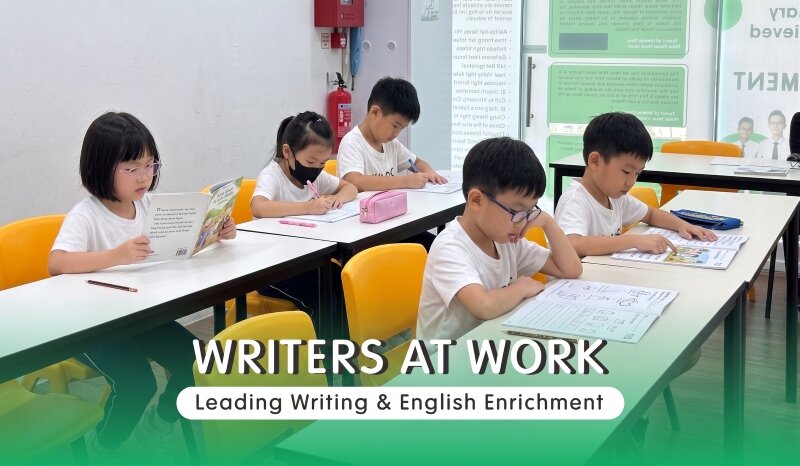
At WRITERS AT WORK, our Primary 5 and Primary 6 English programmes give students that listener in classes where every child speaks and gets feedback. The same disciplined approach that powers our composition work through STORYBANKING® shapes how we coach oral: clear ideas, organised into confident and audible responses. We help students observe carefully and express opinions in a way that sounds natural rather than rehearsed.
She should pick the one she has thought about most recently, but she does not have to commit to it for life. A line such as “I am currently drawn to teaching because of my P5 form teacher, although I went through a phase last year when I wanted to be a chef” is perfectly fine. Honesty about change reads as self-awareness, not indecision.
Begin with the people closest to her. A grandparent, a parent, an older cousin, a teacher who took the time to notice something about her. The best role models for oral answers are usually the ones in the same house or the same school as the student, because the answers come with built-in detail. If she truly cannot think of one, a Singaporean athlete or a character from a book she finished recently is a perfectly good place to start.
Small moments are often stronger than big ones. A first time learning to ride a bicycle and falling several times. A spelling test that came back with a few wrong answers. A swimming lesson she dreaded. The examiner is not asking for a tragedy. They are listening for a real moment when the student kept going.
They are fine on their own, but they need to be earned by the rest of the answer. “I am driven to be a teacher because I make a difference” is empty. “What drew me to teaching is the time my form teacher stayed back to help us with our composition. That is the kind of difference I would like to make for someone else one day” is the same vocabulary doing real work. The phrases are not the problem. The lack of an example is.

Agnes Ng, Co-Founder and Teaching & Curriculum Director of WRITERS AT WORK. An NUS Honours graduate and published author with over 30 years of experience, Agnes has been the architect of the organization’s student-centric curricula since 2012.
Dedicated to teacher mentorship and academic excellence, she has guided hundreds of students to achieve outstanding results. Her expertise and commitment to high-quality education remain the cornerstone of WRITERS AT WORK’s success in empowering every learner.



Start practising and learning

