Family and daily life are some of the most personal topics in the PSLE Oral examination, and the place where examiners can tell most quickly whether a child is reciting a poster or speaking from real life. The Stimulus-Based Conversation (SBC) section often draws from this territory because every Primary 6 student in Singapore has a family and a daily routine to describe. The question is whether your child can do so honestly.
From the 2025 sitting onward, the PSLE Oral is worth 40 marks (20 per cent of the overall English grade), with 25 of those marks allocated to the SBC. The stimulus is a real-life photograph, and your child will be asked three questions: one anchored in the photograph, and two broader questions on personal experience and opinion.
This post breaks the topic into three connected themes, with talking points, vocabulary, sample answer starters, common mistakes and a parent-practice table you can use at home this week. For broader context on the oral exam, our PSLE Oral Topics 2025 Guide is a good place to start.
The SBC rewards children who can observe a photograph carefully and form a clear opinion, supported by personal experience. Family and routine questions invite all of those skills. A child who has practised this topic well can describe the small habits that make up their week without making them sound like a textbook list of duties.
It is also a topic where memorised phrases are easy to spot. “I help my parents with chores” or “Family is important” are familiar lines from every primary school assembly. Examiners can tell within a sentence whether your child is reading from a poster or describing real life. The good news is that real life is right there to draw from. Your child has almost certainly cleared a plate at the dinner table, walked through an HDB void deck after CCA, or sat with a grandparent over Sunday breakfast. The work of preparation is connecting those moments to a confident spoken answer.
The blog is organised around three connected themes:
Each theme below uses the same structure: what it covers, possible photo stimuli, likely question angles, three speaking points, useful vocabulary and a sample answer starter.
Chores at home are about belonging to the family, not just lightening the workload. The Families for Life Council, run by the Ministry of Social and Family Development, frames household tasks as a way for children to learn responsibility and cooperation at home. The Health Promotion Board’s Parenting for Wellness portal uses an “I Do, We Do, You Do” approach: a parent shows the task, then does it together with the child, then hands it over. A student who can describe a chore they have grown into, rather than one they were assigned this morning, sounds genuine and grounded.
There is also a Singapore reality worth being honest about. Roughly 1 in 5 Singapore households employs a foreign domestic worker, so many P5 and P6 students do not do the heavy cooking or deep cleaning at home. That is not a problem. Parents in those families often still expect their children to do their own part, such as clearing the table after dinner or folding their own laundry on a Sunday.
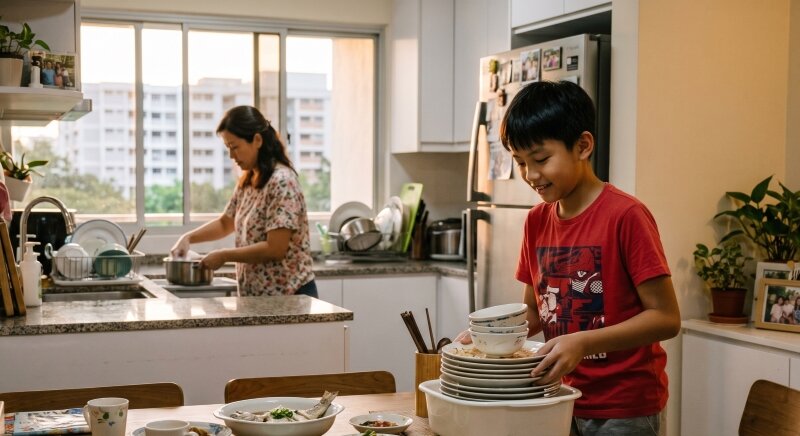
Realistic scenes include:
The photograph is the springboard for the first question. Your child should describe what they see first, then infer the mood of the people in the scene before drifting into personal opinion.
Q1 asks the child to observe and infer; Q2 and Q3 broaden out. Examples:
Point 1: Chores tell the family who you are becoming. Clearing the dinner table, taking out the rubbish, folding clothes, packing your own bag. None of these tasks looks impressive on its own. Together, they signal that your child has stepped from being looked after to being someone the family can count on.
Point 2: Honest answers work better than impressive ones. A student in a family with a helper does not need to claim they cook dinner. A stronger answer names what they actually do: “Our helper handles the cooking and deep cleaning, but my parents made it clear that I am still responsible for my own room and my own school bag.” That sounds like a real Singapore household.
Point 3: Some chores are special because the whole family does them together. Spring cleaning before Chinese New Year is the best-known example. Every member of the household helps wipe shelves, sort old things into donation bags, and put up new decorations. A student who describes this with their own family sounds rooted in their culture and their home at the same time.
“Yes, I do chores at home. My family has a helper, so she handles the cooking and the deep cleaning, but my parents are very clear that I am responsible for my own room and my own laundry. Before Chinese New Year, we all clean together as a family. My mum says it is not about needing the help, it is about learning to look after myself.”
Keep the starter short. The examiner will follow up.

Quality time with family in Singapore is a conscious choice made against busy schedules. The Families for Life Council runs a calendar of campaigns built specifically to protect that time. Eat With Your Family Day, started by the Centre for Fathering in 2003, runs on the last Friday of each school term, when over 600 organisations encourage employees to leave work by five so they can eat dinner with their families. The National Family Festival ran from 31 May to 29 June 2025 as the SG60 edition with over 360 partner organisations. Celebrating Our Grands brings grandparents into the picture every October. A student who can name even one of these campaigns and connect it to something their own family does sounds aware and grounded.
Realistic scenes include:
Point 1: Quality time often hides in routines. Sunday breakfast at the same hawker centre. Friday dinner after Eat With Your Family Day. The 20 minutes before bedtime when a grandparent tells the same old story. The strongest answers describe a regular small ritual, not a special one-off outing.
Point 2: Screens are the modern challenge to family time. A 2025 study found that 83 per cent of Singaporeans use a phone during meals, and the Grow Well SG strategy from January 2025 actively pushes families towards screen-free mealtimes. A child who can describe a real “phones in a basket at dinner” rule, or any version of it, is offering exactly the kind of personal detail examiners reward.
Point 3: Grandparents count too. Many Primary 6 students in Singapore are picked up from school by a grandparent, share Sunday lunches with their extended family, or made a personalised card for Celebrating Our Grands at school. Bringing grandparents into the answer makes the picture of family more complete and more Singaporean.
“Yes, my family spends time together every Sunday. We go to our favourite hawker centre for breakfast with my grandparents. My ah-ma always orders the chwee kueh for me, and my dad and my grandfather argue about which kopi stall is best. Last year my mum started a rule that phones go into a basket on the table before we eat. At first I complained, but now I look forward to that hour more than almost anything else in my week.”
Managing time is one of the most realistic Primary 6 challenges a student can talk about. The Ministry of Education’s homework guidelines suggest about 2 hours of homework a day for P5 and P6 students, on top of school and a packed afternoon schedule of CCA and tuition. Singapore families spent S$1.8 billion on private tuition in 2023, so the question of how to balance schoolwork with family time and rest is genuinely on every PSLE-year student’s plate. The strongest answers come from students who can describe a small habit they have built to take control of their own time, rather than complaining about how busy they are. Our piece on the morning routine for primary kids is a useful starting point for parents who want to help.
Realistic scenes include:
Point 1: Small habits beat big plans. Packing the bag the night before. Finishing homework before opening YouTube. Setting an alarm clock instead of waiting to be woken up. A student who owns even one of these habits sounds far more credible than a student who claims to follow a perfect daily schedule. For more ideas, our post on time management strategies is worth a look.
Point 2: Honest answers about tuition land better than defensive ones. Many P5 and P6 students attend two or three tuition sessions a week. A child who describes how they fit homework around tuition (“I finish part of my homework on the MRT so I can have dinner with my family”) sounds far more in control than one who insists they have no spare time.
Point 3: Responsibility is built through ownership, not nagging. The shift from “my mum reminds me to pack my bag” to “I pack my bag myself the night before” is small but visible. A student who can describe that shift, and even admit that they used to forget things, sounds real and self-aware.
“Yes, I have built a few small habits this year. The biggest one is packing my school bag the night before, after I check the timetable. My mum used to remind me every morning, but now I do it myself, and I have not forgotten a textbook for three months. I also try to finish part of my homework on the MRT after tuition so that I can have dinner with my family without rushing. It feels good to be in control of my own time.”
The most useful thing you can do this week is sit with your child for 15 minutes and walk through one of the prompts below. Aim for a back-and-forth conversation. Skip the recitation drill.
Theme A – Helping with Household Chores
→ Ask Your Child: “What is one chore that has become yours alone?”
A Good Example to Use: “I have been clearing the dinner table every night for the past year, and now my parents do not even ask anymore.”
Useful Phrase: do my part at home
What Parents Should Listen For: Does the child name a specific chore they have grown into?
Theme B – Spending Quality Time with Family
→ Ask Your Child: “What is one family ritual you would not want to lose?”
→ A Good Example to Use: “Sunday breakfast at our hawker centre with my grandparents. My ah-ma always orders the chwee kueh for me.”
→ Useful Phrase: a regular family ritual
→ What Parents Should Listen For: Does the child describe a specific ritual rather than a one-off outing?
Theme C – Managing Time and Responsibilities
→ Ask Your Child: “What is one habit you have built to take control of your time?”
→ A Good Example to Use: “I pack my school bag the night before, so I do not forget anything in the morning.”
→ Useful Phrase: take ownership
→ What Parents Should Listen For: Does the child describe a habit they own, rather than a rule they follow?
Use one row per night across a school week. By the weekend, your child has practised all three themes with a real audience.
Most strong SBC answers follow a simple, repeatable shape. Teach your child this five-step structure and they will sound clear and confident in any direction the conversation moves.
This is the same answer shape we coach in our oral classes at WRITERS AT WORK. It gives the examiner everything they are looking for in the SBC rubric: a clear opinion supported by a personal example and a real reason.
Even children who know the topic well lose marks for predictable reasons:
Two photo-stimulus practice scenes to try this week:
Discussion questions to ask after each scene:
A checklist your child can run through before answering:
PSLE Oral preparation rewards consistency more than cleverness. A child who has practised the same answer structure on a dozen everyday topics with a real listener walks into the examination room knowing what to do.
At WRITERS AT WORK, our Primary 5 and Primary 6 English programmes give students that listener in classes where every child speaks and gets feedback. The same disciplined approach that powers our composition work through STORYBANKING® shapes how we coach oral: clear ideas, organised into confident and audible responses. We help students observe carefully and express opinions in a way that sounds natural rather than rehearsed.
Honestly. A simple line such as “Our helper handles the cooking and deep cleaning, but I am responsible for my own room and for clearing my own plate after dinner” sounds far stronger than pretending to do chores the child does not actually do. Parents who set this expectation are giving their child both the chore and the right way to talk about it.
One memorable campaign can lift an answer if it connects to something the family actually does. Eat With Your Family Day works if the child’s parent has come home early on those Fridays. Celebrating Our Grands works if the child made a card at school for it. Choose one that maps onto a real family moment, and let the rest go.
Try the phrase “What do you do inside that busy schedule?” The shift from “I have no time” to “I have learned to use the gaps” is the single biggest improvement on this topic. Doing part of the homework on the MRT, protecting dinner with the family, or packing the bag the night before all show that the child has a relationship with their schedule, not just a complaint about it.
Not at all. A small honest habit is just as strong as a polished system. “I am trying to pack my bag the night before, but I forget about once a week” is more credible than “I always finish my homework on time.” The examiner is not checking a list. They are listening for self-awareness.

Agnes Ng, Co-Founder and Teaching & Curriculum Director of WRITERS AT WORK. An NUS Honours graduate and published author with over 30 years of experience, Agnes has been the architect of the organization’s student-centric curricula since 2012.
Dedicated to teacher mentorship and academic excellence, she has guided hundreds of students to achieve outstanding results. Her expertise and commitment to high-quality education remain the cornerstone of WRITERS AT WORK’s success in empowering every learner.



Start practising and learning

