Hobbies are one of the friendliest topics in the PSLE Oral examination, and one where examiners can tell most quickly whether a child is being themselves. The Stimulus-Based Conversation (SBC) section often draws from this territory because every Primary 6 student has at least one thing they have done for fun this year, even if PSLE has shrunk the list. The question is whether your child can describe it with specifics, or whether they will fall back on a generic line about the importance of reading.
From the 2025 sitting onward, the PSLE Oral is worth 40 marks (20 per cent of the overall English grade), with 25 of those marks allocated to the SBC. The stimulus is a real-life photograph, and your child will be asked three questions: one anchored in the photograph, and two broader questions on personal experience and opinion.
This post breaks the topic into three connected themes, with talking points, vocabulary, sample answer starters, common mistakes and a parent-practice table you can use at home this week. For broader context on the oral exam, our PSLE Oral Topics 2025 Guide is a good place to start.
The SBC rewards children who can observe a photograph carefully and form a clear opinion, supported by personal experience. Hobby questions invite all of those skills, plus one more: personality. A child who has practised this topic well can describe the book on their bedside table or the piano piece they are working on with the kind of specifics that turn a generic answer into a real one.
It is also a topic where the difference between a CCA and a hobby matters. A CCA is something a school has assigned. A hobby is something a child has chosen. The examiner is asking about the second. A student who plays badminton in CCA can absolutely say so, but the stronger answer is what they do with the sport when no one is making them: a casual game with cousins on a Sunday morning, a YouTube channel they follow for technique, a player they keep up with.
The blog is organised around three connected themes:
Each theme below uses the same structure: what it covers, possible photo stimuli, likely question angles, three speaking points, useful vocabulary and a sample answer starter.
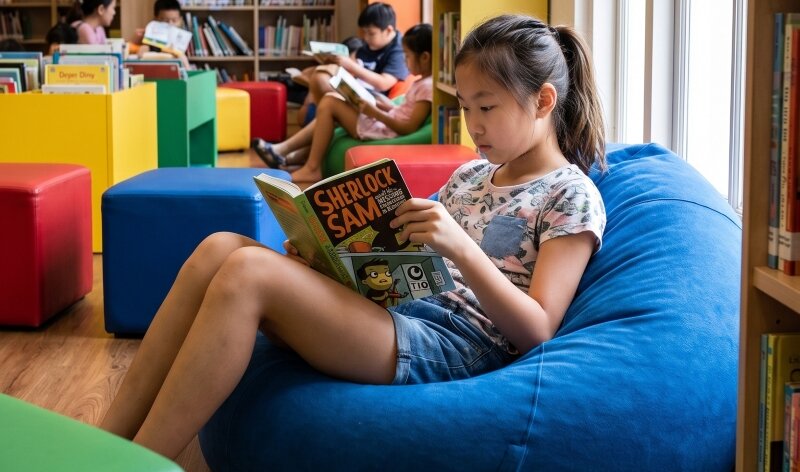
Reading is alive and well in Singapore. The National Library Board’s most recent National Reading Habits Study, published in June 2025, found that 90 per cent of teenagers had read at least one book in the past year and that 81 per cent read multiple times a week. Physical books still dominate, even among readers who also borrow from the NLB Mobile app. The catch is that 62 per cent of readers say they spend more time on other activities than on books. The strongest oral answer is not a sermon about why reading matters. It is a clear, specific description of what your child is actually reading. Our piece on reading more effectively and efficiently is a useful starting point for parents who want to build the habit.
Realistic scenes include:
The photograph is the springboard for the first question. Your child should describe what they see first, then infer the mood of the people in the scene before drifting into personal opinion.
Q1 asks the child to observe and infer; Q2 and Q3 broaden out. Examples:
Point 1: Name the book. Name a character. Name something that happened. “I read Sherlock Sam and the Vanished Robot in Kembangan” lands miles ahead of “I read books.” Specificity is the single biggest jump in oral quality for this theme, and our post on fun ways to improve your child’s vocabulary gives parents practical ways to support it.
Point 2: Singapore has built reading habits at scale. NLB membership is free, every member can borrow 16 eBooks at a time on the NLB Mobile app, and campaigns like Book Bugs and Read for Books are run every year. The 2025 Read for Books drive raised 3,190 books for beneficiaries. A student who can name even one NLB initiative sounds informed and current.
Point 3: The honest answer about reading versus scrolling is the strongest one. A child who admits that they sometimes choose YouTube over a book, and who then describes a small habit such as reading 15 minutes before bed, sounds far more credible than one who claims to read every spare minute.
“Yes, I have been reading a book called Sherlock Sam and the Missing Heirloom in Katong. The main character is a 10-year-old detective who solves mysteries with his robot Watson. My favourite scene is when he uses an old photograph to crack the case. I borrowed it from the Tampines library last weekend, and I finished it in two evenings. I tend to read 15 minutes before bed because it helps me sleep better than scrolling does.”
Keep the starter short. The examiner will follow up.
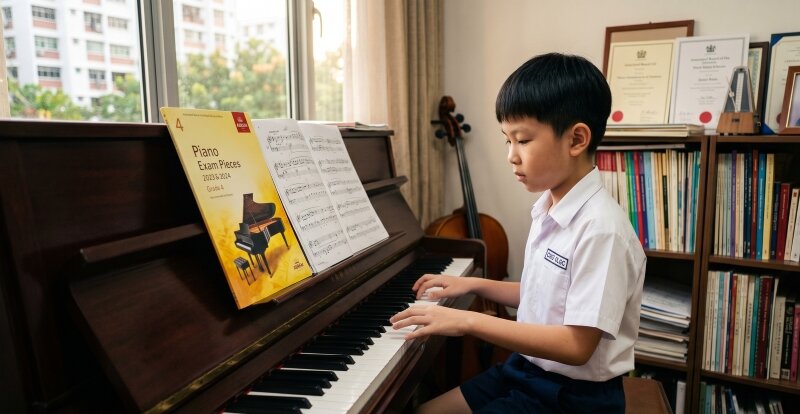
This is the theme where the difference between a CCA and a hobby matters most. A CCA is selected from a school’s list and runs on a school timetable. A hobby is something your child carries into their own time. Singapore has a deep enrichment landscape around this kind of personal interest. Around 30,000 students sit ABRSM music examinations a year, the Singapore National Youth Orchestra has 180 members drawn from over 60 schools, and Helen O’Grady Drama Academy runs weekly speech and drama classes in centres across the island. The strongest answers come from students who can describe what they are working on, in their own words.
Realistic scenes include:
Point 1: Name the activity, then name the detail. “I play piano” is a beginning. “I am working on a Grade 4 ABRSM piece called Sonatina in C by Clementi, and I practise four times a week” is a real answer. The detail is what tells the examiner this is a real hobby and not a generic claim.
Point 2: Be honest about PSLE-year reality. Many P6 students have paused a hobby this year. Saying “I used to attend wushu every Saturday at my community club, but I stopped in P5 to focus on PSLE, and I am looking forward to going back next year” sounds far more grounded than pretending the schedule is unchanged. The honesty itself is the answer.
Point 3: Gaming counts if the answer earns it. “I play Roblox” stops conversations dead. “I build my own role-play worlds on Roblox, and last term my classmates and I made a replica of our school canteen that 300 visitors have explored” is a completely different answer. The same rule applies to any hobby. Specificity earns the marks.
“Yes, I enjoy playing chess. I started in Primary 3, and I now play in the chess interest group at my community club every Saturday morning. Recently I learned a strategy called the King’s Indian Defence, and I tried it for the first time last week. I lost, but I noticed I lasted twenty moves longer than I usually do. I have not stopped playing during PSLE year because it helps me think more calmly under pressure.”
Singapore has built a wide range of ways for primary school students to pick up skills beyond the school timetable. The Ministry of Education’s Code for Fun programme has reached over 50,000 upper primary students a year since it became mandatory in 2020, and the new AI for Fun modules launched in 2025. Outside school, Saturday Kids has taught coding to thousands of children since 2012, and mother-tongue language enrichment is widely available through community-based self-help groups, covering every mother tongue taught in Singapore schools. The strongest answers come from students who can describe one skill they have built up over time, however small. A drawing in a sketchbook, a steady improvement at a musical instrument, a recipe learned from a grandparent. All of these count.
Realistic scenes include:
Point 1: Self-taught counts. A child who has been learning to draw manga characters from YouTube tutorials since Primary 4 and has filled three sketchbooks is describing a real hobby and a real skill. The fact that no one is grading the progress makes it more, not less, credible.
Point 2: Learning from a family member is a uniquely strong answer. A student who can describe learning to make kueh dadar with their grandmother during the last school holidays is offering exactly the kind of specific, cultural, in-person example examiners reward. The skill and the relationship come through in a single sentence.
Point 3: Pick one skill. Many students try to list four or five things they are good at, and the answer ends up sounding like a CV. Choosing one skill and going deep on it, even if the progress feels modest, sounds much more like a real Primary 6 student. The examiner is not counting items. They are listening for depth.
“Yes, I have been learning to bake with my mother. We started during the school holidays at the end of last year, when she taught me how to fold egg whites for a chiffon cake. The first one I made on my own was too dry, but the third one came out fluffy and I sent a photo to my grandmother. I like baking because it is one of the few things I do where I can clearly see whether I improved from the last time.”
The most useful thing you can do this week is sit with your child for 15 minutes and walk through one of the prompts below. Aim for a back-and-forth conversation. Skip the recitation drill.
Theme A – Reading for Enjoyment
→ Ask Your Child: “What was the last book you finished?”
→ A Good Example to Use: “Sherlock Sam and the Missing Heirloom in Katong. I finished it in two evenings.”
→ Useful Phrase: lose myself in a book
→ What Parents Should Listen For: Does the child name a specific book and one thing that happened in it?
Theme B – Sports, Music, Art or Other Hobbies
→ Ask Your Child: “What is one hobby you do outside school?”
→ A Good Example to Use: “I play chess at my community club every Saturday morning. I learned a new opening last week.”
→ Useful Phrase: something I do for fun
→ What Parents Should Listen For: Does the child describe a hobby, not just a CCA?
Theme C – Learning New Skills Outside School
→ Ask Your Child: “What is one skill you have picked up that nobody made you learn?”
→ A Good Example to Use: “I taught myself to bake a chiffon cake with my mum. My third try came out fluffy.”
→ Useful Phrase: pick up a new skill
→ What Parents Should Listen For: Does the child go deep on one skill rather than list many?
Use one row per night across a school week. By the weekend, your child has practised all three themes with a real audience.
Most strong SBC answers follow a simple, repeatable shape. Teach your child this five-step structure and they will sound clear and confident in any direction the conversation moves.
This is the same answer shape we coach in our oral classes at WRITERS AT WORK. It gives the examiner everything they are looking for in the SBC rubric: a clear opinion supported by a personal example and a real reason.
Even children who know the topic well lose marks for predictable reasons:
Two photo-stimulus practice scenes to try this week:
Discussion questions to ask after each scene:
A checklist your child can run through before answering:
PSLE Oral preparation rewards consistency more than cleverness. A child who has practised the same answer structure on a dozen everyday topics with a real listener walks into the examination room knowing what to do.
At WRITERS AT WORK, our Primary 5 and Primary 6 English programmes give students that listener in classes where every child speaks and gets feedback. The same disciplined approach that powers our composition work through STORYBANKING® shapes how we coach oral: clear ideas, organised into confident and audible responses. We help students observe carefully and express opinions in a way that sounds natural rather than rehearsed.
Ask “What was the last book?” Then ask “What happened in the part you liked best?” The shift from a general claim about reading to a specific book and a specific scene is the single biggest improvement on this topic. If your child cannot name the last book, that is the first thing to work on.
Not if they can describe it well. “I play Roblox” is a weak answer. “I build my own role-play worlds on Roblox, and our class server has 300 visitors this month” is a strong one. The same rule applies to any hobby. The examiner is listening for specifics, not approving the activity.
No. Honesty is the stronger answer. A line such as “I used to attend ABRSM grade four piano lessons every Saturday, but I stopped in P5 to focus on PSLE. I miss the feeling of finishing a piece, and I am planning to go back next year” sounds much more like a real student than a fabricated current hobby.
Start small and start local. Borrow one Sherlock Sam title or one Diary of a Wimpy Kid book from the NLB this weekend. Reading 15 minutes before bed for two weeks builds enough of a habit to give a real oral answer. The point is not to become a reader overnight, but to have one specific book and one moment from it to talk about in the exam.

Agnes Ng, Co-Founder and Teaching & Curriculum Director of WRITERS AT WORK. An NUS Honours graduate and published author with over 30 years of experience, Agnes has been the architect of the organization’s student-centric curricula since 2012.
Dedicated to teacher mentorship and academic excellence, she has guided hundreds of students to achieve outstanding results. Her expertise and commitment to high-quality education remain the cornerstone of WRITERS AT WORK’s success in empowering every learner.



Start practising and learning

