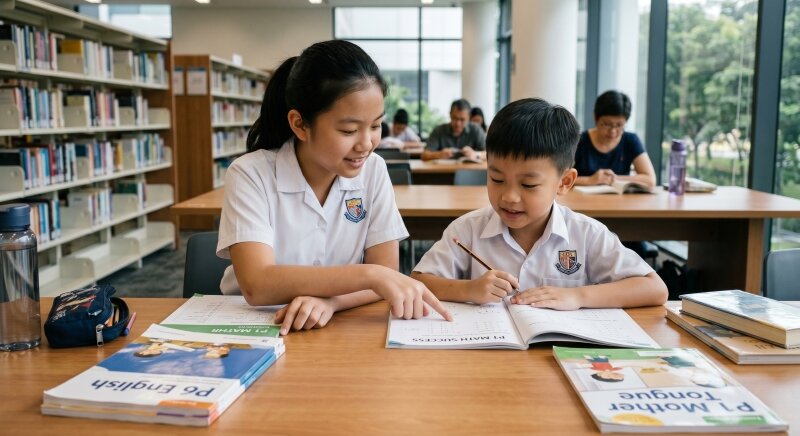
Kindness is one of the most heart-warming topics in the PSLE Oral examination, and one of the easiest to mishandle. Every Singaporean child has been told to be kind since Primary 1, and every child knows the right things to say. The Stimulus-Based Conversation (SBC) section often draws from this territory because it gives the examiner a clear window into whether your child is reciting a Character and Citizenship Education (CCE) poster or describing real moments. Past PSLE oral questions in circulation have asked students about volunteering and what they have done for others.
From the 2025 sitting onward, the PSLE Oral is worth 40 marks (20 per cent of the overall English grade), with 25 of those marks allocated to the SBC. The stimulus is a real-life photograph, and your child will be asked three questions: one anchored in the photograph, and two broader questions on personal experience and opinion. You can read more in our guide to the 2025 oral changes.
This post breaks the topic into three connected themes, with talking points, vocabulary, sample answer starters, common mistakes and a parent-practice table you can use at home this week.
The SBC rewards children who can observe a photograph carefully and form a clear opinion, supported by personal experience. Kindness questions invite all of those skills. A child who has practised this topic well can describe what is happening at a lift door, then explain a small moment from their own week without sounding rehearsed.
It is also a topic where memorised slogans are easy to spot. “Kindness is important” and “We should help one another” are familiar lines from every primary school assembly. Examiners can tell within a sentence whether your child is reciting a poster or speaking from real experience. The good news is that real experience is within reach. Your child has almost certainly helped a younger pupil at recess, sat with a grandparent who wanted to talk, or contributed to a Values-in-Action (VIA) project at school. The work of preparation is connecting those small moments to a confident spoken answer.
For more topic ideas across the syllabus, see our PSLE Oral Topics 2025 Guide.
The blog is organised around three connected themes:
Each theme below uses the same structure: what it covers, possible photo stimuli, likely question angles, three speaking points, useful vocabulary and a sample answer starter.
This theme covers the small daily acts of help that build the relationships closest to your child: classmates at school and neighbours at home. The Buddy System pairs Primary 4 and 5 pupils with incoming P1 children at the start of every school year, and every MOE primary school now has a Peer Support Relationship (PSR) programme with trained Peer Support Leaders. On the neighbourhood side, the Singapore’s Friendly Neighbourhood Award organised by HDB and the Singapore Kindness Movement received 232 nominations in 2025, each one a story of residents looking out for one another. A child who can point to a real moment from their own school or block sounds grounded and credible.
Realistic scenes include:
The photograph is the springboard for the first question. Your child should describe what they see first, then infer the mood of the people in the scene before drifting into personal opinion.
Q1 asks the child to observe and infer; Q2 and Q3 broaden out. Examples:
Point 1: Help often looks small. Picking up a classmate’s pencil case without being asked, sharing notes with someone who was absent due to illness, sitting with a new pupil who is eating alone at recess. None of these takes more than a minute. All of them say something true about the kind of person your child is becoming.
Point 2: The Buddy System taught most P5 and P6 students how to take responsibility for someone younger. A student who has been a buddy can describe what they actually did: walking a P1 child to the canteen, showing them where the toilets are, helping them queue at the drinks stall. This is concrete and credible.
Point 3: Knowing the neighbours matters. Friendly neighbourhoods build themselves from short conversations at the lift, a held door, a quick “hello, how are you?” exchanged when passing in the corridor. Students who can describe a real moment with a neighbour sound aware of their community in a way that a slogan cannot match.
“Yes, I helped a classmate recently. He missed two days of school because of fever, and on the third day he sat down looking lost during our maths lesson. I quietly slid my notes across the table and stayed back during recess to explain the questions he had missed. He thanked me, and I realised I had probably done the same thing he would have done for me.”
Keep the starter short. The examiner will follow up.
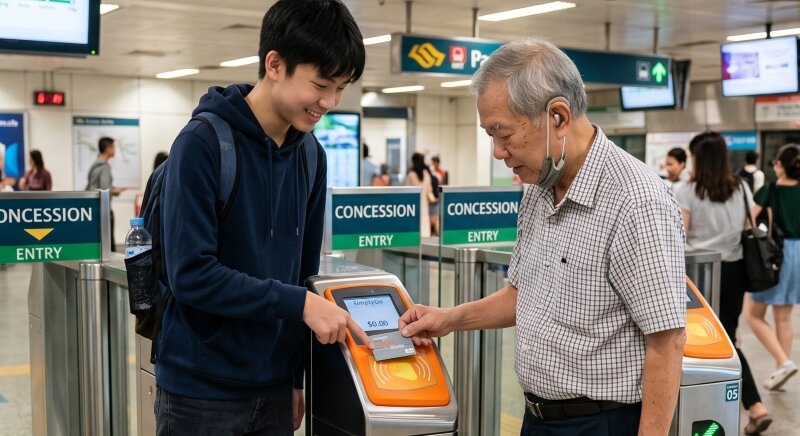
Singapore is on the verge of becoming a super-aged society in 2026, meaning more than 21 per cent of citizens will be aged 65 and above. By 2030, the figure is expected to reach roughly 1 in 4 Singaporeans. The country has responded with 223 Active Ageing Centres islandwide, around 3,000 Silver Generation Ambassadors who visit seniors door-to-door, and an Age Well Neighbourhoods initiative announced at the 2025 National Day Rally, starting in Toa Payoh. Kindness to the elderly is no longer a small private matter. It is one of the defining habits a Singaporean child will need to grow up with.
Realistic scenes include:
Point 1: Respect is the right frame. Saying “old people need our help” can sound a little patronising. A stronger frame is that seniors have a lifetime of experience worth listening to, and that small acts of attention are a form of care. A student who pauses to ask their grandfather about his school days is doing more than they realise.
Point 2: Practical help has a real role too. Many seniors now use SimplyGo at MRT gantries, and not all of them are confident with the change. Showing an uncle where to tap a card, or teaching a grandmother to use WhatsApp video calls, sounds modern and grounded in real life rather than a textbook script.
Point 3: Volunteering with seniors is more accessible than students think. Lions Befrienders has been visiting socially isolated seniors at home since 1995. RSVP Singapore, the National Centre of Excellence for Senior Volunteerism, has over 4,500 active volunteers. Active Ageing Centres run cardio drumming and art classes that students help with through school VIA projects.
“Yes, I spend time with my grandfather every Sunday. He used to teach Chinese at a primary school, and he loves telling me stories from when he was younger. I help him use WhatsApp to send voice messages to his old colleagues. The more I listen, the more he smiles. I think that is one of the simplest forms of kindness.”
Closer to exam season, our exam-prep guide for PSLE oral walks parents through the final two weeks.
Volunteering and community service are where small acts of kindness meet organised effort. Singapore has SG Cares Volunteer Centres in all 24 HDB towns, an SG Cares App that lists opportunities, and around 138,000 volunteers across the social service sector. The Great Singapore Give 2025 campaign aimed to raise more than $42 million in donations and rally 10,000 volunteer sign-ups under the theme “Everyone Can Give”. The President’s Volunteerism and Philanthropy Awards (PVPA) 2025 saw a record 451 nominations, more than 50 per cent up from 2024. A student who can describe even one Values-in-Action project from their own school can connect to all of this with credibility. For background on what young volunteering looks like in Singapore, see our piece on youth volunteerism and the spirit of giving.
Realistic scenes include:
Point 1: Real Values-in-Action projects tell the most credible stories. Dazhong Primary’s P5 cohort packed care packs and wrote thank-you cards for estate cleaners in 2024. Punggol Green Primary sent students to spend an afternoon with injured migrant workers. A student who can describe a project they personally took part in, including what they learned, sounds far stronger than one who lists charities.
Point 2: Volunteering changes the volunteer too. The 2024 Be Greater campaign by the Singapore Kindness Movement reached more than 11 million views with short films arguing that kindness should be a part of who we are, not a one-off gesture. A student who can say “I went into the food sorting expecting to help, but I came out understanding what hunger means in my own neighbourhood” is offering exactly the kind of reflection examiners reward. For more on how volunteering shapes children, our post on the impact of volunteering on child development is a good starting point.
Point 3: Community service is more accessible than students think. SG Cares Volunteer Centres exist in every HDB town. Charities such as ItsRainingRaincoats, which marked its 10th anniversary in 2025 with a $125,000 Heart Fund for migrant workers in emergencies, welcome school volunteers. A student who has even one named example sounds informed and engaged.
“Yes, my class did a Values-in-Action project last term where we wrote appreciation cards for the estate cleaners around our school. I had walked past those cleaners every day for years without saying anything. When I handed over the card I had drawn, the uncle held it carefully and said it was the first time anyone had given him one. I will not forget that, and I have started saying good morning to him whenever I see him now.”
For more practice prompts, our page of past PSLE oral questions is the closest thing to a real warm-up.
The most useful thing you can do this week is sit with your child for 15 minutes and walk through one of the prompts below. Aim for a back-and-forth conversation. Skip the recitation drill.
Theme A – Helping Classmates and Neighbours
→ Ask Your Child: “When was the last time a classmate or neighbour helped you?”
→ A Good Example to Use: “My neighbour next door watered our plants the week we travelled, and we left a thank-you card and some cookies on her doorstep.”
→ Useful Phrase: look out for one another
→ What Parents Should Listen For: Does the child describe a specific moment rather than a general claim?
Theme B – Showing Kindness to the Elderly
→ Ask Your Child: “How do you spend time with your grandparents or older neighbours?”
→ A Good Example to Use: “I taught my grandmother to send voice messages on WhatsApp, and now she sends me one every morning before school.”
→ Useful Phrase: lend a patient ear
→ What Parents Should Listen For: Does the child frame seniors as people to listen to, rather than people to help?
Theme C – Volunteering and Community Service
→ Ask Your Child: “Tell me about a Values-in-Action project you have done at school.”
→ A Good Example to Use: “We packed care packs for cleaners, and the supervisor said it was the first time anyone had given his team appreciation cards.”
→ Useful Phrase: give back to the community
→ What Parents Should Listen For: Does the child say what they learned from the project, not just what they did?
Use one row per night across a school week. By the weekend, your child has practised all three themes with a real audience.
Most strong SBC answers follow a simple, repeatable shape. Teach your child this five-step structure and they will sound clear and confident in any direction the conversation moves.
This is the same answer shape we coach in our oral classes at WRITERS AT WORK. It gives the examiner everything they are looking for in the SBC rubric: a clear opinion supported by a personal example and a real reason. For more exam strategies, this blog is worth a read.
Even children who know the topic well lose marks for predictable reasons:
Two photo-stimulus practice scenes to try this week:
Discussion questions to ask after each scene:
A checklist your child can run through before answering:
Closer to exam season, our exam-prep guide for PSLE oral walks parents through the final two weeks.
PSLE Oral preparation rewards consistency more than cleverness. A child who has practised the same answer structure on a dozen everyday topics with a real listener walks into the examination room knowing what to do.
At WRITERS AT WORK, our Primary 5 and Primary 6 English programmes give students that listener in classes where every child speaks and gets feedback. The same disciplined approach that powers our composition work through STORYBANKING® shapes how we coach oral: clear ideas, organised into confident and audible responses. We help students observe carefully and express opinions in a way that sounds natural rather than rehearsed.
Ask for a specific moment outside the house. “Tell me about a time you helped someone at school” or “Can you think of something you did for a neighbour?” The shift from a general claim (helping parents) to a concrete moment (carrying a P1 pupil’s bag, holding the lift for an auntie) is the single biggest jump in oral quality for this topic.
One memorable number can lift an answer, but more than that becomes recitation. The figure that 1 in 4 Singaporeans will be aged 65 or above by 2030 is worth remembering because it grounds an opinion about why kindness to seniors matters. The 24 SG Cares Volunteer Centres across HDB towns is another useful anchor. Choose one per theme and let it earn its place.
Not at all. A small honest moment at school or at home is just as strong. “I held the lift for an auntie with grocery bags last week” or “I sat with a new classmate at recess so she would not eat alone” are both perfectly grounded examples. The examiner is not checking a list.
Change the verb. Instead of “I help my grandmother”, try “I spend time with my grandmother” or “I listen to my grandmother’s stories”. The shift from “help” to “spend time with” or “listen to” reframes the relationship from one-way care to two-way respect, which is what a strong oral answer sounds like.

Agnes Ng, Co-Founder and Teaching & Curriculum Director of WRITERS AT WORK. An NUS Honours graduate and published author with over 30 years of experience, Agnes has been the architect of the organization’s student-centric curricula since 2012.
Dedicated to teacher mentorship and academic excellence, she has guided hundreds of students to achieve outstanding results. Her expertise and commitment to high-quality education remain the cornerstone of WRITERS AT WORK’s success in empowering every learner.



Start practising and learning

