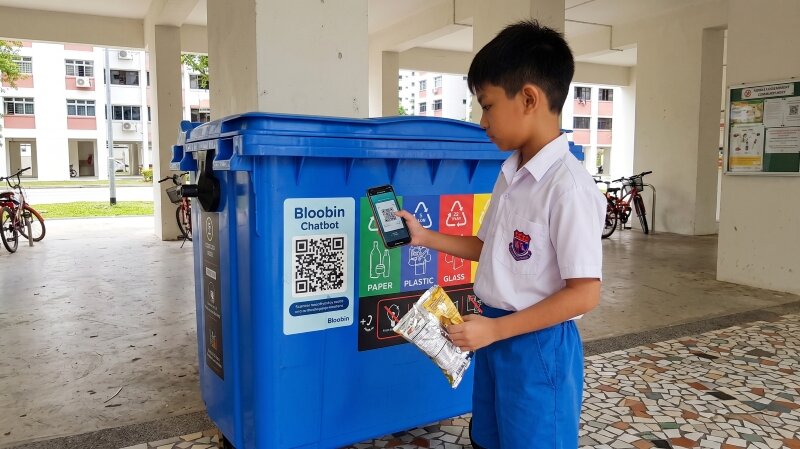
The environment is one of the most enduring conversation topics in the PSLE Oral examination, and one of the easiest for parents to engage with. It runs through the Primary Social Studies and Science syllabus, and it features in almost every Singaporean child’s daily life: the blue Bloobin near their HDB block, the canteen tray they return after recess, the 25-degree air-conditioner setting at home, the school water bottle they refill at the fountain. Past PSLE oral questions in circulation have asked students how they recycle at home and whether they think Singapore is doing enough to reduce waste.
From the 2025 sitting onward, the PSLE Oral is worth 40 marks (20 per cent of the overall English grade), with 25 of those marks allocated to the Stimulus-Based Conversation (SBC). The stimulus is a real-life photograph, and your child will be asked three questions: one anchored in the photograph, and two broader questions on personal experience and opinion. You can read more in our guide to the 2025 oral changes.
This post breaks the topic into three connected themes, with talking points, vocabulary, sample answer starters, common mistakes and a parent-practice table you can use at home this week.
The SBC rewards children who can observe a photograph carefully and form a clear opinion, supported by personal experience. Environmental questions invite all of those skills. A child who has practised this topic well can describe what is happening at a Bloobin recycling station, then weigh up whether Singaporeans are doing enough to reduce waste.
It is also a topic where memorised slogans are easy to spot. “Reduce, reuse, recycle” and “We must save Mother Earth” are familiar lines from every primary school assembly. Examiners can tell within a sentence whether your child is reciting a poster or speaking from real experience. The good news is that real experience is within reach. Your child has almost certainly switched off a classroom light, refilled a water bottle at the school fountain, returned a hawker centre tray, and helped sort old batteries for an ALBA bin. The work of preparation is connecting those small moments to a confident spoken answer.
For more topic ideas across the syllabus, see our PSLE Oral Topics 2025 Guide.
The blog is organised around three connected themes:
Each theme below uses the same structure: what it covers, possible photo stimuli, likely question angles, three speaking points, useful vocabulary and a sample answer starter.
Recycling in Singapore means putting clean paper, plastic, glass and metal items into the blue Bloobin, which collects all four materials together. Items do not need to be sorted by the household; they are separated later at a Materials Recovery Facility. The catch is contamination. About 40 per cent of what goes into the blue bin nationwide is either food-stained or non-recyclable, and ends up incinerated anyway. A student who understands that the bin is not a magic box, and that what they put in matters, sounds informed and grounded.
Realistic scenes include:
The photograph is the springboard for the first question. Your child should describe what they see first, then infer the mood of the people in the scene before drifting into personal opinion.
Q1 asks the child to observe and infer; Q2 and Q3 broaden out. Examples:
Point 1: The blue bin only works if what goes in is clean. NEA’s data shows that contamination in the blue bin has stayed at around 40 per cent since 2017. That means almost half of what households put in cannot be recycled because it is stained with food or liquid, or because it is the wrong material entirely. A student who rinses out a milk carton before recycling is doing something genuinely useful.
Point 2: Soft plastics do not go in the Bloobin. Plastic bags and crisp packets are two everyday items that look recyclable but are not. Many students learn the slogan “all plastic can be recycled” and never check whether that is true. The honest answer is that hard, clean plastic bottles go in the bin, but soft plastics must go in the general waste.
Point 3: Singapore now has tools that make recycling easier to get right. NEA launched the Bloobin AI chatbot in September 2024 on WhatsApp and Telegram. A student who is unsure whether a foil snack bag can be recycled can send a photo to the chatbot and get an answer within seconds. Knowing about practical tools like this signals genuine engagement with the topic.
“Yes, I have been unsure before. I once held a foil potato chip bag in front of the Bloobin at my void deck and could not decide. In the end, I checked the Bloobin chatbot on WhatsApp, and it told me foil bags are not recyclable. Since then, I have learned to check before tossing.”
Keep the starter short. The examiner will follow up. For more ideas across the oral syllabus, see our PSLE Oral Topics 2025 Guide.
Public cleanliness in Singapore is upheld by strict laws and the daily work of cleaners. First-offence ground littering carries a fine of up to $2,000, and a court can issue a Corrective Work Order requiring the offender to sweep public spaces in an orange vest. In 2025 alone, NEA took about 13,600 enforcement actions for littering and issued over 700 Corrective Work Orders. Singapore declared 2024 the Year of Public Hygiene, and the programme has continued through 2025 as the “Cleaner Neighbourhood” effort. A student who can describe even one of these efforts sounds aware and current.
Realistic scenes include:
Point 1: Cleaners do the work that keeps Singapore looking the way it does. Cigarette butts and tissue paper are still the two most common litter items nationwide. Every piece of litter on the floor is something an uncle or auntie in a vest will sweep up later, usually in the heat. A student who has noticed this can talk about it without sounding preachy.
Point 2: Singapore enforces cleanliness laws seriously. First-offence ground littering can result in a $2,000 court fine and a Corrective Work Order of up to 12 hours. The orange vests are intentionally visible at busy hotspots, so the public can see the consequence. A student who knows the actual penalty sounds well-informed.
Point 3: Community efforts matter as much as personal habits. Beach cleanups at Pasir Ris and the annual Clean & Green Singapore Day both bring volunteers together to do the work that cleaners cannot do alone. A student who has joined one of these activities, even once, has a personal story that is far stronger than any general comment.
“Yes, I think Singapore is clean, but only because cleaners work very hard. I noticed an auntie sweeping the void deck under my block last week, and the floor still had food wrappers from people who could not be bothered to use the bin five steps away. I think Singaporeans can be cleaner if we stop assuming someone else will pick up after us.”
Closer to exam season, our exam-prep guide for PSLE oral walks parents through the final two weeks.
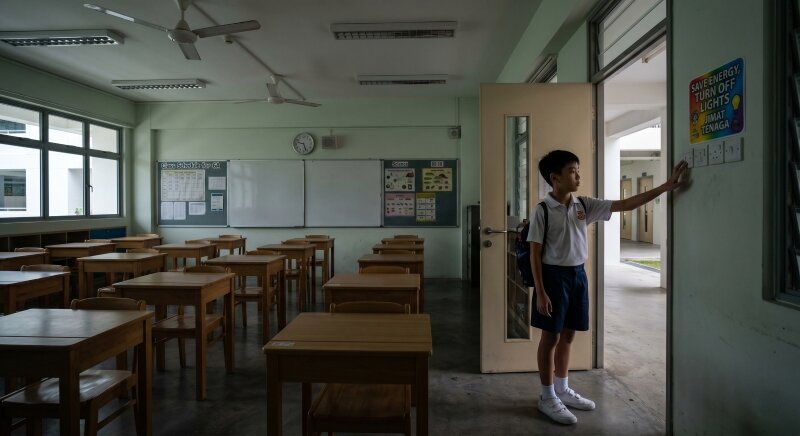
Saving resources at home and at school is the most personal of the three themes. PUB reports that each Singaporean used 141 litres of water per day in 2025, and the Green Plan 2030 target is 130 litres. EMA recommends setting the air-conditioner at 25 degrees Celsius or higher, because every degree lower uses about 10 per cent more electricity. NEA reported 784,000 tonnes of food waste in 2024, of which only 18 per cent was recycled. A student who knows even one of these numbers, and connects it to a specific habit at home, sounds genuine and prepared.
Realistic scenes include:
Point 1: Singapore’s water comes from four taps, and conservation is genuinely important. The four taps are local catchments, imported water from Malaysia, NEWater, and desalinated water. None is unlimited. Each Singaporean used 141 litres a day in 2025, and the Green Plan 2030 target is 130 litres. A student can do their part by taking shorter showers, since the shower is the largest use of household water.
Point 2: A few degrees on the air-conditioner makes a real difference. EMA recommends 25 degrees Celsius or higher because each degree lower uses around 10 per cent more electricity. From April 2025, all new split-type air-conditioners sold in Singapore must meet a minimum 4-tick energy rating. A student who can mention that their family keeps the air-con at 25 degrees, and switches it off when no one is in the room, sounds practical and aware.
Point 3: Food waste is the easiest to reduce. Singapore produced 784,000 tonnes of food waste in 2024, and only 18 per cent was recycled. The simplest fix is ordering or taking less food, then asking for more if needed. A student who finishes what is on their tray at the school canteen is doing more for the environment than they realise.
“Yes, I think food waste is a serious problem because Singapore produced 784,000 tonnes of it last year, and only 18 per cent was recycled. At home, my family used to throw away the last bit of rice from dinner. Now we keep the leftovers for breakfast or pack them as porridge. I have realised that small changes at home add up.”
For more practice prompts, our page of past PSLE oral questions is the closest thing to a real warm-up.
The most useful thing you can do this week is sit with your child for 15 minutes and walk through one of the prompts below. Aim for a back-and-forth conversation. Skip the recitation drill.
Theme A – Recycling
→ Ask Your Child: “Why do you think the blue bin has so much contamination?”
→ A Good Example to Use: “I once put a greasy takeaway box in the Bloobin without rinsing it, and my dad pointed out that I had just contaminated the whole load.”
→ Useful Phrase: rinse before recycling
→ What Parents Should Listen For: Does the child give a real example, not just the statistic?
Theme B – Keeping Public Spaces Clean
→ Ask Your Child: “Do you think Singapore is clean enough?”
→ A Good Example to Use: “The void deck under my block still had food wrappers when the cleaner had just left.”
→ Useful Phrase: take pride in our neighbourhood
→ What Parents Should Listen For: Does the child describe a specific scene rather than a general claim?
Theme C – Saving Resources
→ Ask Your Child: “What is one habit you have built at home to save energy or water?”
→ A Good Example to Use: “I now take 4-minute showers because I learned the shower is the biggest use of household water.”
→ Useful Phrase: live sustainably
→ What Parents Should Listen For: Does the child explain why the habit matters, and not just describe it?
Use one row per night across a school week. By the weekend, your child has practised all three themes with a real audience.
Most strong SBC answers follow a simple, repeatable shape. Teach your child this five-step structure and they will sound clear and confident in any direction the conversation moves.
This is the same answer shape we coach in our oral classes at WRITERS AT WORK. It gives the examiner everything they are looking for in the SBC rubric: a clear opinion supported by a personal example and a real reason. For more strategies, our piece on powerful PSLE oral tips is worth a read.
Even children who know the topic well lose marks for predictable reasons:
Two photo-stimulus practice scenes to try this week:
Discussion questions to ask after each scene:
A checklist your child can run through before answering:
Closer to exam season, our exam-prep guide for PSLE oral walks parents through the final two weeks.
PSLE Oral preparation rewards consistency more than cleverness. A child who has practised the same answer structure on a dozen everyday topics with a real listener walks into the examination room knowing what to do.
At WRITERS AT WORK, our Primary 5 and Primary 6 English programmes give students that listener in classes where every child speaks and gets feedback. The same disciplined approach that powers our composition work through STORYBANKING® shapes how we coach oral: clear ideas, organised into confident and audible responses. We help students observe carefully and express opinions in a way that sounds natural rather than rehearsed.
Push gently for the example. Ask “What is one small thing you did this week that fits with that?” or “Can you tell me about something you saw that made you think this?” The shift from a slogan (“we must save the environment”) to a concrete moment (“I noticed my brother left the air-con on after he went out, so I turned it off”) is the single biggest jump in oral quality for this topic.
One memorable number can lift an answer, but stacking three or four becomes recitation. The 40 per cent contamination rate of the blue bin is worth remembering because it tells a small story (the bin is not magic). The 784,000 tonnes of food waste also works because it grounds an opinion about personal habits. Choose one number per theme and let it earn its place.
Not at all. The examiner is not asking for a CV. A small, honest moment at home or at school is just as strong. “I helped my mum sort old batteries to take to the ALBA bin at the supermarket last Saturday” is a perfectly grounded example.
Three signs are reliable. The child answers directly without warming up with a slogan. They give a specific personal example without being prompted. They sound natural rather than performed. Record one practice answer each week and the difference becomes obvious by month’s end.

Agnes Ng, Co-Founder and Teaching & Curriculum Director of WRITERS AT WORK. An NUS Honours graduate and published author with over 30 years of experience, Agnes has been the architect of the organization’s student-centric curricula since 2012.
Dedicated to teacher mentorship and academic excellence, she has guided hundreds of students to achieve outstanding results. Her expertise and commitment to high-quality education remain the cornerstone of WRITERS AT WORK’s success in empowering every learner.



Start practising and learning

