Technology is one of the highest-probability conversation topics in the PSLE Oral examination, and one where every Primary 6 student has plenty to say. Every child in Singapore uses a device for school, for entertainment, or for staying in touch with family. The Stimulus-Based Conversation (SBC) section often draws from this territory because the examiner can hear within a sentence whether your child has actually thought about how they use technology, or whether they are reciting a poster about it.
From the 2025 sitting onward, the PSLE Oral is worth 40 marks (20 per cent of the overall English grade), with 25 of those marks allocated to the SBC. The stimulus is a real-life photograph, and your child will be asked three questions: one anchored in the photograph, and two broader questions on personal experience and opinion.
This post breaks the topic into three connected themes, with talking points, vocabulary, sample answer starters, common mistakes and a parent-practice table you can use at home this week. For broader context on the oral exam, our PSLE Oral Topics 2025 Guide is a good place to start.
The SBC rewards children who can observe a photograph carefully and form a clear opinion, supported by personal experience. Technology questions invite all of those skills. A child who has practised this topic well can describe the device in the photograph, then explain how they use one themselves without making it sound like a lecture on screen time.
It is also a topic where slogans land flat. “Devices are useful but they have many disadvantages” is a sentence the examiner has heard from every child. The strongest answers come from students who can name a specific app, a specific rule at home, or a specific moment when something on the internet made them pause. The good news is that real moments are easy to find. Your child has almost certainly watched a maths explanation on YouTube, been asked to put their phone down at dinner, or seen something online that did not feel right.
The blog is organised around three connected themes:
Each theme below uses the same structure: what it covers, possible photo stimuli, likely question angles, three speaking points, useful vocabulary and a sample answer starter.
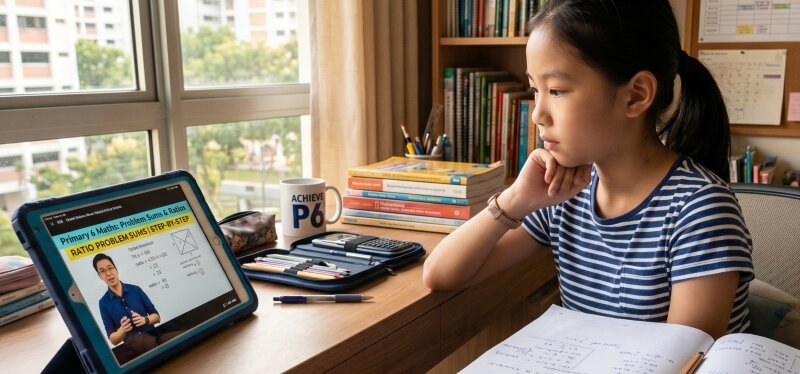
Devices have moved into the centre of how Singapore students learn. The Ministry of Education’s EdTech Masterplan 2030 lists digital literacy and computational thinking as core skills every student should leave school with, and every secondary school student has a Personal Learning Device for use on the Student Learning Space platform. Primary school students do not yet have their own devices to take home, but they do use shared classroom devices during lessons and the Student Learning Space platform for assignments. A student who can describe a specific moment a device helped them learn something will sound far more credible than one who says technology is good for education.
Realistic scenes include:
The photograph is the springboard for the first question. Your child should describe what they see first, then infer the mood of the people in the scene before drifting into personal opinion.
Q1 asks the child to observe and infer; Q2 and Q3 broaden out. Examples:
Point 1: A device is only as useful as the way it is used. Watching a 10-minute Khan Academy explanation of fractions is different from spending an hour on YouTube Shorts. The strongest answers draw that line clearly. For more on this, our piece on AI in composition writing for primary students is a useful starting point for thinking through where the help ends and where the cheating begins.
Point 2: The Student Learning Space and educational apps make personalised practice possible. A student who finds maths difficult can rewatch an explanation as many times as they need without holding up the rest of the class. A student who is ahead can move on. Examples like this anchor the abstract claim that “devices help” in something specific.
Point 3: There is a fair way to use AI for learning. “AI explains, I still write” is a good rule for a Primary 6 student to articulate. Asking an AI tool to clarify a tricky concept is different from asking it to write the composition itself. A student who can name where they draw that line sounds thoughtful and self-aware.
“Yes, a device has helped me at school. Last year I was struggling with fractions, and my teacher recommended a Khan Academy video that explained them using pizza slices. I watched it three times before it finally clicked. I would not have understood it that quickly from the textbook alone. After that, I started using SLS to revisit topics I missed in class. The device is only useful when I have a clear reason to open it.”
Keep the starter short. The examiner will follow up.
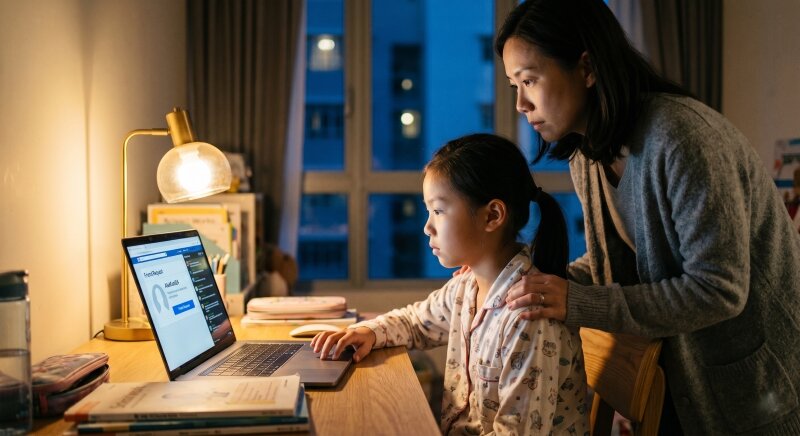
Singapore has been one of the most active countries in the world on the question of how much screen time is too much for children. The Ministry of Health’s Grow Well SG guidelines, updated in January 2025, recommend less than two hours of recreational screen time a day for children aged 7 to 12. From January 2026, every primary and secondary school in Singapore has banned smartphones and smartwatches during school hours, including recess and CCA. The Device Management Application on secondary school Personal Learning Devices now switches into sleep mode from 10.30pm to nudge students to sleep earlier. The strongest answers come from students who can describe a small habit they own at home, rather than reciting the official numbers.
Realistic scenes include:
Point 1: The two-hour daily recommendation from Grow Well SG is a useful number to know, but the more interesting answer is what the student does about it. Putting the phone in a different room after 8.30pm, parking devices in a basket at dinner, or finishing homework before opening YouTube are all real habits a Primary 6 student can describe.
Point 2: The 2026 MOE rule banning smartphones in school is recent enough that examiners are likely to ask about it. A child who can give an honest opinion, including the awkwardness of getting used to it, sounds far more credible than a child who simply agrees. Saying “I was unhappy at first, but I have noticed I talk to my classmates more during recess” is a strong answer.
Point 3: Screen time has a useful side and a tempting side. Devices help with school work and with staying connected to family on a video call. The temptation to game or scroll after homework is real. Putting the phone in another room often works better than relying on willpower in the moment.
“Yes, my family has a screen time rule at home. After dinner, all our phones go into a small basket on the kitchen counter until breakfast the next morning. At first I argued about it, but my mum did the same with her own phone, and after a few weeks I noticed I was sleeping better and remembering more from the day. I think the rule worked because she also followed it.”
Staying safe online is the part of this topic that has changed the most in the past few years, and it is now central to Singapore’s Cyber Wellness curriculum. By Primary 6, students at every MOE school have covered topics from Surf Safe in P1 to Disclosing Personal Data and the Digital Footprint in P6. The Cyber Security Agency runs the SG Cyber Safe Students Programme with MOE to reinforce these lessons. A 2024 MDDI survey found that 74 per cent of internet users in Singapore had encountered harmful content online, up from 65 per cent the year before. The risks are real and the curriculum is mature, which means a thoughtful Primary 6 student has plenty to draw on. Our post on media literacy for primary school students covers some of this in more depth.
Realistic scenes include:
Point 1: Personal information is the line. Full name, school, home address, daily routine, family details. None of these belongs in a chat with someone the student has never met. A useful test a student can describe in their answer is the bus stop test: “Would I tell this to a stranger at the bus stop?” If the answer is no, it should not go online either.
Point 2: The THINK framework gives students something concrete to remember. Before posting, ask whether the message is True, Helpful, Inspiring, Necessary and Kind. Naming the framework in an oral answer sounds informed and grounded in what schools actually teach.
Point 3: Cyberbullying is best handled with a trusted adult, not by replying. A 2024 study of secondary school students in Singapore found that 7.3 per cent had been cybervictims, and experts say the figure is likely underreported because young people often suffer in silence. A child who can describe what they would do, including telling a teacher or a parent, sounds aware of the right response.
“Yes, the most important rule for staying safe online is to keep personal information private. My teacher taught us the bus stop test: would I tell this to a stranger at the bus stop? If the answer is no, then it should not go online either. Last term, a classmate received a friend request from someone she did not know, and she asked her mother first. The account turned out to be fake. That moment made the lesson feel very real for our whole class.”
The most useful thing you can do this week is sit with your child for 15 minutes and walk through one of the prompts below. Aim for a back-and-forth conversation. Skip the recitation drill.
Theme A – Using Devices for Learning
→ Ask Your Child: “When was the last time a device helped you understand something at school?”
→ A Good Example to Use: “I rewatched a Khan Academy video on fractions three times until it clicked.”
→ Useful Phrase: use my device with purpose
→ What Parents Should Listen For: Does the child name a specific app or moment, not just “I use the iPad to study”?
Theme B – Managing Screen Time
→ Ask Your Child: “What is one rule about screens that has actually worked at home?”
→ A Good Example to Use: “After dinner, all phones go into a basket on the kitchen counter until breakfast.”
→ Useful Phrase: set healthy limits
→ What Parents Should Listen For: Does the child describe a rule the family follows together, not just one imposed on them?
Theme C – Staying Safe Online
→ Ask Your Child: “What is one thing you would never share online?”
→ A Good Example to Use: “I would never tell a stranger which school I go to or what time I walk home.”
→ Useful Phrase: keep personal information private
→ What Parents Should Listen For: Does the child explain why the rule matters, and not just state it?
Use one row per night across a school week. By the weekend, your child has practised all three themes with a real audience.
Most strong SBC answers follow a simple, repeatable shape. Teach your child this five-step structure and they will sound clear and confident in any direction the conversation moves.
This is the same answer shape we coach in our oral classes at WRITERS AT WORK. It gives the examiner everything they are looking for in the SBC rubric: a clear opinion supported by a personal example and a real reason.
Even children who know the topic well lose marks for predictable reasons:
Two photo-stimulus practice scenes to try this week:
Discussion questions to ask after each scene:
A checklist your child can run through before answering:
PSLE Oral preparation rewards consistency more than cleverness. A child who has practised the same answer structure on a dozen everyday topics with a real listener walks into the examination room knowing what to do.
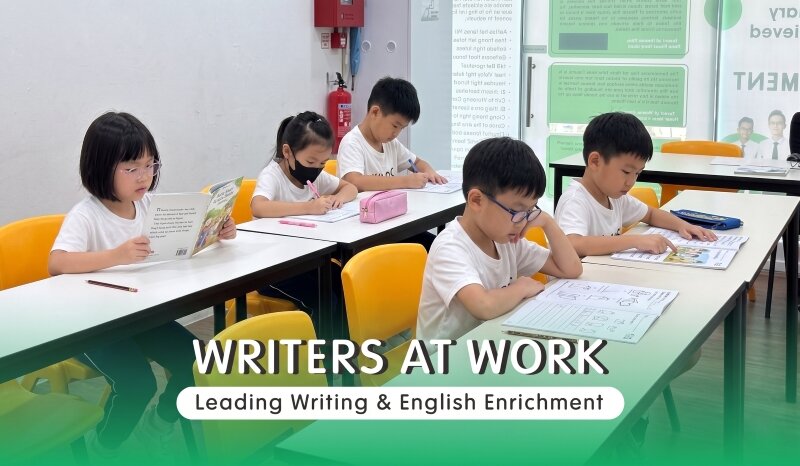
At WRITERS AT WORK, our Primary 5 and Primary 6 English programmes give students that listener in classes where every child speaks and gets feedback. The same disciplined approach that powers our composition work through STORYBANKING® shapes how we coach oral: clear ideas, organised into confident and audible responses. We help students observe carefully and express opinions in a way that sounds natural rather than rehearsed.
It depends on what the AI is being asked to do. Using an AI tool to explain a concept is closer to using a tutor: the student still has to write the answer themselves. Asking the AI to write the composition or solve the maths problem from scratch is closer to copying. The phrase “AI explains, I still write” is a useful line for a Primary 6 student to articulate in an oral answer.
Honesty is the right move. A student who admits that they used to spend three hours a day on the phone and then describes what changed sounds far more thoughtful than one who claims they never use it. The interesting answer is what your child has tried and what they are still working on.
Knowing the rule is helpful, especially if a photo stimulus shows a student putting away a phone at school. A short sentence such as “From January 2026, every primary and secondary school in Singapore has banned smartphones during school hours” lands well, especially when followed by a personal opinion on whether the rule is helpful.
Not at all. A near-miss, a story from a teacher, or a moment of being cautious about a friend request all work just as well. “I have never received a strange message myself, but a classmate did, and I learnt from watching her mother help her handle it” is a perfectly grounded answer.

Agnes Ng, Co-Founder and Teaching & Curriculum Director of WRITERS AT WORK. An NUS Honours graduate and published author with over 30 years of experience, Agnes has been the architect of the organization’s student-centric curricula since 2012.
Dedicated to teacher mentorship and academic excellence, she has guided hundreds of students to achieve outstanding results. Her expertise and commitment to high-quality education remain the cornerstone of WRITERS AT WORK’s success in empowering every learner.



Start practising and learning

