In PSLE Situational Writing, many students make the mistake of writing too quickly. They see the task, read the stimulus, and immediately start writing. However, this can lead to missing important details, using the wrong tone, or forgetting key points.
Situational Writing is not just about good English. It is about knowing who you are writing to, why you are writing, what details you must include, and how you should sound. If you ask the right questions before writing, your response will be clearer, more organised, and more suitable for the task.
The first question to ask is: Who am I in this situation?
For example, if you are writing as a student to your principal, your tone should be respectful and formal. If you are writing to a close friend, your tone can be warmer and more casual.
Question | Why It Matters |
Am I writing as myself, a student, or a representative? | This helps you choose the correct tone and content. |
Do I need to sound polite, friendly, grateful, or persuasive? | This helps your writing match the situation. |
Am I writing on behalf of myself or a group? | This affects whether you use “I” or “we”. |
The second question is: Who is my audience?
Audience | Suitable Tone |
Friend or cousin | Friendly and warm |
Teacher or principal | Polite and respectful |
Organisation or event organiser | Formal and clear |
Parent or relative | Warm and appreciative |
The third question is: What is the purpose of this task?
Knowing the purpose helps you decide what to focus on.
Purpose | What You Should Do |
Inform | Give clear and accurate details |
Invite | Share event details and encourage the person to attend |
Apologise | Explain what happened and show regret |
Thank | Show appreciation and describe the benefit |
Recommend | Explain your choice and give reasons |
Persuade | Use convincing points and examples |
The fourth question is: What are the required points?
Required Information | Example |
What the workshop is | A creative writing workshop |
Why you chose it | It helps students improve story writing |
When and where it will be held | Saturday, 2 p.m., at the community club |
What your friend should bring | A notebook and pen |
A common mistake is to include only some of the points and forget the rest. Another mistake is to copy details wrongly from the stimulus.
Have I answered every bullet point in the task?
Have I used the information from the stimulus correctly?
Have I added enough explanation where needed?
Good Situational Writing is not just about including details. It is about selecting the right details and using them clearly.
The final question is: How should my writing look and sound?
You should also check the tone. Tone refers to how your writing sounds.
Ask yourself:
| Situation | Suitable Tone |
| Writing to a friend | Friendly and natural |
| Writing to a teacher | Respectful and polite |
| Making a complaint | Firm but polite |
| Giving a recommendation | Helpful and persuasive |
| Thanking someone | Warm and appreciative |
For example, instead of writing:
“I want you to approve this activity.”
You could write:
“I hope you will consider approving this activity as it will benefit many students.”
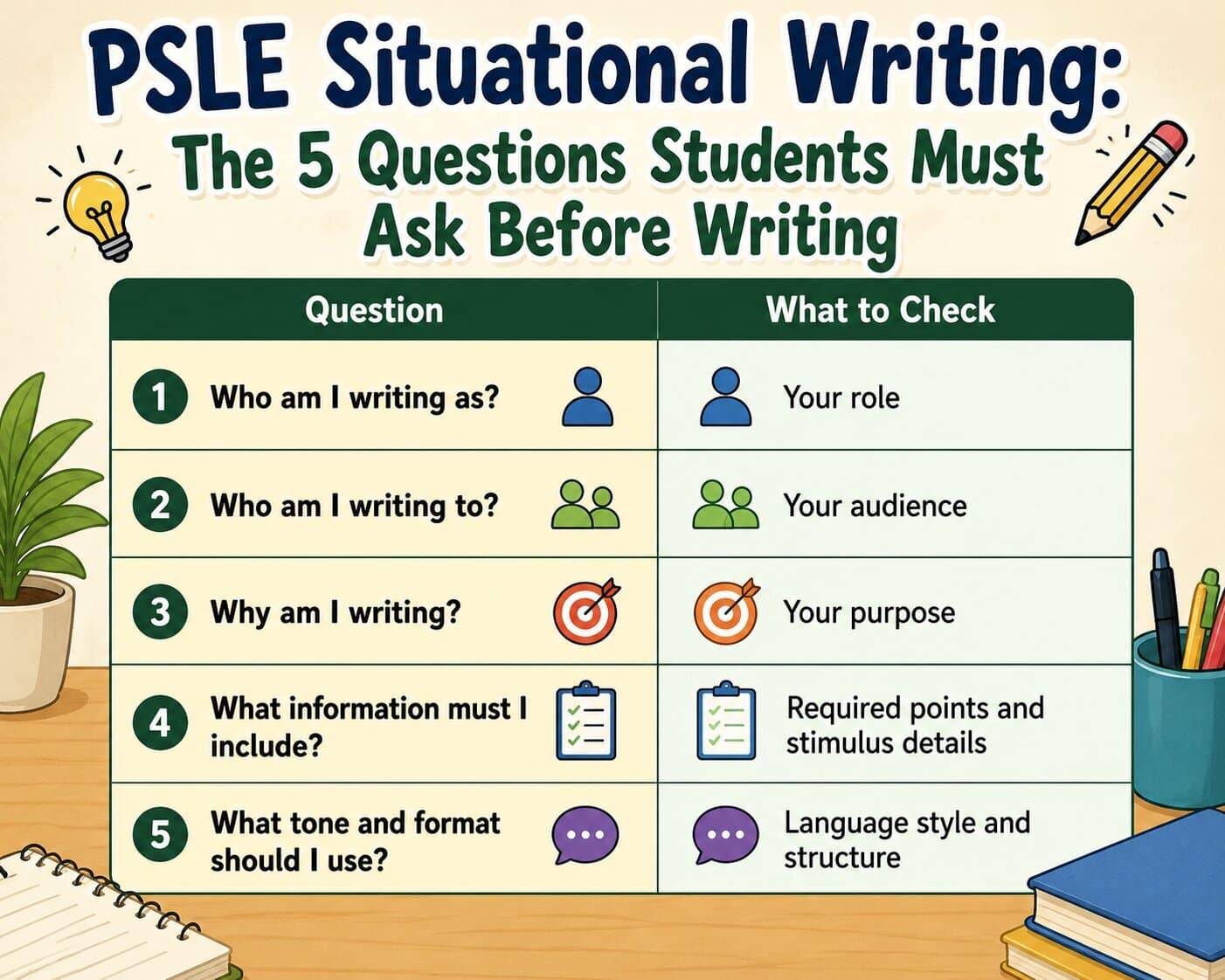
Remember: do not rush into writing.
Who am I writing as?
Who am I writing to?
Why am I writing?
What information must I include?
What tone and format should I use?
For primary students, our PURE Composition Writing Programmes help children build creativity, develop stronger ideas, and learn how to write vivid, well-structured compositions. Our Comprehensive English Programmes support students in key areas such as grammar, comprehension, oral communication, and writing, giving them a strong all-round foundation for school and national exam success.
Beyond the classroom, students and parents can also tap into our wider learning resources through W@W eSeries, and stay updated with tips, insights, and student support on TikTok and Facebook.

Jemmies Siew, Managing Director and Co-Founder of WRITERS AT WORK Enrichment Centre. With over 15 years of experience in education, entrepreneurship, and marketing, Jemmies has helped shape Singapore’s English enrichment landscape through her vision for transformative learning.
She is passionate about connecting real-world issues with language learning, helping students think critically and express themselves clearly. Connect with her on LinkedIn to follow her insights on education, content marketing, and thought leadership.



Start practising and learning

