One common format students may encounter is the article. Knowing how to approach this format can make a big difference. In this guide, we will walk through how to write an article step by step, so students can feel more confident and parents can better support them at home.
An article is a piece of writing meant to inform, share ideas, or encourage readers to think about a topic. In PSLE Situational Writing, students are often given a context, a purpose, and a set of points they must include. Their task is to turn that information into a clear and relevant response.
When writing an article, students should remember that they are not simply listing points. They are presenting information in a way that is interesting, organised, and suitable for the intended readers. That means they need to think carefully about tone, purpose, and structure.
Before writing anything, read the question slowly and carefully. Many students rush into writing and miss key details. This leads to lost marks because they may not fulfil the task properly.
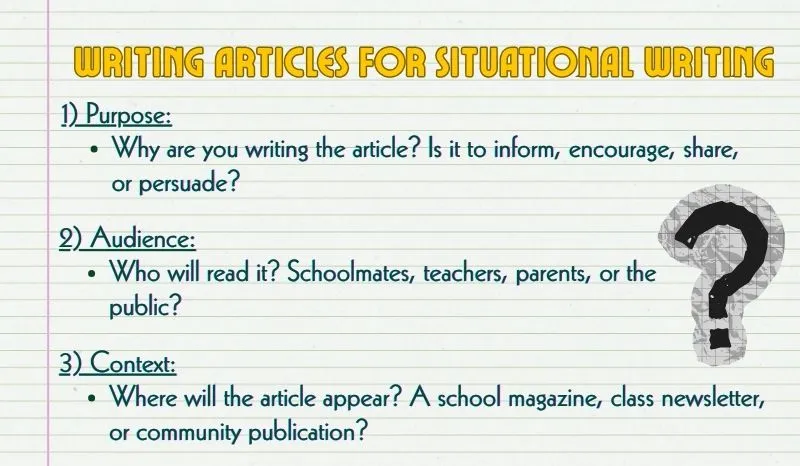
Purpose: Why are you writing the article? Is it to inform, encourage, share, or persuade?
Audience: Who will read it? Schoolmates, teachers, parents, or the public?
Context: Where will the article appear? A school magazine, class newsletter, or community publication?
If a student misunderstands any one of these, the article may sound unsuitable even if the language is accurate.
A good habit is to underline or list the required points before writing. This helps students keep track of what they must cover. If even one point is missed, marks for task fulfilment may be affected.
What information must I include?
Can I group some points together logically?
Which point should come first?
This small planning step can prevent careless omissions later.
Title
Introduction
Main body paragraphs
Conclusion
The introduction should briefly introduce the topic and set the purpose. The body paragraphs should develop the required points clearly. The conclusion should wrap up the article in a natural way.
Students should avoid writing one long block of text. Paragraphing makes the writing easier to read and shows better organisation.
An article usually needs a title. A clear and relevant title helps signal the topic immediately.
For example, if the topic is about healthy habits in school, a title such as “Simple Ways to Stay Healthy in School” works better than something vague like “How to be Healthy”.
The title does not need to be fancy. It just needs to match the content.
The opening paragraph should tell the reader what the article is about. It should also create a smooth entry into the topic.
A weak introduction may sound too abrupt. A stronger one gives context and direction. For example, instead of jumping straight into a list of points, students should begin by introducing the issue or event first.
This is where many students struggle. They may mention a point but fail to develop it. In PSLE Situational Writing, simply copying the content points is not enough. Students need to explain, describe, or elaborate appropriately.
Explain why it matters
Give a relevant example
Describe how it helps others
Link it back to the purpose of the article
For instance, if one point is about joining a school clean-up campaign, the student should not stop at “Students can join the campaign.” A better response would explain how the campaign helps keep the school clean and teaches responsibility.
The tone of an article should match the audience and purpose. If the article is for schoolmates, the tone may be friendly and encouraging. If it is for a more formal school publication, the language should sound more polished.
Students should aim for sentences that are clear and accurate. They do not need difficult vocabulary to score well. What matters more is choosing words that fit the context and expressing ideas smoothly.
Slang or overly casual expressions
Repeating the same words too often
Writing in a tone that does not suit the audience
Lifting the task points word for word without development
A good conclusion brings the article to a proper close. It can summarise the main message, encourage action, or leave the reader with a final thought.
The ending should not feel sudden and abrupt. Even two or three well-written sentences can be enough to complete the piece effectively.
For students, article writing becomes easier with repeated guided practice. The more familiar you are with identifying purpose, audience, and content points, the less stressful the exam will feel.
For parents, it helps to look beyond whether the writing is merely complete. Ask whether all the task points were covered, whether the tone suits the audience, and whether the ideas were developed clearly. These are often the differences between an average response and a strong one.
Need more support for PSLE Situational Writing and Paper 1 writing tasks? At WRITERS AT WORK, we help primary school students build the skills needed to plan, organise, and write with greater clarity and confidence. Through our PURE Composition Writing Programmes and Comprehensive English Programmes, students learn how to tackle different writing formats, strengthen their language use, and improve across key English components tested in school and national exams.
Parents who want a more structured and effective approach to English learning can also explore our wider resources through W@W eSeries, or follow us on TikTok and Facebook for more English tips and updates.

Agnes Ng, Co-Founder and Teaching & Curriculum Director of WRITERS AT WORK. An NUS Honours graduate and published author with over 30 years of experience, Agnes has been the architect of the organization’s student-centric curricula since 2012.
Dedicated to teacher mentorship and academic excellence, she has guided hundreds of students to achieve outstanding results. Her expertise and commitment to high-quality education remain the cornerstone of WRITERS AT WORK’s success in empowering every learner.



Start practising and learning

