W@W Blog

PSLE Situational Writing Tips for Speech Writing

Primary school student planning a PSLE situational writing speech
Student writing notes for a situational writing charity speech

Step 1: Understand the Purpose, Audience, and Topic

Before writing, ask yourself these three questions:
Who am I speaking to?
You are speaking to your principal, teachers, and fellow students.
Why am I speaking?
You are giving a speech about the importance of charity work.
What must I include?
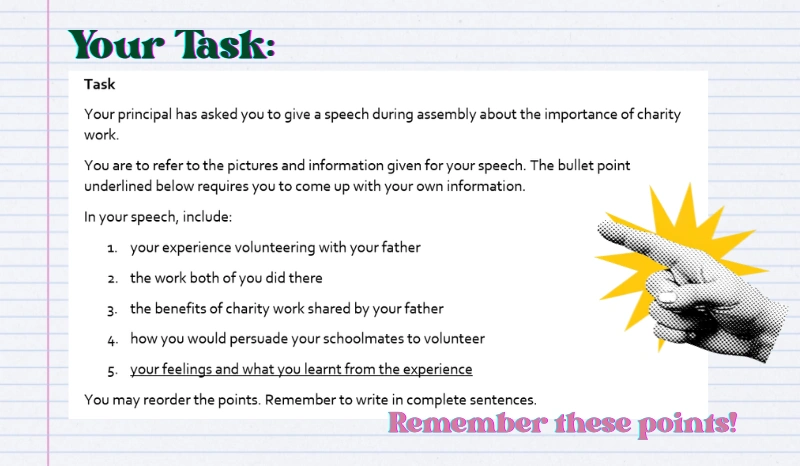
You must include all 5 points from the task:
Student preparing speech points for PSLE situational writing
Since Point 5 asks for your own information, this is the inference point. You must not just copy from the comic. You need to add your own thoughts and learning.

Step 2: Plan the Order of Your Speech

You do not have to follow the points in the exact order given. A more natural flow would be:

→ Greeting
→ Self-introduction and topic
→ Experience volunteering with your father
→ Work done at Sunshine Centre
→ Benefits of charity work shared by your father
→ Your feelings and what you learnt
→ Persuade schoolmates to volunteer
→ Conclusion
→ Closing

This order works well because it starts with your personal experience, then explains why charity matters, and ends by encouraging others to act.

Step 3: Start Writing!

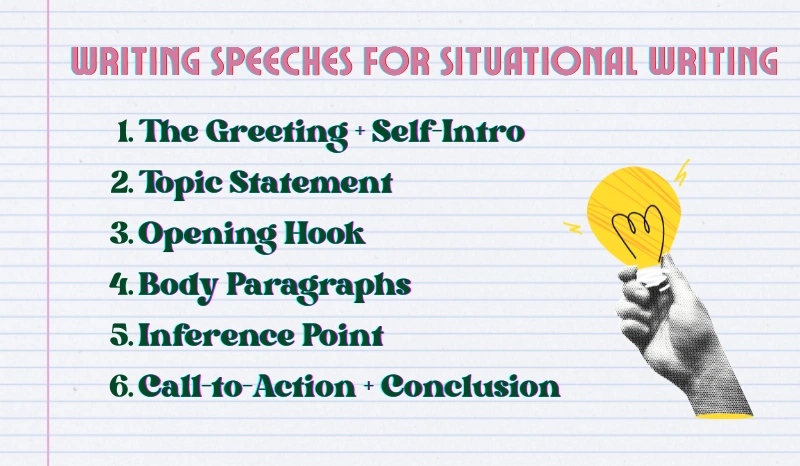
1. The Greeting +Self Introduction

A school assembly speech should begin with a polite greeting.
A suitable greeting is:
“Good morning Principal, teachers, and fellow students.”

2. State the Topic Statement

After the greeting, introduce yourself and say what your speech is about.

Example:
“My name is Ryan from Primary 6 Integrity. I am here today to speak about the importance of charity work.”
This makes your purpose clear right from the start.

3. Add an Opening Hook

To make your speech more engaging, add a hook after your introduction. A rhetorical question works very well here.
Example:
“Have you ever wondered how a small act of kindness can bring comfort and joy to someone in need?”

This links nicely to the charity theme and captures attention.

4. Building the Body

topic sentence
elaboration
example or evidence
link back to purpose

Here is how to handle each point.

Your Experience Volunteering with Your Father

Write about when and where you went, and what happened.
You can say:

you went to Sunshine Centre with your father
you volunteered there together
it was a meaningful experience

Example idea:
“Recently, I had the opportunity to volunteer with my father at Sunshine Centre. I was glad to go with him because it was my first time helping out at a charity organisation.”
This covers Point 1 clearly.

The Work Both of You Did There

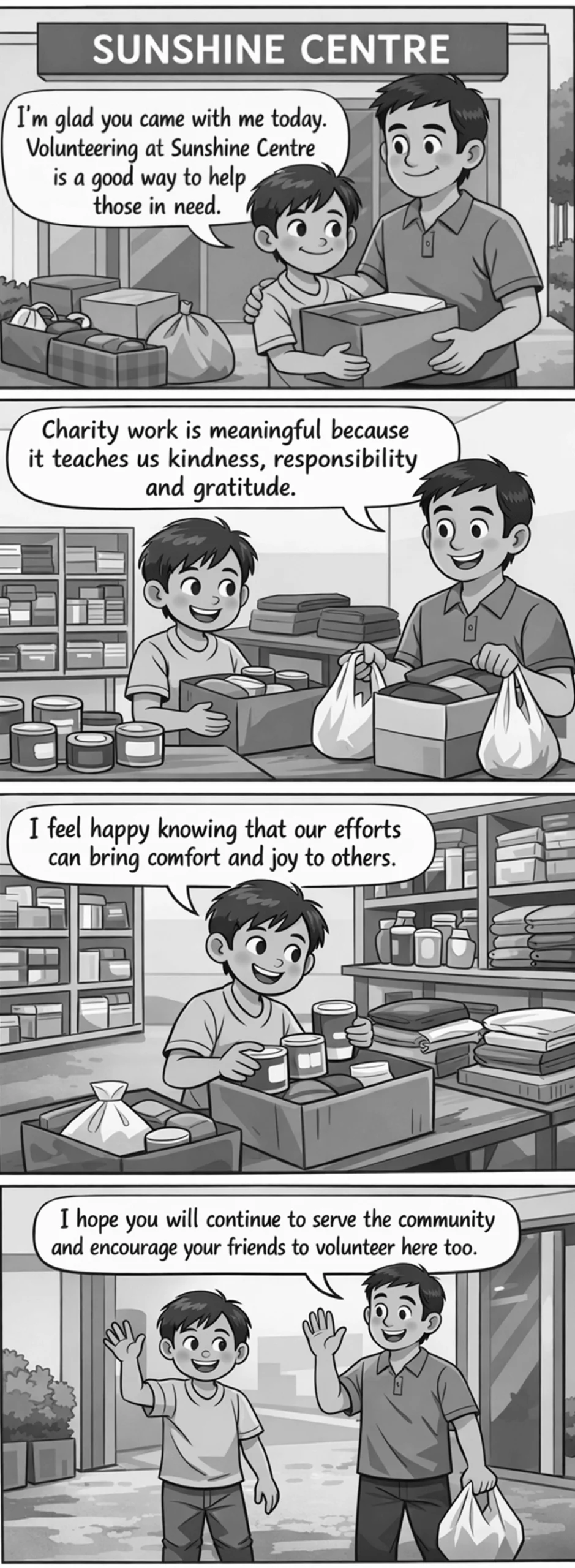
Use details from the comic:

carrying boxes
packing supplies
sorting food items
preparing items for people in need

Example idea:
“At Sunshine Centre, my father and I carried boxes, packed groceries, and sorted items such as canned food and daily necessities. Although the tasks were simple, they were important because they helped the centre prepare supplies for those in need.”
This covers Point 2.

The Benefits of Charity Work Shared by Your Father

The comic already gives you the key idea:

charity work teaches us kindness
charity work teaches us responsibility
charity work teaches us gratitude

Example idea:

While we were volunteering, my father told me that charity work is meaningful because it teaches us kindness, responsibility, and gratitude. I realised that helping others is not only about giving things away. It is also about learning to care for people and appreciate what we have.

This covers Point 3 well.

5. Inference Point- Your Feelings and What You Learnt

This is the part where you must add your own thinking. Do not just repeat, “I felt happy.” Explain why you felt that way and what you learnt from the experience.
Possible feelings:

happy
proud
grateful
inspired

Possible lessons:

small actions can make a big difference
helping others gives meaning to our time
we should not take our own blessings for granted
charity builds compassion

Example idea:

“I felt happy and proud knowing that our efforts could bring comfort and joy to others. From this experience, I learnt that even small acts of service can make a big difference. I also became more grateful for the things I have, such as food, clothes, and a loving family.”
This is a strong response to Point 4 because it adds original reflection.

6. Call-to-Action + Conclusion

Now speak directly to your audience. Use persuasive language such as:

I encourage you
I hope you will
Let us
Together, we can

The speech notes say a good conclusion should include a call to action.

Example idea:

“I would like to encourage all my schoolmates to volunteer at Sunshine Centre. By spending just a little of our time helping others, we can bring hope and happiness to people who need support. Let us serve the community together and make a positive difference in the lives of others.”
This addresses Point 5 directly.

End with a Strong Conclusion

Your conclusion should:

summarise the message
remind the audience why charity matters
encourage action

Example:
“In conclusion, my experience at Sunshine Centre taught me that charity work is meaningful and rewarding. It teaches us to be kind, responsible, and grateful. I hope all of us will take part in helping those in need and do our part for the community.”

Then close with:

“Thank you for your attention.”

This follows the recommended ending for speeches.
Primary student practising situational writing during English revision

Use the Right Tone and Language

Your speech should sound semi-formal:
respectful, because you are addressing the school warm, because you are sharing a personal experience persuasive, because you want others to volunteer

Use:

complete sentences
clear paragraphing
transition words such as Firstly, Furthermore, Most importantly, In conclusion
inclusive words such as we, us, and our

Avoid:

slang
contractions like “don’t” and “can’t”
repeating “I” too often
copying the comic word for word

Final Check Before You Finish

Before ending, ask yourself:

Did I write it like a speech?
Did I include all 5 content points?
Did I add my own ideas for the Inference Point?
Did I use complete sentences?
Did I end with a call to action?

If the answer is yes, then your response is likely well-structured and task-focused. Good luck!

For parents who are considering more structured guidance, a Comprehensive English Programme can support children across multiple areas of the language. Programmes that cover reading, writing, comprehension, and oral communication together are especially helpful for students from Primary 1 to Secondary 4, as they reinforce skills progressively and in line with school requirements.

Exploring programmes by level and focus allows parents to choose support that best matches their child’s needs, learning stage, and goals for the year ahead. Parents may also find our English e-books helpful for guided practice at home, alongside regular tips and learning insights shared on our TikTok and Facebook pages.
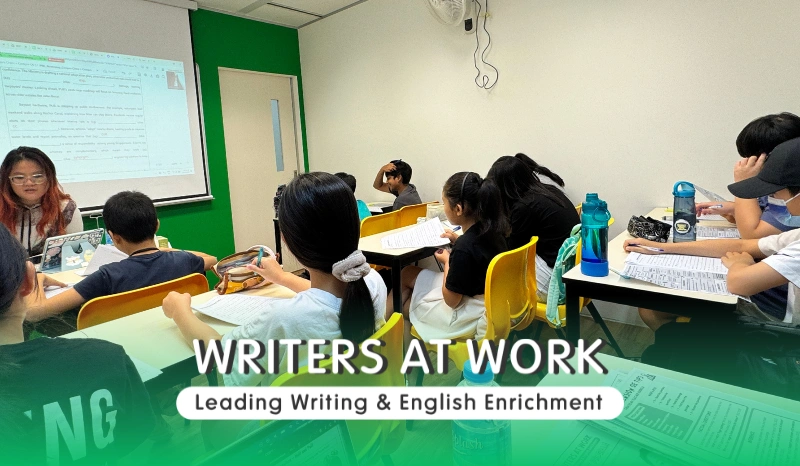
Students joining WRITERS@WORK programme, workshops, holiday camps

Frequently Asked Questions

Q1: What is the correct format for a PSLE situational writing speech?

A PSLE speech should begin with a greeting, followed by a short self-introduction and the purpose of the speech. After that, the body paragraphs should cover the required points clearly, and the speech should end with a conclusion and a polite closing such as “Thank you for your attention.”

Q2: How can I score well for a charity speech in PSLE Situational Writing?

To score well, make sure you cover all the task points, use the correct speech format, and write in a tone that suits a school assembly. You should also explain your ideas clearly instead of only listing them. Strong answers often include personal reflection, clear organisation, and a persuasive ending.

Q3: How can I score better for PSLE Situational Writing Tips questions?

Focus on task fulfilment first. Cover all the required points, write in the correct format, and make sure your tone suits the situation. Then improve your marks further by developing your ideas clearly and adding thoughtful explanations instead of short, plain statements. This is something students often strengthen through guided practice at WRITERS AT WORK.

Jemmies Siew
Article Written By

Jemmies Siew

Jemmies Siew, Managing Director and Co-Founder of WRITERS AT WORK Enrichment Centre. With over 15 years of experience in education, entrepreneurship, and marketing, Jemmies has helped shape Singapore’s English enrichment landscape through her vision for transformative learning.

She is passionate about connecting real-world issues with language learning, helping students think critically and express themselves clearly. Connect with her on LinkedIn to follow her insights on education, content marketing, and thought leadership.

Share

2026 Registration
W@W-LOGO-WRITERS-AT-WORK
Promotional Popup
Primary 4 model compositions

Unlock Our Free Resources Today

Start practising and learning
