For many Primary 6 students, the months after PSLE can feel like a well-earned break. After years of spelling lists, composition drills and exam papers, it is tempting to put English aside until January. However, the jump to Secondary 1 English can be surprisingly steep.
At WRITERS AT WORK, we often see students who did well at PSLE struggle when they enter Secondary 1. This is not because they have become weaker in English. It is because the demands of secondary school English are different. Students are expected to write with greater structure, explain ideas more clearly, analyse texts more deeply and speak about issues with confidence.
The good news is that students do not need to wait until January to prepare. With the right skills, P6 students can enter Secondary 1 feeling confident and ready.
The period between PSLE and Secondary 1 is one of the best times to build strong English habits. Without the pressure of major exams, students can focus on developing the skills that will help them adjust smoothly.
Secondary 1 English is not just a harder version of Primary 6 English. It introduces new expectations. Students must move beyond simply telling a story or giving a direct answer. They need to explain why an idea matters, organise their thoughts logically and support their views with examples.
→ The Writing Shift: Primary school compositions are often picture-based and narrative-driven. In Secondary 1, students may face personal recounts, expository questions, discursive topics and article writing tasks.
→ The Comprehension Shift: Students must answer more inference and language-based questions. They need to explain how words create mood, tone or impact.
→ The Oral Shift: Students are expected to speak in a more organised way. Instead of simply sharing personal experiences, they may need to discuss school, community or social issues.
One of the most important skills P6 students should learn before January is paragraph organisation.
In primary school, many students focus on writing exciting stories with dramatic events and vivid descriptions. While these skills are still useful, Secondary 1 writing requires clearer structure. Students must learn how to develop one idea at a time.
This is where the PEEL framework becomes useful.
→ Point: State the main idea clearly.
→ Evidence: Give a relevant example or detail.
→ Explanation: Explain how the example supports the point.
→ Link: Connect the idea back to the question.
A student who can write a clear PEEL paragraph will be better prepared for expository, discursive and argumentative writing. This skill also helps in comprehension answers because students learn to explain ideas instead of merely stating them.
Many P6 students are comfortable with narratives. They know how to write about a challenge, a mistake, a rescue or a lesson learnt. However, Secondary 1 students need to handle a wider range of essay types.
Before January, students should practise responding to prompts such as:
These questions require students to think, explain and support their ideas. The focus is no longer only on what happened. It is also on what the experience teaches us and how ideas can be applied to real life.
A good Secondary 1 student should still be able to write a story, but he or she must also learn how to explain and persuade.
In Secondary 1, students need vocabulary that is accurate, mature and purposeful. This does not mean stuffing essays with difficult words. It means choosing the right word for the right situation.
For example, instead of writing “good”, students can learn to use more precise words such as:
Instead of writing “bad”, they can use:
Precision vocabulary helps students sound clearer and more confident. It is especially useful in Situational Writing, where students must sound persuasive, respectful or enthusiastic depending on the task.
Paraphrasing is one of the most important skills for Secondary 1 English. Students will need it for comprehension, summary writing and Situational Writing.
In primary school, students may be used to copying key phrases from the passage or visual stimulus. In secondary school, excessive lifting can weaken their answers. Students must learn how to express the same idea in their own words.
For example:
This skill is especially important when students use information from brochures, posters or passages. They must show that they understand the material instead of simply copying it.
Secondary 1 comprehension questions often require students to read between the lines. The answer may not be stated directly. Students must infer meaning from the writer’s words, tone and details.
For example, if a passage says that a character “forced a smile while gripping the edge of the table”, students should not simply say that the character is smiling. They should infer that the character may be nervous, anxious or trying to hide discomfort.
To build inference skills, P6 students should practise asking:
These questions train students to think like secondary school readers.
Oral communication becomes more demanding in secondary school. Students need to speak clearly, organise their ideas and give relevant examples.
Before January, P6 students should practise short responses using a simple structure:
For example, if asked whether students should join CCAs, a strong response might include a clear opinion, a reason linked to teamwork or discipline, an example from school life and a final statement about personal growth.
This helps students avoid rambling. It also trains them to sound confident and thoughtful.

Secondary school comprehension passages are longer and more complex. Students who rarely read may struggle to follow the writer’s argument or understand unfamiliar vocabulary.
Before January, P6 students should build reading stamina by reading a mix of texts:
Reading widely helps students develop stronger vocabulary, better sentence control and broader ideas for writing and oral communication.
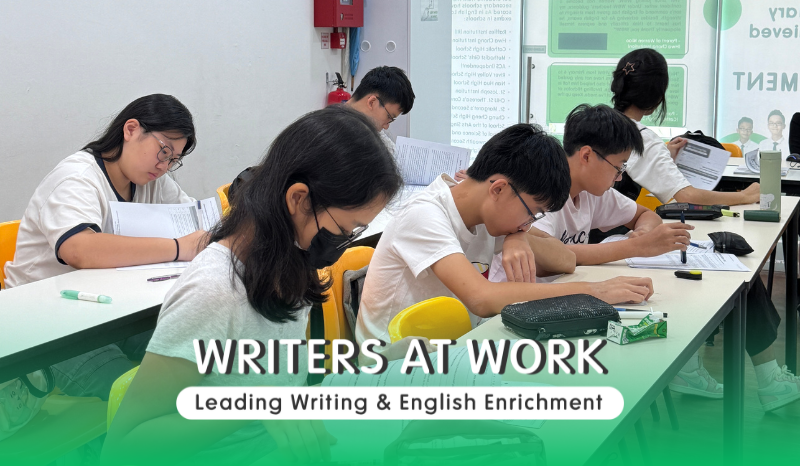
At WRITERS AT WORK, we help P6 students prepare for Secondary 1 before the January rush begins. Our Secondary 1 English Holiday Programmes are designed to give students early exposure to the demands of secondary school English, so they can step into their new school year with greater confidence. The Secondary 1 English Holiday Camp focuses on bridging the gap from Primary 6 to Secondary 1, including essay writing and summary writing skills. The Secondary 1 Essay Writing programme also introduces students to key secondary essay genres such as argumentative, discursive, expository, descriptive and hybrid essays.
Our lessons focus on:
By preparing early through our holiday programmes, students can enter Secondary 1 with confidence instead of confusion. Parents can explore our full range of WRITERS AT WORK Holiday Programmes to find a suitable class for their child. The transition from Primary 6 to Secondary 1 is an important turning point, and students who build the right skills before January will find it easier to cope with new writing formats, longer comprehension passages and more demanding oral tasks.
For more guidance, parents may also read our articles on starting your secondary school journey and 3 essential tips for a smooth transition to secondary school. Secondary school brings new expectations, routines and academic challenges, so students benefit greatly from building strong habits early.
English success in secondary school does not happen by chance. It begins with strong habits, clear structure and regular practice. Join WRITERS AT WORK and help your child step into Secondary 1 prepared, confident and ready to excel.
The students who improve the most are not always the ones who scored the highest in their EOY examinations. They are the ones who take the time to learn from their mistakes and work on them systematically.
If you are unsure where to begin, guidance from an experienced teacher can make the process much clearer. At WRITERS AT WORK, we help students identify their key weaknesses, develop effective examination strategies, and build the skills needed to perform confidently in both Paper 1 and Paper 2.
The EOY papers have already shown you where the gaps are. The next step is deciding what to do about them.
Join WRITERS AT WORK and start turning this year’s feedback into next year’s success. Don’t forget to follow us on TikTok and Facebook for regular exam tips, useful resources, and a closer look at what goes on inside our classrooms.
Yes. The post-PSLE period is a good time to build skills without exam pressure. Students do not need heavy drilling, but they should strengthen writing, reading and speaking habits before Secondary 1 begins.
Paragraph structure is one of the most important skills. Students who can explain one idea clearly will perform better in essays, comprehension answers and oral responses.
Yes, but narrative writing is no longer enough. Secondary 1 students also need to handle personal recounts, expository tasks, discursive questions and article writing.
Encourage your child to read regularly and practise inference questions. Ask them what a word, action or phrase suggests instead of only asking what happened.

Jemmies Siew, Managing Director and Co-Founder of WRITERS AT WORK Enrichment Centre. With over 15 years of experience in education, entrepreneurship, and marketing, Jemmies has helped shape Singapore’s English enrichment landscape through her vision for transformative learning.
She is passionate about connecting real-world issues with language learning, helping students think critically and express themselves clearly. Connect with her on LinkedIn to follow her insights on education, content marketing, and thought leadership.



Start practising and learning

