If grammar is the skeleton of a story, then tenses are its heartbeat. In every Primary English composition, tenses tell the reader exactly when an action is happening. Without them, your story would be a confusing jumble of events!
Whether your child is just starting with English enrichment for Primary 1 or is deep in revision for Primary 6 English tuition, mastering tenses is the key to a polished, professional essay. At WRITERS AT WORK, we teach our students that tenses aren’t just about memorising verb charts. They are about creating a clear “logical thread” that the examiner can follow with ease.
Tenses are changes we make to a verb to show the time of an action. They act as a “time stamp” for your sentences. If you get the tense wrong, you might tell your teacher you will eat breakfast yesterday, which sounds like you’ve invented a time machine!
In our English Writing Class for Primary School, we focus on these seven heavy-hitters that appear most frequently in the PSLE and school exams.
Even in Primary 5 English tuition, these “Tense Traps” can lower a student’s mark significantly.
Test your skills with these common questions!
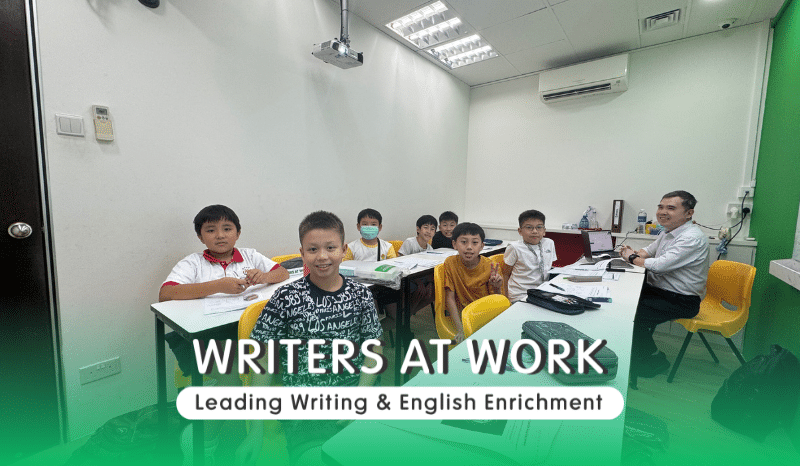
At WRITERS AT WORK, our English tuition for primary school focuses on building “Thinking Frameworks” that help students instinctively choose the right tense for every situation.
Ready to help your child excel? Explore our resources on PSLE Past Years Composition Questions to see how tenses apply to real exam prompts. You can also prepare for the spoken component with our PSLE Oral Topics 2025 Guide and a review of Past Years PSLE Oral Questions. Join us and discover why we are the top choice for parents seeking the best English tuition in Singapore.
This is often “narrative drift”. We teach students to decide on a “base tense” (usually past tense for stories) before they start writing.
Yes, but usually in Direct Speech (characters talking) or in the Reflective Ending of a story (e.g., “In the future, I will be more careful”).
In English enrichment for Primary 1, we focus on “Time Words”. If the sentence has “yesterday”, the verb gets a “tail” (-ed) or changes its shape!
Present Perfect is usually the “Final Boss”. Students often struggle with when to use “have eaten” versus “ate”. We use a “Timeline Filter” to help them decide!

Agnes Ng, Co-Founder and Teaching & Curriculum Director of WRITERS AT WORK. An NUS Honours graduate and published author with over 30 years of experience, Agnes has been the architect of the organization’s student-centric curricula since 2012.
Dedicated to teacher mentorship and academic excellence, she has guided hundreds of students to achieve outstanding results. Her expertise and commitment to high-quality education remain the cornerstone of WRITERS AT WORK’s success in empowering every learner.



Start practising and learning

