If your child has been shortlisted for a DSA-Sec interview, audition or trial, the next two months are likely to feel busier than any in their Primary 6 year so far. The Direct School Admission selection window runs from 22 June to 28 August 2026 across the 142 participating secondary schools and 20 JCs, and every school runs its own process on its own schedule. This post is for parents trying to make sense of what comes next without overwhelming their child, including what schools are looking for, how to prepare without over-coaching, and what to do on the day. For a broader walkthrough of the entire DSA-Sec process, our complete guide to Direct School Admission in Singapore is a useful starting point.
DSA-Sec lets Primary 6 students apply for secondary school admission based on a specific talent area before PSLE results are released. Non-Integrated Programme secondary schools can admit up to 20 per cent of their Secondary 1 intake through DSA. Specialised independent schools like NUS High School of Mathematics and Science can admit up to 100 per cent of theirs through this route.
The 2026 application portal closes on 2 June 2026 at 4.30pm. If you are reading this and your child has not applied yet, the window for new applications is very short. If your child has applied and is awaiting selection details, this post will help you use the time between now and 28 August well.
Not every shortlisted student faces the same kind of assessment. The format depends on the talent area, and many schools combine more than one.
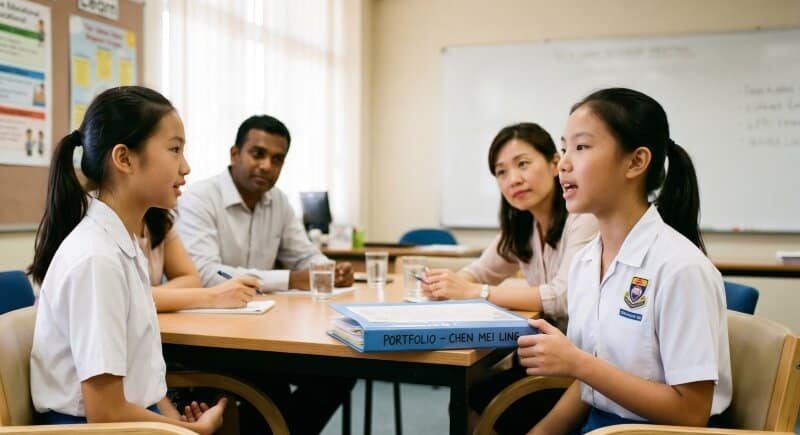
Interviews are the most common DSA selection format and are used for almost every category, from leadership and academic subjects to languages. They may be one-on-one with a panel of teachers, or they may take a group form where several candidates are observed interacting with each other. Most interviews run between 10 and 20 minutes.
Auditions are the standard for performing arts applicants, including music, dance, drama and choir. Schools usually ask the student to prepare and perform a piece. They may also assess sight-reading and aural skills, along with stage presence.
Trials are the standard for sports and games. Coaches watch students demonstrate individual skills and respond to coaching under pressure.
A sports applicant may be invited to a trial followed by a panel interview. A music applicant may audition first and then sit for a conversation about their motivation and commitment. The school’s website is the only reliable place to confirm the format for your child’s category. Check the dates early, especially if your child is applying to more than one school, because scheduling conflicts can arise.
Understanding what assessors prioritise helps you guide your child without rehearsing them into a robotic version of themselves.
Schools are placing more weight on holistic qualities than they used to. The Ministry of Education has explicitly signalled a shift towards future-ready students who can think clearly and communicate well. Even MOE has said schools will be looking for students who show genuine potential and the kind of character that allows a young person to thrive amidst adversity, even when they do not arrive with a wall of competition placements. The implication for parents is that an articulate, curious, self-aware student can be more impressive than one with a longer trophy shelf.
Schools are also looking for genuine passion. Interviewers are trained to spot the difference between a student who shows real curiosity in the talent area and one who is reciting a scripted answer. Students with no formal experience may still be eligible at many schools, because schools also assess potential.
For sports trials especially, coachability and character matter as much as raw skill. A highly skilled but uncoachable triallist rarely beats a less polished student who is eager to learn and works well with others. Coaches notice how a child responds when corrected.
Even at Primary 6 level, schools expect students to articulate their thoughts clearly and reflect on themselves honestly. Being asked “what are your weaknesses” may be the first time a 12-year-old has been challenged to think publicly about their own development. A real, honest answer, said calmly, stands out.

Exact questions vary by school and talent area, but most DSA interviews map onto five categories. Practising one or two questions in each will give your child a useful spine to work from.
Our post on preparing for DSA interview questions goes deeper into how to coach a Primary 6 student through each of these categories without making them sound rehearsed.
Drilling produces students who sound robotic. Robotic students are the easiest to spot, and they tend to do worse than students who simply have something genuine to say. Aim for preparation that lifts your child’s natural voice rather than replacing it.
Research the school properly. Your child should be able to name two or three things about the school that genuinely appeal to them. The school’s website, recent achievements of their CCA or sports team, and the school culture as expressed in open-house material are all useful sources. Being able to say specifically why this school, and not just that it is a good school, is one of the most powerful things a shortlisted student can do in the room.
Build the portfolio early. A strong portfolio usually includes a personal introduction, certificates and awards relevant to the talent area, evidence of CCA participation and leadership, and write-ups or photos of projects, performances or competitions. For visual arts, a curated collection of original artwork is essential. A neat, organised portfolio signals attention to detail, which is itself an assessable quality.
Run mock interviews at home, but not only with parents. The pressure of being watched by an unfamiliar adult is part of what your child needs to acclimatise to. A family friend, an uncle or aunt, or a tuition teacher can usefully play the role of a stranger on the panel. Recording the practice on a phone is also valuable, because watching themselves on video helps a child self-correct body language and filler words faster than any feedback you can give.
For music auditions, balance the technical and the expressive. A piece that is too easy looks unchallenging, and a piece that is too hard risks errors under pressure. Daily aural and sight-reading practice is just as important as the main piece.
For sports trials, attitude matters as much as ability. Arrive prepared to demonstrate specific skills, but understand that coaches are watching how your child responds to feedback and how they treat other triallists alongside the technical work. A student who sweats hard and listens well, even after a difficult drill, often leaves a stronger impression than a more skilled child who looks bored.
The day of the interview, audition or trial is where the prepared work meets the unfamiliar room. A few small things make a real difference.
Wear the full primary school uniform, neat and complete, with polished shoes. This is not about appearance for its own sake. It signals respect for the panel and pride in representing the current school. Both qualities register from the moment your child walks in.
Bring a hard copy of the portfolio even if the school has the digital version, along with any certificates or supporting documents the school has asked for. For sports trials, bring appropriate attire and personal equipment if relevant. For music auditions, bring the instrument and the sheet music.
Arrive 15 to 30 minutes early. This gives your child time to compose themselves and avoid the stress of rushing. First impressions form quickly, and a flustered late entry can undermine the best preparation.
Coach your child on a few body language basics. Sit up straight, with an open and composed posture. Maintain eye contact with every panel member, not only the one currently speaking. Smile naturally and breathe slowly to keep the voice steady. Avoid looking at the floor or speaking too fast under pressure.
If your child is asked something they do not know, the right response is to ask for a moment to think rather than to panic or go silent. A line such as “that is an interesting question, may I have a moment to think about it” buys real time and signals composure. Panels do not expect 12-year-olds to have every answer ready. The way the student handles the unfamiliar question often matters more than the answer itself.
The most common mistakes are predictable, which is good news, because they are also avoidable.
After the selection period ends, your child will receive one of three outcomes by 28 August 2026.
A Confirmed Offer means a reserved place in the school, provided your child qualifies for the school’s Posting Group based on PSLE results. A Wait List means your child may receive a place if others with Confirmed Offers decline. In previous years, about half of students on school wait lists were eventually given a place. An Unsuccessful outcome means your child participates in the regular Secondary 1 Posting Exercise after PSLE.
If your child receives a Confirmed Offer or is on a Wait List, you submit up to three school preferences in ranked order through the DSA-Sec Portal between 19 and 23 October 2026. A Confirmed Offer from your second-ranked school is protected even if you rank a Wait List school first.
This is the part of the DSA process that catches some families by surprise. Accepting a DSA offer is binding. Once your child accepts a Confirmed Offer, they cannot participate in the regular Secondary 1 Posting Exercise and cannot transfer to another school after PSLE results are released. They must also participate in activities related to their selected talent area throughout their secondary education, which is four years for the secondary track or six years for the Integrated Programme.
This means if your child applies under basketball and later loses interest in the sport, they will still be required to honour that CCA commitment in school. Think carefully before applying, and choose talent areas that reflect a sustained interest your child genuinely wants to keep developing. If your family is uncertain after the selection round, the safest move is to not submit school preferences during the October window. Failing to submit is treated as a withdrawal, and your child can proceed through the regular Secondary 1 Posting Exercise normally.
The skills tested at the DSA selection stage are the same skills strong English oral candidates have already built. Speaking clearly under unfamiliar pressure. Structuring an opinion with a reason and an example. Reflecting honestly when asked a difficult question. Holding eye contact and steady voice through the awkward middle of an answer. These are all small habits that compound across months of practice.
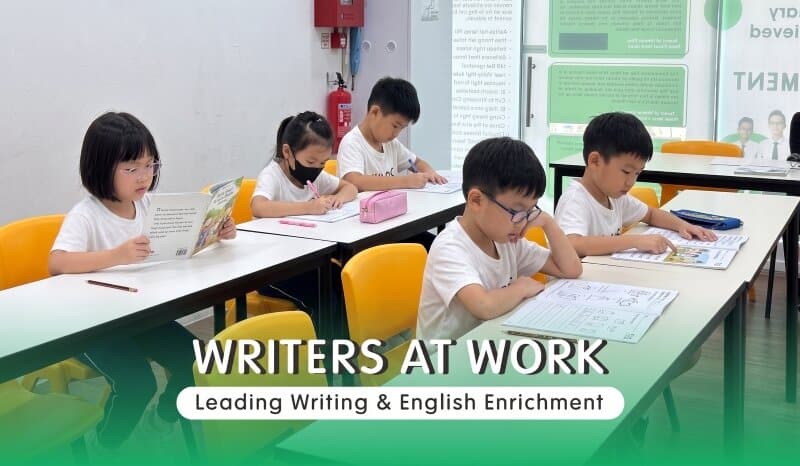
At WRITERS AT WORK, our Primary 5 and Primary 6 English programmes run as small classes where every child speaks every week and receives targeted feedback. The disciplined approach that powers our composition work through STORYBANKING® shapes how we coach oral too, and many of our students have used the same oral toolkit to walk into DSA interviews calmer and more articulate than they otherwise would have been. Our piece on how public speaking helps with Direct School Admission explains the overlap in more detail.
For many Primary 6 children, the DSA interview is the first time they have sat before a panel of strangers and been asked to speak about themselves under pressure. It is a formative experience regardless of outcome. The communication and self-reflection skills your child is building in the run-up to it are the same ones that will serve them in scholarship interviews, university admissions panels, internship conversations and job interviews for decades. A child who internalises this perspective tends to perform better in the room, and is far more resilient if the outcome is not the one they hoped for.
Process your own disappointment privately, before any conversation with your child about an outcome that did not go their way. Whether they receive a Confirmed Offer, a Wait List or a rejection, how you frame the result is what shapes how they relate to challenge and setback for years to come.
Lay out every school’s selection date as soon as you have it, in one shared family calendar. Many schools will allow some flexibility if you have a genuine clash with another school’s selection. Contact the schools early and politely if you anticipate one. The bigger trap is overcommitting your child in a short window. Three schools in two weeks is taxing, and it is fine to focus the practice on the schools your child is most invested in.
It depends on the talent area and the school. Some schools require a documented track record. Others assess potential and are willing to take students with no formal experience if the student shows clear motivation and aptitude. Read the school’s website carefully for each category and reach out to the school if anything is unclear. A thin portfolio is not always a disqualifier.
Pick a real weakness your child is genuinely working on. Not “I am too much of a perfectionist.” A real example might be that your child used to give up on maths problems they could not solve in five minutes, and they have been working with a teacher to push past the discomfort. The structure that works is naming the weakness honestly, describing the specific change they have made, and acknowledging that the work is ongoing.
Most DSA-Sec selections take place only in the Primary 6 year, so there is no second attempt within the same DSA route. The skills your child has built through the preparation, however, transfer directly to the PSLE oral examination and to scholarship and JC admissions interviews further along. The investment was not wasted, even if the immediate outcome was not the one you wanted.

Agnes Ng, Co-Founder and Teaching & Curriculum Director of WRITERS AT WORK. An NUS Honours graduate and published author with over 30 years of experience, Agnes has been the architect of the organization’s student-centric curricula since 2012.
Dedicated to teacher mentorship and academic excellence, she has guided hundreds of students to achieve outstanding results. Her expertise and commitment to high-quality education remain the cornerstone of WRITERS AT WORK’s success in empowering every learner.



Start practising and learning

